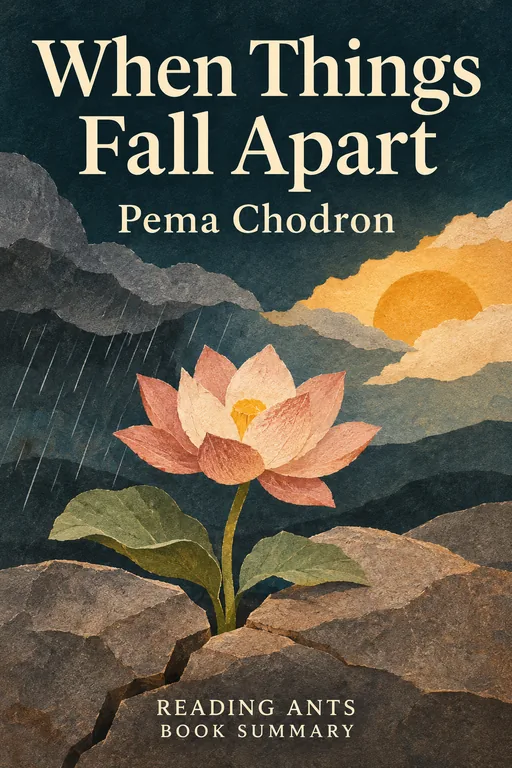
When Things Fall Apart
Buddhist nun Pema Chodron teaches that when life falls apart, the way forward is not to run from pain or to fix everything, but to stay with the uncertainty, to soften and to meet our fear and sorrow with kindness.
Overview
When Things Fall Apart: Heart Advice for Difficult Times was published in 1996 by Pema Chodron, an American-born Buddhist nun in the Tibetan tradition. She studied with the teacher Chogyam Trungpa Rinpoche, became a nun in 1974, and in 1986 became director of Gampo Abbey, a monastery in Nova Scotia. The book is a collection of short chapters on how to cope with difficulty. She draws on traditional Tibetan teachings, such as the practice of tonglen, and expresses them in simple, everyday language for general readers, whether or not they follow a spiritual path. The book has 22 short chapters, with titles such as Intimacy with Fear, Hopelessness and Death, Widening the Circle of Compassion and Three Methods for Working with Chaos.
Full Summary
1. Fear and the ground that falls away
The idea: Chodron says that when things collapse, such as a relationship, a job or our sense of control, we often feel a groundless panic. She describes this groundlessness as a basic condition of life, which we often meet as restlessness and fear, and which society and our own habits push us to avoid. The usual reaction is to look for something solid to hold on to, or to try to escape the feeling. The first chapters (Intimacy with Fear and When Things Fall Apart) suggest instead that fear is a natural reaction to moving closer to the truth, and that when things fall apart we can stay on the brink of the unknown, without acting out, repressing or blaming, and treat the time as both a test and a kind of healing.
In real life: When a plan falls through, noticing the sense of uncertainty without rushing to fix it can be the first step.
2. Be a friend to yourself
The idea: A repeated theme is that we do not need to be perfect or to change ourselves before beginning to practice. We can work with who we are, with our faults, our moods and our confusion, and with the present moment as our teacher (This Very Moment Is the Perfect Teacher and Relax as It Is are early chapters). She encourages “maitri,” an attitude of unconditional friendliness toward oneself, which she presents as honest acceptance rather than self-improvement, and which matters most in times of self-doubt.
In real life: Treating yourself as you would a good friend after a mistake can help you to learn from it.
3. Staying with discomfort
The idea: Chodron teaches that our habit is to escape pain, through addictions and other distractions, and that these habits keep us stuck. The alternative is to stay, even for a few moments, with the raw feeling and to let it be, neither indulging it nor repressing it. She presents this as something that takes courage. Over time, she says, it builds compassion and bravery. Strong emotions such as shame, rage and jealousy can be met in the same way, with openness instead of being acted out or pushed away.
In real life: Instead of immediately checking your phone when you feel uneasy, you might sit with the feeling for a minute.
4. Tonglen: breathing in suffering, breathing out relief
The idea: She describes tonglen, a meditation in which one breathes in the pain of someone who is suffering, wishing to take it away, and breathes out peace or whatever would bring relief. One can begin with one’s own suffering, and then extend the wish to all beings who suffer in the same way. The practice reverses the habit of avoiding suffering, can be done formally in meditation or informally whenever we meet suffering in daily life, and fosters compassion.
In real life: When you are sad, you might think of everyone who is sad at this moment, and wish them peace.
5. Letting go of hope and fear
The idea: One of the surprising teachings is to give up the constant swing of hope and fear. Hoping for something better somewhere else, she says, keeps us from relaxing with the life we have now, and the chapter Hopelessness and Death is part of this theme. This does not mean being hopeless in a gloomy sense, but dropping the idea that we must be somewhere else in order to be at peace. She also ties our anxiety and our hopes for something different to the fear of death, and says that facing death means facing the facts without escapism.
In real life: A person who stops waiting for an ideal future may start to enjoy the present.
6. Three methods for working with chaos
The idea: In a later chapter, she gives three ways of working with chaos and confusion. The first is to stop struggling, so that in meditation one accepts whatever arises and simply labels it “thinking,” without judgment. The second is to use the poison as medicine, by breathing in difficulty, as in tonglen, and turning it into compassion for ourselves and others. The third is to regard whatever arises as awakened energy, and to find wisdom in ourselves and the world as they already are.
In real life: When you are overwhelmed, you might stop trying to fight your thoughts and simply name them and let them pass.
7. Compassion and connection
The idea: Chodron connects the personal practice to caring for others. As we get used to our own pain, we recognize that everyone shares it, and compassion arises naturally, as in the chapter Widening the Circle of Compassion. She speaks of bodhichitta, the awakened or noble heart that she says is present in all beings and can be found in the tenderness of pain itself, and tonglen is a practice for awakening it, moving from our own suffering outward to everyone. She also links peace to nonaggression, including not hating those we think of as the enemy.
In real life: Listening patiently to a friend who is struggling is a form of compassion.
Why It Matters
When Things Fall Apart has been a long-term bestseller, and has become a classic for those facing loss and other hardships. Its message that we can face difficulty with openness is written for general readers, whether Buddhist or not. The book has introduced Tibetan Buddhist ideas, such as tonglen, to many readers outside the tradition. Its publisher, Shambhala, calls it a perennial bestseller and issued a new twentieth-anniversary edition in 2016, with a new afterword by the author. The chapters cover practical matters as well as meditation, from working with difficult emotions and breaking negative habits to communicating openly and taking compassionate action in the world. The Pema Chodron Foundation has donated copies of her books, including this one, to prisons, shelters and nonprofit groups. It is one of the best known of her many books.
Key Takeaways
- Groundlessness is part of life. Uncertainty can be a doorway to wisdom.
- Be kind to yourself. Begin with who you are now.
- Turn toward pain. Avoidance keeps us stuck.
- Practice compassion. Breathing in suffering and breathing out relief can open the heart.
- Let go of hope and fear. Presence is more helpful than waiting.
- Work with chaos. Stop struggling, use difficulty as medicine and see what arises as energy.
What We Can Learn
When you face a difficulty, try pausing for a few breaths and noticing what you feel in your body. Say to yourself that this is hard, and that it is okay. Try to be gentle toward yourself, as you would be with a friend. You can try tonglen by thinking of someone who suffers, breathing in with the wish to take their pain, and breathing out with the wish for their ease. Do not push yourself to do anything that feels overwhelming, and seek professional help for serious distress or trauma.
Criticism and Counterpoints
As with any book of spiritual advice, the suggestion to stay with pain and let go of hope is not meant to replace therapy or practical action, and it may not suit people who are in danger or who suffer from severe depression or trauma. Some readers may find that the book presents a simplified, personal version of Tibetan Buddhism, without the rituals and community of the tradition, and may find the writing repetitive or very gentle. The idea of dropping hope can also be misunderstood, and it is meant as a way of being present, not as giving up.
Who Should Read It
This book is for anyone going through hard times, or who is interested in Buddhist approaches to suffering. It is warm and easy to read in short chapters. Those who need urgent help, or who want a scholarly account of Buddhism, should look to other resources.
Want the whole book?
A summary is a taste, not the meal. Here is where to find the full book.
You reached the end 🎉
Nicely done. Mark this one as read, and we will suggest what to read next.
Read this next
Peace Is Every Step
Thich Nhat Hanh
The Vietnamese Buddhist monk Thich Nhat Hanh shows how to find calm and joy in ordinary moments, through mindful breathing, walking and living, and how personal peace can grow into peace in the world.
🕊️ Philosophy & Religion
The Book of Joy
Dalai Lama and Desmond Tutu with Douglas Abrams
Two Nobel Peace Prize winners, the Dalai Lama and Archbishop Desmond Tutu, talk about how to find lasting joy even in the face of suffering, and share the habits and attitudes that they believe lead to it.
🕊️ Philosophy & Religion
Zen Mind, Beginner's Mind
Shunryu Suzuki
In simple, direct talks, the Japanese Zen teacher Shunryu Suzuki explains that the heart of Zen practice is to sit quietly, breathe and approach each moment with the openness of a beginner.
🕊️ Philosophy & Religion
The Power of Now
Eckhart Tolle
Eckhart Tolle teaches that much of our suffering comes from living in thoughts about the past and future, and that peace is found by paying full attention to the present moment.
🌱 Self-ImprovementReasons to Stay Alive
Matt Haig
Novelist Matt Haig describes how he lived through severe depression and anxiety, how he found his way back, and why he believes that hope is always possible, even when it feels out of reach.
🍎 Health
The Art of War
Sun Tzu
The greatest victory is the one won without fighting, achieved through careful planning, knowing both yourself and your opponent, and using deception, flexibility and timing.
🕊️ Philosophy & ReligionWant something different?
Pick another topic and we will show you three books to start with.