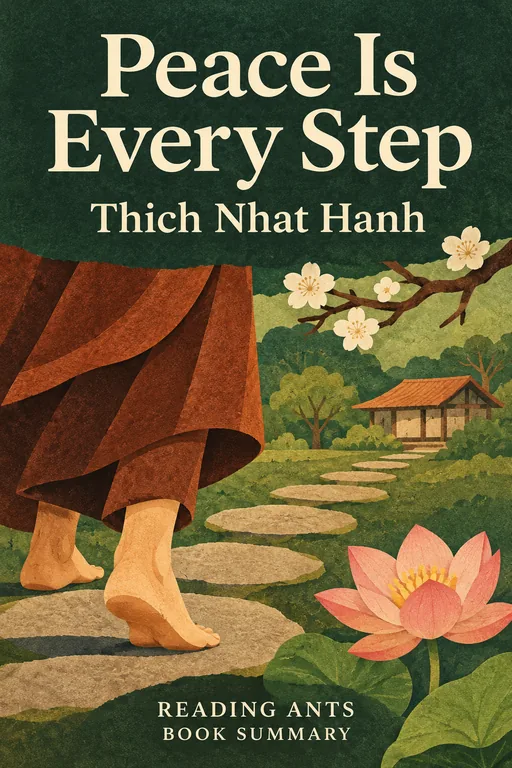
Peace Is Every Step
The Vietnamese Buddhist monk Thich Nhat Hanh shows how to find calm and joy in ordinary moments, through mindful breathing, walking and living, and how personal peace can grow into peace in the world.
Overview
Peace Is Every Step: The Path of Mindfulness in Everyday Life was published in 1991 by Thich Nhat Hanh, a Zen monk, teacher, poet and peace activist from Vietnam. During the Vietnam War, he worked to help victims of the conflict, and was later exiled. He lived in France, where he founded a community called Plum Village. The book is a collection of short, simple chapters, which can be read in small pieces, with practical exercises for bringing mindfulness into daily life. It is written in a gentle voice, with images drawn from everyday experience, and is suitable for readers of any belief.
Full Summary
1. Breathing and coming back to the present
The idea: The foundation of the book is the practice of mindful breathing. Thich Nhat Hanh says that when we breathe in, we can simply know that we are breathing in, and when we breathe out, we know that we are breathing out. This brings us back from worries about the past and future to the present moment, where life actually is. He offers short phrases to say silently with the breath, such as calming the body and smiling.
In real life: Taking three slow breaths before an exam or a difficult talk can settle the mind.
2. The smile and the bell of mindfulness
The idea: He suggests that we smile, even a small, gentle smile, as a way of relaxing the face and the mind. He also describes using everyday sounds as a reminder to be mindful. In his community, the ringing of a temple bell is a signal to stop and breathe. At home, he says, we can use the ring of a telephone, or a red traffic light, as a bell: instead of rushing to answer the phone, we stay where we are, breathe and smile, and then pick up after a few rings.
In real life: Each time you hear a notification, you can take one breath before you look.
3. Walking and washing dishes
The idea: Mindfulness, he says, does not need special time or place. Walking meditation means taking slow, easy steps and enjoying each one, as if you are kissing the earth with your feet. In the same way, washing the dishes can be a pleasure if we do it for its own sake, feeling the warm water and the movement of our hands, and not only to get to the end. He describes simple tasks as opportunities to live fully.
In real life: A walk to school can be a calm moment, if you notice the sky and the air, and not only your thoughts.
4. Dealing with anger and difficult feelings
The idea: The author teaches that anger and other strong feelings are not enemies, and that mindfulness can hold them the way a mother tenderly holds a crying baby. Rather than suppress or act on them, we can breathe, and recognize them with kindness, noting that anger is present in us. This calms the emotion, and allows us to look deeply into its causes. He advises that we refrain from speaking or acting while we are in the grip of anger, and wait until we are calmer.
In real life: Walking away to breathe, before replying to an angry message, can prevent harm.
5. Interbeing and understanding
The idea: A central teaching is that nothing exists by itself, and that all things depend on one another. He calls this “interbeing.” A sheet of paper, for example, contains the cloud that rained on the tree, the sunshine, the logger who cut the tree and took it to the mill, and even the wheat that became the logger’s bread. Seeing this, we feel connected, and compassion grows. He says that understanding the suffering of others makes it possible to love them, and that love, in turn, brings peace.
In real life: Thinking of the people who grew, packed and delivered your food can make a meal feel more precious.
6. Peace in the world
The idea: Thich Nhat Hanh connects inner peace with peace in society. He says that real strength lies in deep inner peace, and that people who work for justice can sustain their efforts only if they cultivate it. He tells of his work during the war, and of the importance of seeing the roots of war in everyday life and of understanding that both sides in a conflict are victims. Mindfulness, he says, helps us to protect the earth and to respond to suffering with compassion, so that peace becomes a way of living, not a distant goal.
In real life: A calm and caring friend can bring a group together after a quarrel.
Why It Matters
Peace Is Every Step has been one of the most widely read books on mindfulness, and has been translated into many languages. Its simplicity and warmth have made it a favorite with beginners, and many people use its short practices in daily life. Thich Nhat Hanh, who was nominated for the Nobel Peace Prize by Martin Luther King Jr., became one of the world’s most respected teachers of Buddhism, and his ideas have shaped the modern mindfulness movement. The book shows that a spiritual practice can be a part of everyday life, available to everyone, without special equipment or belief.
Key Takeaways
- Return to the breath. It anchors you in the present.
- Use ordinary cues. A bell, a phone or a doorway can remind you to pause.
- Care for your emotions. Hold anger gently, and look at its roots.
- We are interconnected. Seeing this brings compassion.
- Peace begins within. Inner peace sustains work for peace in the world.
What We Can Learn
Start with something small: take three slow breaths at the start of each class or meal, and try a short slow walk each day. Choose a regular signal, such as a doorway or a bell, to remind you to pause. When you feel upset, name the feeling, breathe, and wait until you are calmer before you respond. Look at ordinary objects and think of the many things and people that make them possible. These habits are easy and take no special equipment, and they can make everyday life more peaceful.
Criticism and Counterpoints
Some critics say that the book’s simplicity can seem naive when it comes to serious problems such as violence or injustice, and that mindfulness taken out of its Buddhist ethical framework may become a self-help technique that does not challenge the causes of suffering. Others point out that the writing is repetitive, and a bit sweet for some tastes. A few scholars note that the popularization of mindfulness has sometimes overlooked the teaching’s deeper aims. Supporters respond that the practices are real and helpful, and that the author himself linked mindfulness to social action.
Who Should Read It
This book is for anyone who wants a gentle introduction to mindfulness, including teenagers and older children with help. It is short and easy to read in small pieces. Those who are facing serious mental health problems should also seek professional support, and those looking for a more detailed study of Buddhist philosophy may want to read other works.
Want the whole book?
A summary is a taste, not the meal. Here is where to find the full book.
You reached the end 🎉
Nicely done. Mark this one as read, and we will suggest what to read next.
Read this next
Zen Mind, Beginner's Mind
Shunryu Suzuki
In simple, direct talks, the Japanese Zen teacher Shunryu Suzuki explains that the heart of Zen practice is to sit quietly, breathe and approach each moment with the openness of a beginner.
🕊️ Philosophy & Religion
The Way of Zen
Alan Watts
Alan Watts traces the history and spirit of Zen from India and China to Japan, and explains for Western readers its teaching that liberation comes from direct experience rather than from concepts and doctrines.
🕊️ Philosophy & Religion
The Power of Now
Eckhart Tolle
Eckhart Tolle teaches that much of our suffering comes from living in thoughts about the past and future, and that peace is found by paying full attention to the present moment.
🌱 Self-Improvement
The Book of Joy
Dalai Lama and Desmond Tutu with Douglas Abrams
Two Nobel Peace Prize winners, the Dalai Lama and Archbishop Desmond Tutu, talk about how to find lasting joy even in the face of suffering, and share the habits and attitudes that they believe lead to it.
🕊️ Philosophy & Religion
When Things Fall Apart
Pema Chodron
Buddhist nun Pema Chodron teaches that when life falls apart, the way forward is not to run from pain or to fix everything, but to stay with the uncertainty, to soften and to meet our fear and sorrow with kindness.
🕊️ Philosophy & Religion
The Art of War
Sun Tzu
The greatest victory is the one won without fighting, achieved through careful planning, knowing both yourself and your opponent, and using deception, flexibility and timing.
🕊️ Philosophy & ReligionWant something different?
Pick another topic and we will show you three books to start with.