 Reading Ants
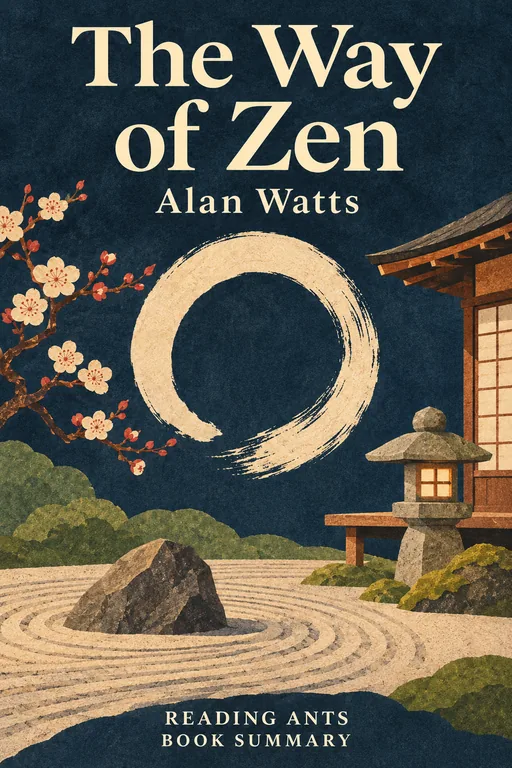
Alan Watts traces the history and spirit of Zen from India and China to Japan, and explains for Western readers its teaching that liberation comes from direct experience rather than from concepts and doctrines.
Overview
The Way of Zen was published in 1957 by Alan Watts, a British-born writer and speaker who lived in the United States and became a leading interpreter of Eastern thought for Western audiences. At a time when Zen was little known outside Asia, the book offered a lively, readable and sympathetic introduction. Watts was not a monk, and approached the subject as a philosopher, with a gift for analogy and for humor. The first part of the book discusses the background and history of Zen, and the second looks at its principles and practice, including its influence on the arts.
Full Summary
1. The roots in India and China
The idea: Watts begins with the Chinese philosophy of the Tao, then turns to the teachings of the Buddha in India, who offered a way to freedom from suffering through insight into the nature of the self and of reality, and to the Mahayana tradition. When Buddhism came to China, it met Taoism, which valued naturalness and spontaneity. Watts argues that Zen is the result of this meeting: it combined the Indian emphasis on awakening with the Chinese love of the practical and the simple. The Chinese called it Chan, and in Japan it became Zen.
In real life: When two cultures meet, they often produce something that neither would have created alone.
2. The problem of words
The idea: A major theme is that Zen distrusts abstract thinking and fixed doctrines. Watts says that words and concepts are labels that can be mistaken for the reality they point to, and that they can trap us when we do. Zen teachers, from the early masters in China, used indirect methods to point to direct experience, such as unexpected answers and silence. The aim is to break the habit of explaining everything, and to wake up to the present.
In real life: Reading a description of a taste is not the same as tasting it.
3. Awakening and the sense of self
The idea: According to Watts, the central insight of Zen is that the sense of being a separate ego, a self that stands apart from the world and tries to control it, is a kind of illusion. Awakening, which in Japanese is called satori, is a sudden shift in which we realize that we are not apart from the world but one with it. This does not require going anywhere, since it is already the case, and it is not so much a possession as a letting go of a mistaken idea.
In real life: A moment when you are completely absorbed in music, and forget yourself, hints at what is meant.
4. Masters, stories and koans
The idea: The book describes the methods of the Zen teachers, such as the use of koans, short puzzling stories or questions that cannot be answered by logic, which are designed to bring the student to the limit of thought. Watts tells stories of masters who shouted, struck their students, or answered with a gesture instead of an explanation. He explains that the purpose is not to confuse, but to shock the student out of habitual thinking. The relationship between teacher and student is crucial.
In real life: A riddle with no obvious answer can make you stop and look at the problem in a new way.
5. Zen in the arts and daily life
The idea: Watts shows how the spirit of Zen has influenced Japanese culture, including calligraphy, painting, poetry, gardening, the tea ceremony and the martial arts. In each, he says, the artist aims to act spontaneously, without self-conscious effort, so that the work seems to flow by itself. He points out that these arts value simplicity, space and the beauty of the imperfect. Zen is not a retreat from life, but a way of fully engaging with it.
In real life: A calligrapher who has practiced for years can draw a single brush stroke that captures a feeling.
6. Nothing to attain
The idea: In the second part of the book, Watts returns to the paradox that the effort to become enlightened can get in the way. If you try to get something by practice, he says, you reinforce the idea of the ego as someone who needs improvement. Zen teaches that the ordinary mind is the way, and that you do not need to be anything other than what you are. The practice of zazen, sitting meditation, is a way to be at ease with this realization.
In real life: Relaxing into what you are doing, without pressure to succeed, often leads to better results.
Why It Matters
The Way of Zen was one of the books that introduced Zen to Western readers, and was influential in the 1950s and 1960s, particularly among writers, artists and young people interested in Eastern thought. It helped to prepare the ground for the later popularity of meditation and Buddhism in the West. Watts’s clear style and his ability to link Eastern ideas to Western psychology and philosophy made the material accessible. The book remains in print and widely read, and still serves as a lively starting point for the subject, although scholars of Zen have since provided more detailed and nuanced accounts.
Key Takeaways
- Concepts are not reality. Words and labels point to experience, but they are not the experience.
- The self may be an illusion. Awakening is seeing through the separate ego.
- Direct experience matters. Zen points beyond words.
- Spontaneity has discipline behind it. The arts show effortless skill.
- There is nothing to attain. The ordinary is already the way.
What We Can Learn
You can take a few lessons from the book without becoming a Zen student. Notice when you are living in your head, in words and plans, and bring your attention to what you see, hear and feel. Try to do a task with full involvement, whether cooking, drawing or walking. Be wary of trying too hard to improve yourself, and allow room for rest and play. Read stories of Zen masters as invitations to think differently. If you are interested in practice, consider finding a teacher or a local group, since a book can only point the way.
Criticism and Counterpoints
Scholars of Buddhism say that Watts, who was not trained as a Zen monk, presents an overly romantic and simplified picture, which downplays the role of discipline, ethics and community, and treats Zen as a form of individual spontaneity. Zen teachers have noted that long, rigorous practice is central, and that Watts sometimes gave the impression that it was unnecessary. Others observe that his personal life, including his drinking, seemed at odds with the teaching. Some historical claims in the book have been revised by later research. Supporters say that he conveyed the spirit and the humor of Zen better than most.
Who Should Read It
This book is for readers who are curious about Zen and Eastern philosophy, and who enjoy a lively, essay-like style. It is easy to follow and full of stories. Those who want a rigorous history of Zen, or practical meditation instruction, should consult more specialized works.
Want the whole book?
A summary is a taste, not the meal. Here is where to find the full book.
You reached the end 🎉
Nicely done. Mark this one as read, and we will suggest what to read next.
Read this next
Zen Mind, Beginner's Mind
Shunryu Suzuki
In simple, direct talks, the Japanese Zen teacher Shunryu Suzuki explains that the heart of Zen practice is to sit quietly, breathe and approach each moment with the openness of a beginner.
🕊️ Philosophy & Religion
Tao Te Ching
Laozi
The deepest wisdom is to live in harmony with the Tao, the natural way of the universe, by being humble, gentle and simple, and by acting without force.
🕊️ Philosophy & Religion
Zhuangzi
Zhuangzi
A witty collection of stories, jokes and arguments from ancient China that invites readers to loosen their fixed ideas, to follow the natural way of things and to find freedom in changing with the world.
🕊️ Philosophy & Religion
Peace Is Every Step
Thich Nhat Hanh
The Vietnamese Buddhist monk Thich Nhat Hanh shows how to find calm and joy in ordinary moments, through mindful breathing, walking and living, and how personal peace can grow into peace in the world.
🕊️ Philosophy & Religion
The Upanishads
Various
A collection of ancient Indian texts, composed over several centuries, which explore the nature of reality and the self, and teach that the innermost self of each person is one with the ultimate reality behind the universe.
🕊️ Philosophy & Religion
The Art of War
Sun Tzu
The greatest victory is the one won without fighting, achieved through careful planning, knowing both yourself and your opponent, and using deception, flexibility and timing.
🕊️ Philosophy & ReligionWant something different?
Pick another topic and we will show you three books to start with.