 Reading Ants
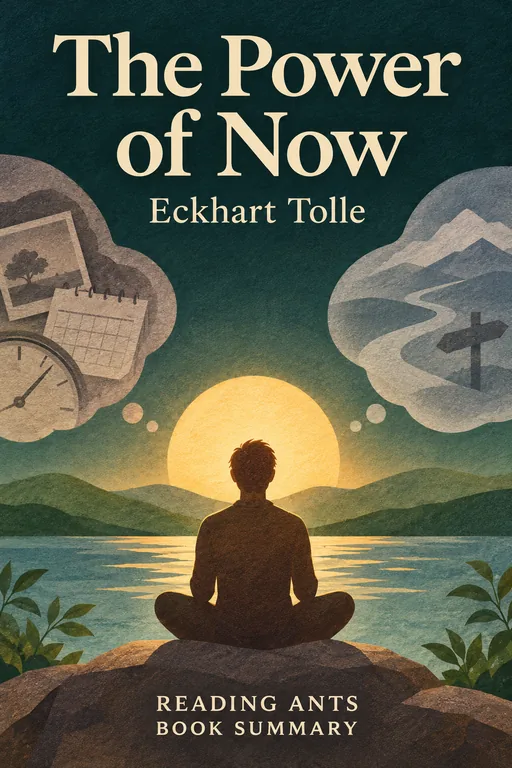
The Power of Now
Eckhart Tolle teaches that much of our suffering comes from living in thoughts about the past and future, and that peace is found by paying full attention to the present moment.
Overview
The Power of Now: A Guide to Spiritual Enlightenment was written by Eckhart Tolle, a German-born spiritual teacher who lived in England and later in Canada, and published in 1997. Tolle describes how, at the age of twenty-nine, after years of anxiety and depression, including periods of suicidal depression, he had a sudden shift in consciousness that freed him from his constant suffering. The book was written to share the insights that followed. It is organized as a mixture of explanation and question-and-answer sections. It was slow to become known but, after being promoted by Oprah Winfrey and others, became an international bestseller and a major title in the field of spirituality.
Full Summary
1. You are not your mind
The idea: Tolle begins by saying that most people are lost in compulsive thinking, and that the voice in the head is not the true self. He describes how the mind creates a false sense of identity, the ego, built from thoughts, roles and stories about ourselves. People identify with the mind and suffer when thoughts are negative. The first step to freedom is to observe thoughts without being carried away by them, and to realize that you are the awareness behind them.
In real life: If you notice that you are worrying, you can pause and see the worry as a passing thought, not as a fact.
2. Consciousness: the way out of pain
The idea: Tolle says that our suffering comes mainly from resisting the present and from dwelling on the past and future. He describes what he calls the pain-body, which he presents as a build-up of old emotional pain that lives in us and sometimes takes over, causing anger or sadness. By bringing awareness to such moments and feeling the emotion without acting it out, we can reduce its power. He suggests that being present dissolves the stored pain.
In real life: When you feel a flash of anger, noticing it in the body and breathing may weaken the urge to lash out.
3. Moving deep into the Now
The idea: The central teaching is to focus on the present, since it is the only moment that exists. The past is a memory, and the future is imagination; life takes place now. Tolle explains that time as we usually think about it, the continuing story of past and future, is a mental creation, which he calls psychological time (practical clock time, for planning and appointments, is fine), and that we can escape its grip by bringing attention to what is happening at this moment. He proposes simple practices, such as being aware of the breath, the body and surroundings.
In real life: When washing dishes, feeling the warmth of the water and the movement of your hands brings you into the present.
4. Inner body and stillness
The idea: Tolle recommends sensing the inner body, the subtle feeling of life energy within the body, as a way to anchor attention in the present. He encourages periods of silence and stillness, listening to the gaps between thoughts. He also speaks about being present in nature, with a tree or a flower, to feel a sense of connection. These practices, he says, can open a deeper peace, which he calls “the joy of Being.”
In real life: Sitting quietly for a few minutes and noticing the sensations in your hands or feet can calm a busy mind.
5. Acceptance and relationships
The idea: Tolle teaches that accepting what is, rather than resisting it, brings peace, even in difficult circumstances. This does not mean passivity: from acceptance, one can take action more clearly. He applies the idea to relationships, which he says are often battlegrounds between egos. By being present with another person and listening fully, we can transform the way we relate. He also suggests that illness and loss can be doors to awakening, because they strip away false identity.
In real life: Instead of arguing about who is right, you can pause, listen and respond with presence.
6. Enlightenment and the way of surrender
The idea: In the later chapters, Tolle describes enlightenment as a state of continuous presence and inner peace that is available to everyone, and which does not depend on a particular religion. He urges surrender: letting go of resistance to the present moment, trusting life and allowing things to be as they are. He ends with practical advice that spiritual awakening is not a distant goal but can begin right now.
In real life: Many people find that accepting a situation they cannot change reduces their stress and frees energy to cope with it.
Why It Matters
The Power of Now has sold millions of copies and has been translated into over thirty languages. It helped bring ideas from Eastern spirituality, particularly about mindfulness and non-attachment, to a wide Western audience, and it influenced many self-help authors and teachers. It also contributed to the popular interest in mindfulness and meditation.
Tolle’s later books, such as A New Earth, further developed his ideas. The book remains popular among readers who are looking for peace in a busy world, and has been recommended by celebrities and public figures.
Many readers say its simplest practice, bringing attention back to the body and the breath when the mind races, gave them a tool they could use in daily stress, which is part of why it has lasted.
Key Takeaways
- You are not your thoughts. Observe the mind instead of being ruled by it.
- The present is all we have. Past and future exist only in thought.
- Resisting what is causes pain. Acceptance reduces suffering.
- Feel the body. Sensation anchors attention in the now.
- Stillness brings peace. Silence opens a deeper calm.
What We Can Learn
The book offers a simple but powerful experiment: notice where your attention is. When we catch ourselves rehearsing worries or replaying old arguments, we can return to our senses and the task at hand.
It also encourages us to treat emotions with awareness rather than judgment. Allowing a feeling to be present without fighting it can reduce its hold.
Finally, it teaches the value of moments of quiet. Even a short pause in the day to breathe and look around can refresh the mind.
Criticism and Counterpoints
Some critics find the book vague and repetitive, with claims that cannot be tested, and note that Tolle’s account of enlightenment and the “pain-body” is not supported by scientific evidence. Others say that the emphasis on living in the present can be misused to avoid planning or to ignore legitimate concerns about the future, and that it can discourage people from seeking professional help for serious problems like depression.
Some religious readers object to its blending of ideas from different traditions, or its dismissal of conventional faith. Skeptics have also pointed out the commercial success of Tolle’s teaching. Even so, many find its core advice, to pay attention and accept the present, useful.
Who Should Read It
This book suits older teenagers and adults interested in mindfulness and spirituality. The style is simple but can be repetitive, and it is best read slowly. It is not a substitute for medical or psychological care.
Want the whole book?
A summary is a taste, not the meal. Here is where to find the full book.
You reached the end 🎉
Nicely done. Mark this one as read, and we will suggest what to read next.
Read this next
The Miracle of Mindfulness
Thich Nhat Hanh
Thich Nhat Hanh shows, through simple practices like washing dishes, breathing and walking, how paying full attention to the present moment can bring calm, joy and a deeper connection to life.
🕊️ Philosophy & Religion
The Dhammapada
Buddhist tradition
This short collection of verses attributed to the Buddha teaches that happiness and suffering come from the mind, and that kindness, self-discipline and mindfulness lead to peace.
🕊️ Philosophy & Religion
The Art of Happiness
Dalai Lama and Howard C. Cutler
In conversations with the American psychiatrist Howard Cutler, the Dalai Lama explains that happiness is the purpose of life, and that it can be trained through compassion, a calm mind and a change in the way we think about suffering and others.
🌱 Self-Improvement
Atomic Habits
James Clear
Big changes in life come not from huge leaps but from tiny habits repeated every day, and you can build good habits (and break bad ones) by designing your life so the right choices are obvious, attractive, easy and satisfying.
🌱 Self-Improvement
The 7 Habits of Highly Effective People
Stephen R. Covey
Lasting success in life and work comes not from quick tricks or a charming personality but from good character, built through seven habits that move us from depending on others, to standing on our own, to working well with others.
🌱 Self-Improvement
How to Win Friends and Influence People
Dale Carnegie
People are driven by emotion and the desire to feel important, so the way to get along with them, and win them to your point of view, is to stop criticizing, show genuine interest and appreciation, and see things from their side.
🌱 Self-ImprovementWant something different?
Pick another topic and we will show you three books to start with.