 Reading Ants
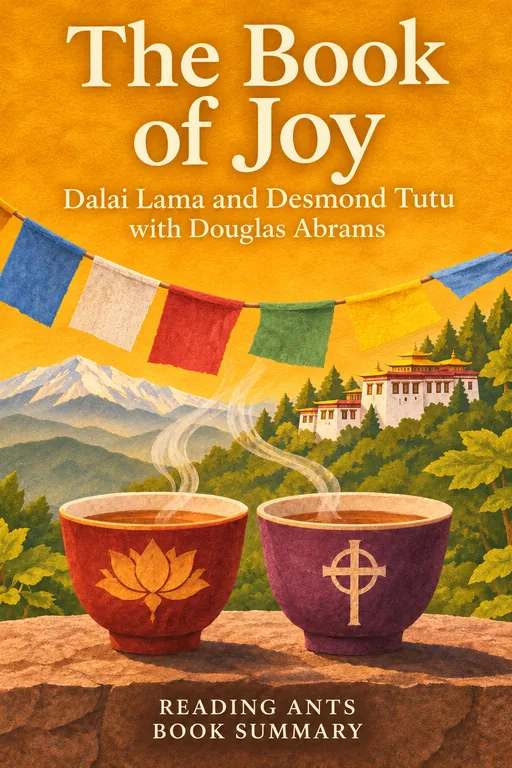
The Book of Joy
Two Nobel Peace Prize winners, the Dalai Lama and Archbishop Desmond Tutu, talk about how to find lasting joy even in the face of suffering, and share the habits and attitudes that they believe lead to it.
Overview
The Book of Joy: Lasting Happiness in a Changing World was published in 2016. It records a week of conversations in April 2015, in Dharamsala, India, where the Dalai Lama lives in exile. The week was organized to celebrate the Dalai Lama’s eightieth birthday with his old friend the Archbishop, who lives in Cape Town, and it ended with a birthday party at the Tibetan Children’s Village. The writer Douglas Abrams interviewed them over five days of dialogues, and added reflections from science and his own observations of the week. The two men had both suffered, one through exile and the loss of his homeland, and the other through the fight against apartheid, and the Archbishop was also facing the return of his prostate cancer. They are also well known for their humor, laughing and teasing each other throughout.
Full Summary
1. What joy is, and why it matters
The idea: The two friends say that joy is deeper than a passing pleasure. Tutu says that joy is much bigger than happiness, because it does not depend on outside circumstances, and he points to a mother who accepts the pain of childbirth and then feels immense joy. The Dalai Lama says that the real source of a good life lies inside us and not in money, power or status. Tutu adds that joy is a by-product, and that people who set out to chase it directly tend to miss it, while those who turn toward others find it. They also say that joy is not the same as the absence of difficulty, and that it can be found in hard times. To show this, the Dalai Lama explains why he is not bitter after more than fifty years in exile: he looks at his loss from a wider angle and sees the new chances it brought.
In real life: A person who has been through a lot and still laughs easily may be a good example.
2. The obstacles to joy
The idea: They discuss common obstacles, including fear, stress and anxiety, frustration and anger, sadness and grief, despair, loneliness, envy, adversity, illness and the fear of death. Instead of denying them, they say that we should accept the reality of suffering, and that much of it depends on how our minds react. The Dalai Lama speaks of building a kind of mental immunity over time, and he points out that we often cause ourselves trouble by focusing too much on our own problems, and that widening our perspective helps to reduce them. Tutu says that we should not be ashamed of natural feelings or berate ourselves for them, and that sadness and grief, which can bring people closer together, do not cancel joy.
In real life: Being able to say “I am sad right now” without panic can make it easier to continue.
3. Perspective, humility and humor
The idea: The eight pillars of joy that the two men describe are split into four qualities of the mind (perspective, humility, humor and acceptance) and four of the heart (forgiveness, gratitude, compassion and generosity). The first three are perspective, humility and humor. They suggest that we can choose to see our difficulties from a larger point of view, as one of many and not the only. Humility means not thinking of oneself as more important than others, and the Dalai Lama, for one, says that he still considers himself a student. And humor, which they both show constantly, helps us to carry heavy things lightly and to see our own absurdity. Tutu says that humor which laughs at ourselves, and does not put others down, brings people together.
In real life: Being able to laugh when you trip in front of others keeps embarrassment from taking over.
4. Acceptance, forgiveness and gratitude
The idea: The next pillars are acceptance, forgiveness and gratitude. Acceptance is not resignation, but facing reality as it is, as a starting point for change. Forgiveness frees us from the past, and Tutu says that it is a sign of strength and not of weakness. Tutu, who was asked by Nelson Mandela to chair the Truth and Reconciliation Commission in South Africa after apartheid, tells of people he met through that work, such as mothers who forgave the man responsible for their sons’ deaths, and a family who supported amnesty for their daughter’s killers. Gratitude means recognizing how much of our good fortune comes from others and from life itself, which helps us to savor what we have.
In real life: Writing down three things you are thankful for each night can lift your mood over time.
5. Compassion and generosity
The idea: The last two pillars are compassion and generosity. The Dalai Lama says that concern for others’ well-being is the source of happiness, while too much self-centered thinking is the source of suffering. Tutu agrees, and says that people are fundamentally good and made for goodness. He adds that giving makes us more joyful, and that we discover this when we stop being turned in on ourselves. Abrams cites studies that suggest that helping others is linked with well-being.
In real life: Helping a classmate with homework or giving someone a kind word often makes you feel better too.
6. Daily practices and the personal stories
The idea: After the story of the birthday celebration and the goodbye, the book closes with a set of joy practices, such as a breathing practice, a morning meditation walk, journaling about three things you are grateful for, a forgiveness path and different forms of giving. Throughout, the book tells stories from the lives of the two friends: the Dalai Lama’s escape from Tibet in 1959, Tutu’s experiences under apartheid, and his illnesses, including polio and tuberculosis as a child and the return of his cancer. They admit their own struggles, and say that joy is something that must be cultivated. Tutu says that we are all masterpieces in the making, and that it is a lifelong practice.
In real life: A short daily practice, like a few minutes of quiet reflection, can become a habit that supports you.
Why It Matters
The Book of Joy was a New York Times bestseller and has sold more than a million copies. It brought together two spiritual leaders from different traditions, a Buddhist and a Christian, who had a deep friendship, and showed that people of different faiths can find common ground. Their warm and funny conversation made a serious subject accessible, and many readers found hope in their message. The book also blended spiritual wisdom with findings from psychology, and so spoke to both religious and secular audiences. A 2021 film, Mission: Joy, was based on the book, and a children’s edition followed in 2022. It remains a popular gift and a source of daily reflection.
Key Takeaways
- Joy can coexist with suffering. It is not the absence of pain.
- Perspective and humor help. Seeing the larger picture lightens burdens.
- Forgiveness frees us. It releases us from resentment.
- Gratitude changes attention. Noticing good things builds contentment.
- Compassion and generosity bring happiness. Caring for others nourishes us.
What We Can Learn
You can try some of the practices in the book: spend a few minutes each day noting what you are thankful for, and do one small kind act for someone. When you are upset, ask how the situation would look from a wider view, or from the other person’s side. Practice laughing at yourself gently. Think about someone you may need to forgive, and consider whether you can let go of some of the weight. Remember that joy, like a skill, grows with practice, and that it is shared with others.
Criticism and Counterpoints
Some readers may find the book’s message comforting but quite general, and may feel that practices such as gratitude are not enough for those who face serious problems such as poverty, violence or mental illness, although the book does ask how we can live with joy while so many others suffer. The conversation is between two religious leaders who mostly agree, with only mild differences, so there is little real debate. The science is summarized briefly, and readers who want detail will need to look at the original studies. Some may find the tone sentimental or the advice repetitive. Still, many find it a heartwarming and inspiring read.
Who Should Read It
This book is for readers of any age or background who want an uplifting and thoughtful look at happiness. It is easy to read, and full of humor. Those who are struggling with depression or trauma should seek professional help, and may use the book as a supplement.
Want the whole book?
A summary is a taste, not the meal. Here is where to find the full book.
You reached the end 🎉
Nicely done. Mark this one as read, and we will suggest what to read next.
Read this next
Peace Is Every Step
Thich Nhat Hanh
The Vietnamese Buddhist monk Thich Nhat Hanh shows how to find calm and joy in ordinary moments, through mindful breathing, walking and living, and how personal peace can grow into peace in the world.
🕊️ Philosophy & Religion
Man's Search for Meaning
Viktor E. Frankl
A psychiatrist who survived the Nazi concentration camps explains that even in the worst suffering, people can choose their attitude, and that finding a reason to live is what gives us the strength to endure.
👤 Real Lives
The Happiness Hypothesis
Jonathan Haidt
Psychologist Jonathan Haidt tests ten ancient ideas about happiness and virtue against modern science, and concludes that happiness comes neither only from within nor only from outside, but from between: from getting the relationships between yourself, other people, your work and something larger right.
🧩 Mind & Psychology
Long Walk to Freedom
Nelson Mandela
Nelson Mandela tells his own story, from a village childhood to twenty-seven years in prison to becoming South Africa's first democratically elected president, and shows how patience, courage and forgiveness helped end apartheid.
👤 Real Lives
When Things Fall Apart
Pema Chodron
Buddhist nun Pema Chodron teaches that when life falls apart, the way forward is not to run from pain or to fix everything, but to stay with the uncertainty, to soften and to meet our fear and sorrow with kindness.
🕊️ Philosophy & Religion
The Art of War
Sun Tzu
The greatest victory is the one won without fighting, achieved through careful planning, knowing both yourself and your opponent, and using deception, flexibility and timing.
🕊️ Philosophy & ReligionWant something different?
Pick another topic and we will show you three books to start with.