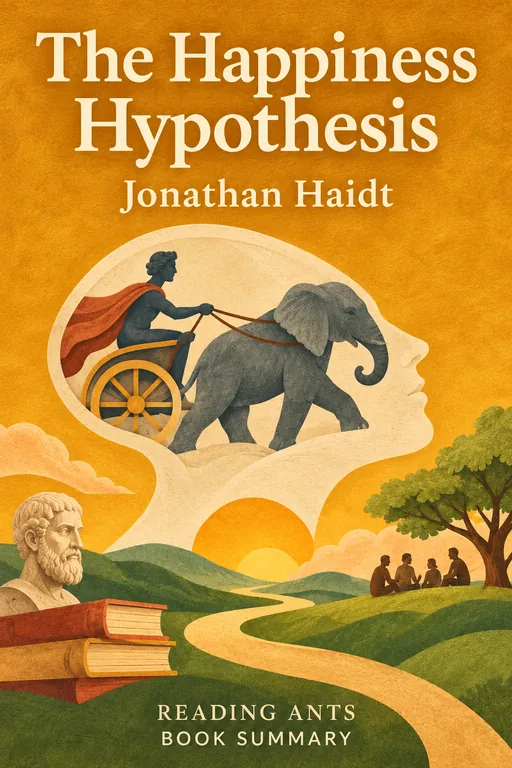
Psychologist Jonathan Haidt tests ten ancient ideas about happiness and virtue against modern science, and concludes that happiness comes neither only from within nor only from outside, but from between: from getting the relationships between yourself, other people, your work and something larger right.
Overview
The Happiness Hypothesis: Finding Modern Truth in Ancient Wisdom was published in 2006 by Jonathan Haidt, a social psychologist who taught at the University of Virginia and later at New York University. He selects ten “Great Ideas” from the wisdom of the world’s traditions, and examines each with the findings of psychology and neuroscience. For each, he asks what is true, what needs to be qualified and what can be learned. The book has ten chapters on the ten ideas, moving from the divided mind to relationships, virtue and meaning, and a short closing chapter on balance. It is written in a clear and engaging style and was widely read and praised.
Full Summary
1. The divided self: the elephant and the rider
The idea: Haidt’s best-known image is that the mind is divided into two parts: an elephant, which stands for the automatic, emotional processes, and a rider, the conscious, reasoning part. The rider seems to be in charge, but the elephant is much stronger, and when they disagree, the elephant usually wins. This explains why it is so hard to change habits through willpower alone. Better results come when the rider works with the elephant, by training it, and by arranging the path.
In real life: You may know that you should study, but find yourself drifting to a game, because the elephant wants it.
2 and 3. Changing your mind, and reciprocity
The idea: The author discusses how the elephant’s automatic emotional reactions guide us through life, with a built-in bias toward negativity, though some people are natural optimists and others pessimists. He describes three ways of changing those reactions: meditation, cognitive therapy and medication of the Prozac type. He then turns to reciprocity, the human habit of returning favors and harm, which he presents as a deep feature of our ultra-social nature. Understanding it, he says, helps us solve problems in social life and guard against people who use it to manipulate us.
In real life: A small kindness often leads to a kind response.
4 and 5. The faults of others, and the pursuit of happiness
The idea: Citing Jesus’s remark about seeing the splinter in another’s eye and not the plank in one’s own, Haidt shows that people are biased to notice the faults in others and to excuse their own, partly because we are constantly managing how others see us without realizing it. Drawing on work in social psychology, he describes ways of taking off the “moral glasses” and seeing ourselves and others more fairly. In the next chapter he asks whether happiness comes from within, as ancient sages such as Buddha and Epictetus held. He argues that some external conditions do matter, and that the Western emphasis on striving has merit. He also notes that happiness comes less from reaching goals than from making progress toward them, which is why achieving a goal can feel disappointing.
In real life: The satisfaction of working toward finishing a project is often greater than finishing.
6. Love and attachments
The idea: In his discussion of love, Haidt distinguishes between passionate love, which is intense and temporary, and companionate love, which is calm and lasting. He says that love makes sense once we see where it comes from and what it does, and he draws on John Bowlby’s work on childhood attachment and Harry Harlow’s experiments with monkeys. Understanding the different kinds of love, he says, helps explain why people make so many mistakes with it. Humans need strong relationships, and the lack of them is damaging.
In real life: Long friendships often provide more steady happiness than a thrilling but brief romance.
7 to 9. Adversity, virtue and divinity
The idea: Haidt considers the saying, often credited to Nietzsche, that what does not kill us makes us stronger. He finds that this is not true for everyone, since adversity can also cause lasting harm, but that many people do grow from suffering, a process called post-traumatic growth, and that adversity can make people more compassionate and better able to balance their own needs and those of others. He then discusses virtue in the broad ancient sense of excellence, using Benjamin Franklin as an example of how success can follow virtue, and argues that the ancients trained the elephant with maxims, fables and role models. Finally, he argues that the sense of sacredness and divinity is a basic feature of the human mind, shown in emotions such as disgust, awe and moral elevation, which moves people and inspires them to be better, whether or not they believe in God.
In real life: Someone who has overcome an illness may value each day more.
10 and 11. Happiness comes from between
The idea: Haidt concludes that happiness is not found only within, as some ancient teachers claimed, nor only in the outside world, as others held, but from getting the relationships right: between yourself and others, yourself and your work, and your work and something larger than yourself. He distinguishes between a purpose for life and a purpose within life, and says that love and work give life meaning. He describes a study of what makes work most meaningful, which gave rise to the idea of vital engagement, and stresses coherence between the different levels of a person’s life. He ends by arguing that the ancient idea of yin and yang is the wisest of all, because we need the perspectives of both ancient religion and modern science, east and west, and even liberal and conservative.
In real life: A person who enjoys their job, has close friends and feels part of a community is likely to be fulfilled.
Why It Matters
The Happiness Hypothesis was one of the first popular books to bring the ideas of positive psychology to a general audience, and it helped to shape the field. It introduced the elephant and rider metaphor, which has been widely cited in later writing on habits and change. By connecting old wisdom to science, it showed that insights from the past can still be valuable, and that science can help us to understand them. The book also prepared the ground for Haidt’s later work on moral psychology, including The Righteous Mind. It remains a good introduction to the science of well-being.
Key Takeaways
- The mind has two parts. The emotional elephant is stronger than the rational rider.
- Progress brings happiness. The pursuit of goals matters more than reaching them.
- We see others’ faults. Be aware of the bias toward self-justification.
- Relationships are central. Love and friendship are key to well-being.
- Meaning comes from connection. Happiness comes from getting the relationships right: with others, with work and with something larger.
What We Can Learn
You can apply the elephant and rider idea by working with your emotions: make good choices easy, such as putting your phone away when studying, and train your habits gradually. Choose goals that matter to you, and enjoy the progress. Practice noticing your own faults before criticizing others. Invest in friendships and in activities that absorb you. Seek meaning in service and in being part of something larger. And be patient with yourself, since lasting change takes time. Try a simple daily practice, like writing down one thing that went well, and see what changes.
Criticism and Counterpoints
Reviews were largely positive, and one reviewer in Nature called it the most intellectually substantial book to come out of the positive psychology movement. Still, a book that surveys ten ideas from many traditions can treat each one only briefly, and readers may find the discussion of virtue and meaning short. Some psychologists note that research in positive psychology has moved on since 2006, and that some findings from that period have been challenged or have failed to replicate. Others say that a simple formula for happiness is bound to be an oversimplification.
Who Should Read It
This book is for readers who are interested in psychology, philosophy and well-being. It is accessible and well written, with a good balance of stories and research. Those who want a rigorous review of the science of happiness may want to consult more recent academic sources.
Want the whole book?
A summary is a taste, not the meal. Here is where to find the full book.
You reached the end 🎉
Nicely done. Mark this one as read, and we will suggest what to read next.
Read this next
Stumbling on Happiness
Daniel Gilbert
Harvard psychologist Daniel Gilbert explains, with wit and research, that we are surprisingly poor at predicting what will make us happy, because the imagination fills in details wrongly, and he suggests that other people's experience is often a better guide than our own forecasts.
🧩 Mind & Psychology
The Righteous Mind
Jonathan Haidt
Jonathan Haidt argues that moral judgments come mainly from intuition and emotion, not reason, that people's moral instincts rest on several foundations that differ across political groups, and that understanding this can help us to disagree without hating each other.
🧩 Mind & Psychology
The Book of Joy
Dalai Lama and Desmond Tutu with Douglas Abrams
Two Nobel Peace Prize winners, the Dalai Lama and Archbishop Desmond Tutu, talk about how to find lasting joy even in the face of suffering, and share the habits and attitudes that they believe lead to it.
🕊️ Philosophy & Religion
Meditations
Marcus Aurelius
The private notebook of a Roman emperor, reminding himself daily to accept what he cannot control, to act with justice and kindness, and to remember that life is short.
🕊️ Philosophy & Religion
Man's Search for Meaning
Viktor E. Frankl
A psychiatrist who survived the Nazi concentration camps explains that even in the worst suffering, people can choose their attitude, and that finding a reason to live is what gives us the strength to endure.
👤 Real Lives
Thinking, Fast and Slow
Daniel Kahneman
Our minds run on two systems, a fast, intuitive one and a slow, careful one, and understanding how the fast system fools us can help us make better decisions about money, risk, work and happiness.
🧩 Mind & PsychologyWant something different?
Pick another topic and we will show you three books to start with.