
Harvard psychologist Daniel Gilbert explains, with wit and research, that we are surprisingly poor at predicting what will make us happy, because the imagination fills in details wrongly, and he suggests that other people's experience is often a better guide than our own forecasts.
Overview
Stumbling on Happiness was published in 2006 by Daniel Gilbert, a professor of psychology at Harvard University. It combines studies from psychology, neuroscience and economics, with humor. Gilbert’s focus is on the ability, unique to humans, to imagine the future, and on how that ability goes wrong. We spend a great deal of time trying to predict how we will feel, about a new job, a house or a partner, and then choose accordingly, but our forecasts are often mistaken. The book explains why, and what to do about it. It became a bestseller and won a science book prize.
Full Summary
1. Prospection: the imagination and the future
The idea: Gilbert begins by noting that the human brain has a large frontal lobe, which allows us to imagine things that have not happened. This is an enormous benefit, which lets us plan and prepare. But it is also a source of error. Many of the choices we make depend on predictions of how we will feel in the future, and thus the quality of those predictions determines how well we choose. Gilbert says that we make the same mistakes again and again.
In real life: Choosing a vacation depends on imagining how enjoyable it will be.
2 and 3. Subjectivity and realism: filling in the blanks
The idea: Gilbert also discusses how happiness is a subjective feeling that is hard to measure, so that researchers rely on honest, real-time reports from many people. The imagination, the author says, does not give a complete picture, but relies on memory and perception, which both leave out important details and add false ones without our noticing. For example, when asked to imagine a future event, people often leave out details that would be important, such as the boring parts. The same is true of memory, which can lead to false recollections. This is why imagined futures are often too simple and too rosy.
In real life: Imagining a beach vacation, you picture the sun and not the long line at the airport.
4. Presentism: the present colors the future
The idea: Gilbert describes presentism, the tendency to imagine the future as being like the present. If you are hungry when you shop, you will buy too much, because you imagine that you will be hungry later. Our present state colors how we imagine the future. He says that this is why we cannot predict our future feelings well when we are in an emotional state.
In real life: Deciding what to cook for the week when you are hungry may lead you to overbuy.
5. Rationalization and the psychological immune system
The idea: The author argues that people have a psychological immune system that helps them to cope with bad events. When something unpleasant happens, we find ways to see it in a better light, such as noticing the positive aspects, and these defenses work mostly unconsciously. As a result, we recover from setbacks faster than we expect, a pattern known as the impact bias, in which we overestimate how long and how intensely events will affect us.
In real life: People who fear a setback often recover more quickly than they predicted, and the thrill of a prize often fades sooner than expected.
Money and adaptation
The idea: Gilbert reviews research on money and happiness, which suggests that wealth raises happiness as people escape poverty and reach a comfortable life, but that further gains are small. He also describes how we judge our situation by comparison with others, and how people adapt to things that become routine. This explains why they do not enjoy a new purchase as much as they expected.
In real life: A new phone is exciting at first, but soon becomes part of the background.
6. Corrigibility: a better guide in other people’s experience
The idea: Since our imagination is unreliable, Gilbert suggests a surprising remedy: consult others who have experienced the situation we are considering, and use their reports of how they felt as a guide, even if we think we are different. He admits that we resist this advice, believing that we are unique, but says that, on the whole, people are more alike than we think. Using other people as surrogates is a good way to predict our own happiness.
In real life: To know whether you would enjoy a particular job, ask people who do it.
Why It Matters
Stumbling on Happiness became a classic of popular psychology. It won the Royal Society’s prize for science books in 2007, was translated into more than thirty languages, and influenced the growing field of research on happiness and well-being. It helped to bring the concepts of affective forecasting, impact bias and presentism to a wide audience. The book is also valued for its wit, which shows that serious science can be entertaining. Along with works by Kahneman, Ariely and Haidt, it contributed to a more humble understanding of how well we know our own minds.
Key Takeaways
- We mispredict our feelings. Forecasts of happiness are often wrong.
- Imagination fills gaps. It leaves out important details.
- The present biases the future. Our current state colors our predictions.
- We adapt faster than expected. Our psychological immune system helps us to recover.
- Ask others. The experience of people who have been there is a good guide.
What We Can Learn
When you face a major decision, such as which school or job to choose, talk to people who have made a similar choice, and ask how they feel. Remember that the first excitement of a purchase or an event will fade, and plan accordingly. Do not make big decisions when you are in the grip of a strong emotion or hunger. Try to imagine the boring and difficult aspects of your plans as well as the pleasant ones. And trust that you will probably cope with setbacks better than you fear.
Criticism and Counterpoints
Publishers Weekly praised the book’s accessible examples but found its approach at times overly prescriptive. Research on affective forecasting has been refined and sometimes qualified since 2006. The advice to rely on others may not work for choices that depend on personal values or unique circumstances, and happiness is only one aspect of a good life. Some readers may feel that the book explains why forecasts fail better than it offers a how-to guide for happiness. Most reviewers, however, praised its wit and clarity.
Who Should Read It
This book is for readers who like popular science and humor, and who are curious about how the mind works. It is easy to read, and has many amusing examples. Those who want a practical guide to happiness may prefer a more directive book, but many enjoy the ideas.
Want the whole book?
A summary is a taste, not the meal. Here is where to find the full book.
You reached the end 🎉
Nicely done. Mark this one as read, and we will suggest what to read next.
Read this next
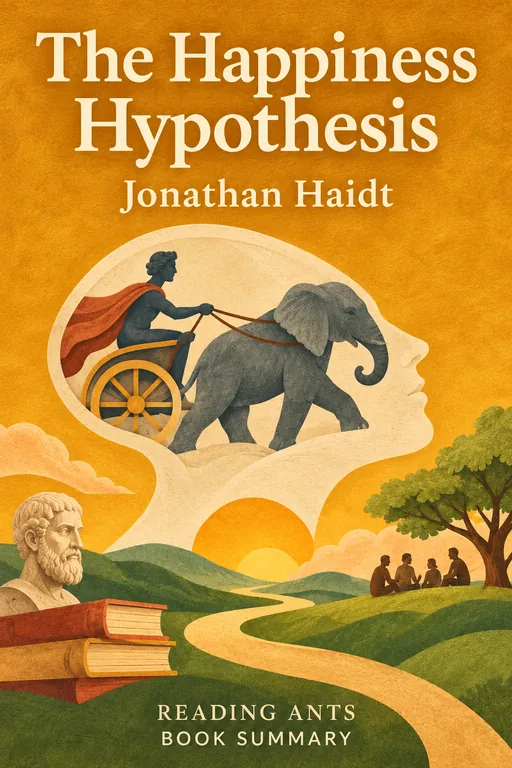
The Happiness Hypothesis
Jonathan Haidt
Psychologist Jonathan Haidt tests ten ancient ideas about happiness and virtue against modern science, and concludes that happiness comes neither only from within nor only from outside, but from between: from getting the relationships between yourself, other people, your work and something larger right.
🧩 Mind & Psychology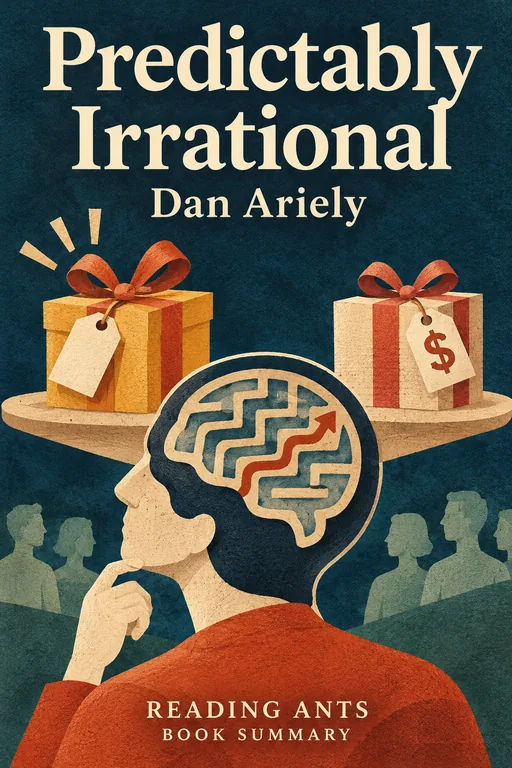
Predictably Irrational
Dan Ariely
Behavioral economist Dan Ariely uses entertaining experiments to show that people's decisions are shaped by predictable mental quirks, such as relativity, the lure of "free" and social norms, rather than by cool, rational calculation.
🧩 Mind & Psychology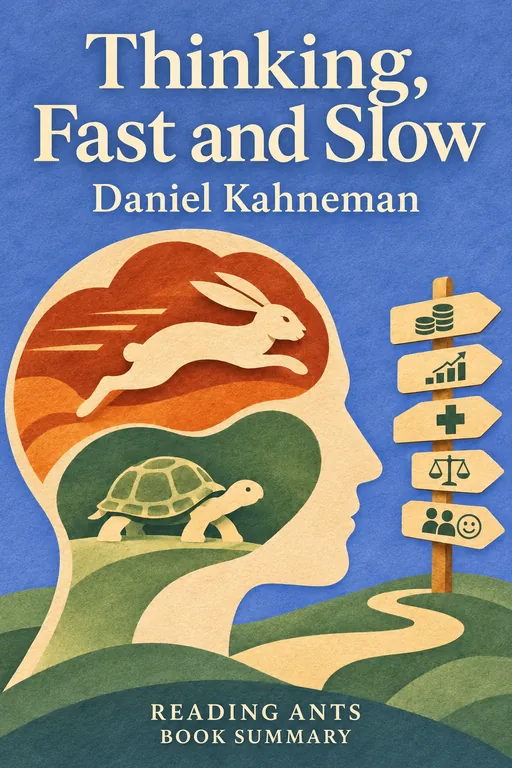
Thinking, Fast and Slow
Daniel Kahneman
Our minds run on two systems, a fast, intuitive one and a slow, careful one, and understanding how the fast system fools us can help us make better decisions about money, risk, work and happiness.
🧩 Mind & Psychology
The Book of Joy
Dalai Lama and Desmond Tutu with Douglas Abrams
Two Nobel Peace Prize winners, the Dalai Lama and Archbishop Desmond Tutu, talk about how to find lasting joy even in the face of suffering, and share the habits and attitudes that they believe lead to it.
🕊️ Philosophy & Religion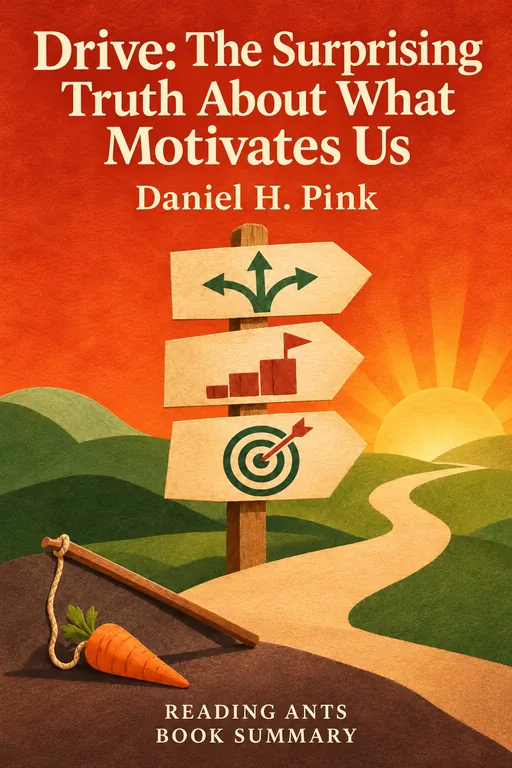
Drive: The Surprising Truth About What Motivates Us
Daniel H. Pink
Daniel Pink argues that, for creative and complex work, carrots and sticks such as bonuses are less effective than the inner drive provided by autonomy, mastery and purpose, and that businesses and schools should be redesigned around them.
🧩 Mind & Psychology
Nudge
Richard H. Thaler and Cass R. Sunstein
Because people are not perfectly rational, the way choices are presented strongly affects what they choose, and designers of choices can gently steer people toward better decisions without taking away their freedom.
🧩 Mind & PsychologyWant something different?
Pick another topic and we will show you three books to start with.