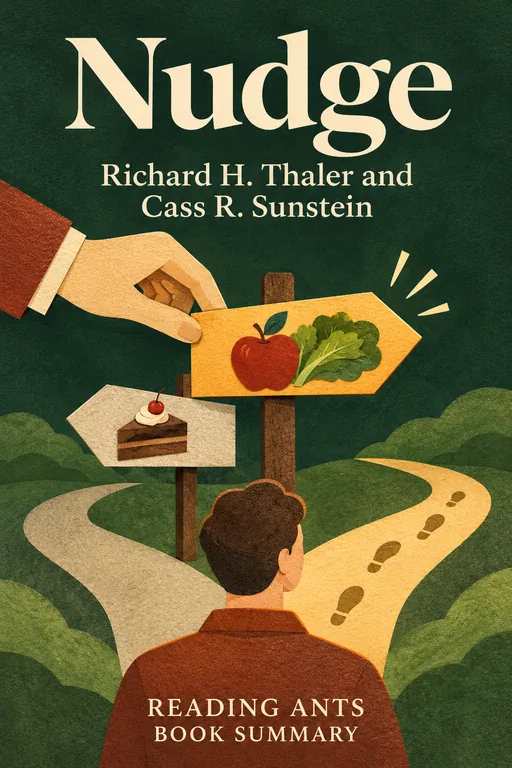
Because people are not perfectly rational, the way choices are presented strongly affects what they choose, and designers of choices can gently steer people toward better decisions without taking away their freedom.
Overview
Nudge: Improving Decisions About Health, Wealth, and Happiness was written by the economist Richard Thaler of the University of Chicago and the legal scholar Cass Sunstein, and published in 2008. Thaler later won the Nobel Prize in Economics in 2017 for his work on behavioral economics. The book applies findings from psychology to public policy and everyday life. Its core idea is that people often make mistakes because they are busy, distracted or influenced by habits and biases, and that “choice architects”, the people who design the way options are presented, can help. A nudge, they say, is any aspect of the design that alters behavior in a predictable way without forbidding options or changing incentives much.
Full Summary
1. Humans, not Econs
The idea: The authors begin by contrasting Econs, the perfectly rational, self-controlled people assumed in traditional economics, with Humans, who are easily influenced by social pressure, forget things, are tempted and make errors. They describe an automatic and a reflective way of thinking, and show how biases such as anchoring, overconfidence and loss aversion cause predictable mistakes. For example, people dislike losses more than they like equal gains, which can keep them from making wise changes.
In real life: People often keep a gym membership they never use because canceling feels like a loss.
2. Choice architecture and the power of defaults
The idea: Every choice is presented in some way, and there is no neutral design. The authors illustrate this with a school cafeteria manager who can raise or lower the consumption of certain foods just by changing where they are placed. They highlight the power of the default option, what happens if people do nothing. Because many people stick with the default out of inertia, setting a good default can have a large effect. In countries where people are automatically organ donors unless they opt out, registration rates as donors are much higher than where people have to opt in, though actual transplant numbers depend on other factors as well.
In real life: Many people leave factory settings on their phones, so whoever sets the defaults influences millions of people.
3. Saving for the future
The idea: The authors apply nudges to retirement saving. Many people want to save but do not follow through. They describe automatic enrollment, where workers are signed up for a savings plan unless they opt out, and the Save More Tomorrow program, in which employees agree in advance to put a portion of future raises into savings. These programs greatly increased saving, because they used inertia and avoided the pain of seeing take-home pay go down.
In real life: Setting up an automatic transfer to savings on payday makes saving something that happens without needing willpower.
4. Health, the environment and other areas
The idea: Thaler and Sunstein show how nudges can help in many other fields: giving clear information on food labels, designing health insurance choices so people are not overwhelmed, reminding people to take medicine or encouraging energy savings by showing how a household’s use compares with neighbors’. They discuss complicated choices, such as drug insurance plans in the United States, to show that too many options and poor presentation can lead people astray.
In real life: Seeing that your neighbors use less electricity can motivate you to cut back.
5. Libertarian paternalism
The idea: The authors call their philosophy libertarian paternalism. It is libertarian because people should remain free to choose, and paternalistic because it is legitimate for choice architects to steer people in directions that will make their lives better, as judged by themselves. They argue that because choices must be designed somehow, it is better to design them with people’s welfare in mind. They offer principles for good nudges, such as making them easy to avoid, transparent and in the interest of the people nudged.
In real life: A cafeteria that puts salads at eye level does not ban pizza but makes the healthier choice easier.
6. Objections and future
The idea: The final chapters respond to critics, who worry about manipulation, government overreach and the risk that officials may be biased or wrong. The authors reply that choice architecture is unavoidable and that transparency and public debate can guard against abuse. They suggest areas in which more nudging could help, such as organ donation, marriage rules and the environment, and invite readers to think about how to design choices that support good decisions.
In real life: If a city decides how to present choices about recycling, it is better to do it thoughtfully than at random.
Why It Matters
Nudge became a worldwide bestseller and helped launch the field of behavioral public policy. Governments, including those of the United Kingdom and the United States, set up “nudge units” to apply behavioral insights to services such as tax collection, public health and organ donation. Businesses also used its ideas in marketing and workplace design.
Thaler’s Nobel Prize highlighted the importance of integrating psychology into economics. The book changed how many policymakers think about why people do not follow their own best interests and how to help. Its vocabulary, including choice architecture and defaults, is now common in business, health care and public administration.
Key Takeaways
- People make predictable mistakes. Biases and habits affect decisions.
- Design shapes choices. How options are presented matters.
- Defaults are powerful. Most people stick with what is pre-selected.
- Keep freedom to choose. Good nudges can be easily avoided.
- Use nudges transparently. They should serve people’s own interests.
What We Can Learn
The book teaches us to arrange our own environments to help us do what we want. Putting healthy snacks in view, automating savings and setting reminders can make good behavior easier.
It also helps us notice how others shape our choices, through store layouts, forms, websites and apps, which can protect us from being steered against our own interests.
Finally, it reminds us to be kind to ourselves and others about mistakes. Understanding that biases are normal can reduce blame and encourage practical solutions.
Criticism and Counterpoints
Critics argue that nudging can be manipulative or disrespectful of autonomy, even when it appears mild, and that who decides what is “better” for people is open to dispute. Others worry that it lets governments and firms avoid bigger changes, such as laws or higher wages, by relying on small tweaks.
Some studies of nudges have shown smaller effects than first reported, and a few well-known behavioral findings have been hard to replicate. Libertarian critics reject the paternalism, while others say the effects can be uneven. Supporters respond that nudges are cheap, often effective and preserve choice, though they are not a cure-all.
Who Should Read It
This book suits teenagers and adults interested in psychology, economics and policy. It is clearly written with many examples, though some sections on policy are detailed. It makes a good companion to books on decision-making.
Want the whole book?
A summary is a taste, not the meal. Here is where to find the full book.
You reached the end 🎉
Nicely done. Mark this one as read, and we will suggest what to read next.
Read this next
Thinking, Fast and Slow
Daniel Kahneman
Our minds run on two systems, a fast, intuitive one and a slow, careful one, and understanding how the fast system fools us can help us make better decisions about money, risk, work and happiness.
🧩 Mind & Psychology
Predictably Irrational
Dan Ariely
Behavioral economist Dan Ariely uses entertaining experiments to show that people's decisions are shaped by predictable mental quirks, such as relativity, the lure of "free" and social norms, rather than by cool, rational calculation.
🧩 Mind & Psychology
Freakonomics
Steven D. Levitt and Stephen J. Dubner
Economics is really the study of incentives, and by asking odd questions and following the data, we can discover surprising truths about cheating, crime, parenting and everyday life.
💰 Money & Economics
The Psychology of Money
Morgan Housel
How you behave with money matters more than how much you know about it, and good financial outcomes come from humility, patience and avoiding big mistakes, not from being the smartest person in the room.
💰 Money & Economics
Stumbling on Happiness
Daniel Gilbert
Harvard psychologist Daniel Gilbert explains, with wit and research, that we are surprisingly poor at predicting what will make us happy, because the imagination fills in details wrongly, and he suggests that other people's experience is often a better guide than our own forecasts.
🧩 Mind & Psychology
The Happiness Hypothesis
Jonathan Haidt
Psychologist Jonathan Haidt tests ten ancient ideas about happiness and virtue against modern science, and concludes that happiness comes neither only from within nor only from outside, but from between: from getting the relationships between yourself, other people, your work and something larger right.
🧩 Mind & PsychologyWant something different?
Pick another topic and we will show you three books to start with.