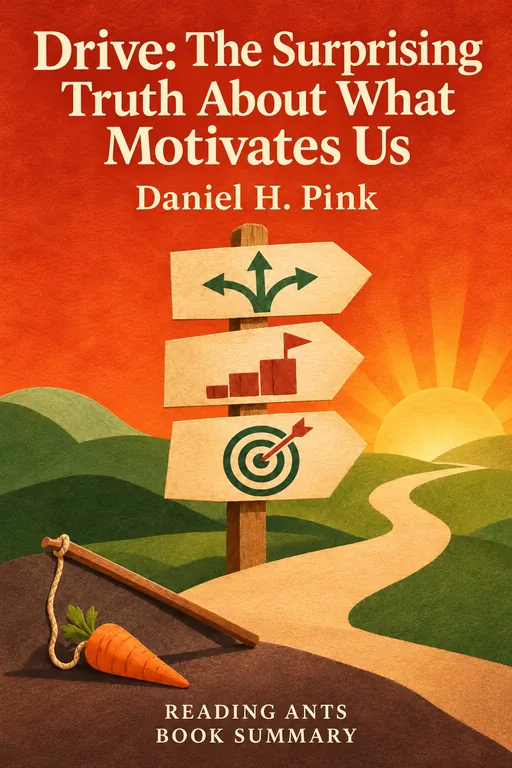
Drive: The Surprising Truth About What Motivates Us
Daniel Pink argues that, for creative and complex work, carrots and sticks such as bonuses are less effective than the inner drive provided by autonomy, mastery and purpose, and that businesses and schools should be redesigned around them.
Overview
Drive: The Surprising Truth About What Motivates Us was published in 2009 by Daniel H. Pink, a writer who had been a speechwriter for Vice President Al Gore, and who wrote other bestsellers on work and business. Pink draws on decades of research in psychology, especially the work of Edward Deci, Richard Ryan and others on intrinsic motivation. He describes three stages of motivation: Motivation 1.0 is survival, 2.0 is rewards and punishments, and the new 3.0 relies on inner drive. The book has three parts: the new operating system, the three elements of motivation, and a practical toolkit.
Full Summary
1. The problem with carrots and sticks
The idea: Pink opens with the psychologist Harry Harlow, whose monkeys solved puzzles for no reward and then did worse when they were given raisins, and with Edward Deci, whose puzzle experiments with students showed that people who had been paid for a task later spent less free time on it. Together they point to a third drive, intrinsic motivation, beside the drives of biology and of rewards and punishments. Pink argues that the old operating system, Motivation 2.0, no longer fits modern work, and then shows how carrots and sticks can backfire. In a classic study, preschoolers who expected a certificate for drawing, which they already enjoyed, later drew much less than those who got none or got one by surprise. He also describes experiments by economists, including Dan Ariely, in which bigger bonuses improved performance on mechanical tasks but led to worse results on tasks needing even basic thinking. He calls the damage the “Sawyer Effect,” after Tom Sawyer in Mark Twain’s story, because rewards can turn play into work.
In real life: A child who is paid for every math workbook page may work harder at first, but may lose interest in math in the long run.
2. Intrinsic motivation and the three elements
The idea: Pink says that the key to high performance on complex tasks is intrinsic motivation, doing something because it is interesting, challenging and satisfying. He identifies three elements: autonomy, the desire to direct our own lives; mastery, the urge to get better at something that matters; and purpose, the yearning to do what we do in service of something larger than ourselves. Together they make up the new operating system.
In real life: A person who plays an instrument for hours is driven by the love of improving.
3. Autonomy
The idea: Pink says that people are naturally curious and self-directed, and that traditional management can switch off that default. He describes autonomy as having four parts: freedom over one’s task, time, team and technique. His examples include the Australian software company Atlassian, whose engineers spend a day, called a FedEx Day, on any problem they like and must deliver something the next day, and the results-only work environment, or ROWE, in which people work whenever and wherever they want as long as the work gets done. He reports that a ROWE at Best Buy’s head office raised productivity and lowered voluntary turnover, and he also cites 3M and Google, which let staff spend part of their time on projects of their own choosing.
In real life: A student who can choose the topic for a project often puts in more effort.
4. Mastery
The idea: Mastery, according to Pink, is the urge to get better at something that matters, and it begins with “flow,” the experience of being fully absorbed in a task whose challenge matches one’s abilities, with clear goals and quick feedback. He recommends tasks that are neither too easy nor too hard, which he calls Goldilocks tasks. He then gives three laws. Mastery is a mindset: it needs the belief that abilities can be developed rather than being fixed, an idea drawn from the psychologist Carol Dweck. Mastery is a pain: it demands effort, grit and deliberate practice over a long time. And mastery is an asymptote: one can approach it but never fully reach it, which makes it both frustrating and alluring.
In real life: Practicing a sport or a language over years brings steady improvement and satisfaction.
5. Purpose
The idea: The third element is purpose. Pink says that humans seek a cause larger than themselves, and that the profit motive alone can be an insufficient driver for both people and organizations. He describes purpose taking its place beside profit as an aim in organizations that pursue a mission as well as a profit, and he looks at how it shows up in their goals, their language and their policies. He also cites a University of Rochester study of graduates: those who reached purpose goals, such as helping others and learning, reported good well-being, while those who reached profit goals, such as wealth or fame, were no happier and showed more anxiety.
In real life: A volunteer who sees how their work helps others may work harder than someone who is paid but sees no point.
6. The toolkit: how to apply it
The idea: In the last part, Pink offers practical suggestions. For individuals, he proposes asking yourself at the end of each day whether you were better than yesterday, giving yourself a regular performance review, and taking a “flow test” to find when you are most absorbed. For organizations, he suggests steps such as paying fairly, and a little above average, so that money is off the table, replacing an off-site with a FedEx Day, and offering Goldilocks tasks. For parents and teachers, he suggests giving children some autonomy over homework, DIY report cards, praising effort rather than intelligence, and keeping allowances separate from chores. The toolkit also includes a reading list and discussion questions.
In real life: Ending a day by asking whether you were better today than yesterday can keep you motivated.
Why It Matters
Drive became a bestseller, reaching the New York Times hardcover nonfiction list in 2010, and was influential in discussions of management, education and parenting. Its simple framework, autonomy, mastery and purpose, was widely adopted. The book encouraged companies to try more flexible arrangements and to rethink bonuses. It also brought the research on intrinsic motivation to a wide audience. Whether or not one agrees with every claim, it drew attention to the importance of meaning in work, and led many to reconsider the idea that people are motivated only by money, in workplaces, schools and homes alike.
Key Takeaways
- Rewards can backfire. For creative tasks, they may reduce interest.
- Autonomy fuels engagement. People want to direct their own work.
- Mastery is a mindset. Improvement brings satisfaction.
- Purpose sustains effort. People want to serve something larger.
- Pay fairly, then look beyond pay. Remove money as a worry, and focus on motivation.
What We Can Learn
You can use the book to look at your own motivation. Ask whether you do something because you want to, or only for a reward, and look for ways to bring in choice, challenge and purpose. In your studies, set goals for improvement rather than only for grades. If you lead a team or help a younger child, give choices and explain the reasons for tasks. Notice the activities that make you lose track of time, and try to do more of them. And remember that small rewards can sometimes help, particularly for dull tasks.
Criticism and Counterpoints
A reviewer in the Los Angeles Times praised the book’s energetic writing but argued that Pink overstates his case. Critics say that his account oversimplifies the research, and that, in practice, rewards do motivate people in many tasks and that pay is important. Research on motivation is still debated, and some findings have been qualified. Others point out that the examples come mainly from creative, white-collar workplaces, and may not apply to routine or low-paid jobs where autonomy is limited. Some argue that his emphasis on intrinsic motivation can be used to justify low pay for work that is “meaningful.” Nonetheless, many consider it a useful guide.
Who Should Read It
This book is for managers, teachers, parents and anyone interested in what makes people tick. It is short, engaging and full of examples. Those who want more detail on the research should consult the studies by Deci and Ryan, among others.
Want the whole book?
A summary is a taste, not the meal. Here is where to find the full book.
You reached the end 🎉
Nicely done. Mark this one as read, and we will suggest what to read next.
Read this next
Predictably Irrational
Dan Ariely
Behavioral economist Dan Ariely uses entertaining experiments to show that people's decisions are shaped by predictable mental quirks, such as relativity, the lure of "free" and social norms, rather than by cool, rational calculation.
🧩 Mind & Psychology
How Children Succeed
Paul Tough
Journalist Paul Tough argues that qualities like perseverance, curiosity and self-control matter more for children's success than test scores alone, and that these qualities can be nurtured, especially for children who face hardship.
🎓 Parenting & Education
Atomic Habits
James Clear
Big changes in life come not from huge leaps but from tiny habits repeated every day, and you can build good habits (and break bad ones) by designing your life so the right choices are obvious, attractive, easy and satisfying.
🌱 Self-Improvement
Grit
Angela Duckworth
Psychologist Angela Duckworth argues that success depends not only on talent but on grit, a combination of passion and long-term perseverance, and shows how people can grow it in themselves and others.
🌱 Self-Improvement
No Rules Rules
Reed Hastings and Erin Meyer
Netflix co-founder Reed Hastings and the business professor Erin Meyer explain how Netflix built a company on very talented people, blunt honesty and very few rules, and why they think that freedom brings both speed and responsibility.
💼 Business
Thinking, Fast and Slow
Daniel Kahneman
Our minds run on two systems, a fast, intuitive one and a slow, careful one, and understanding how the fast system fools us can help us make better decisions about money, risk, work and happiness.
🧩 Mind & PsychologyWant something different?
Pick another topic and we will show you three books to start with.