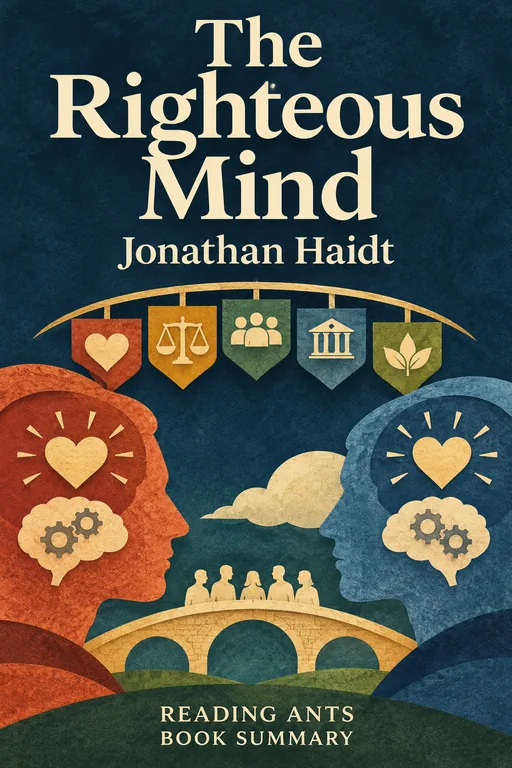
Jonathan Haidt argues that moral judgments come mainly from intuition and emotion, not reason, that people's moral instincts rest on several foundations that differ across political groups, and that understanding this can help us to disagree without hating each other.
Overview
The Righteous Mind: Why Good People Are Divided by Politics and Religion was published in 2012 by Jonathan Haidt, a social psychologist. Haidt began as a liberal, and spent years studying moral thinking across cultures, including in the United States, Brazil and India. He wrote the book to explain why political arguments seem so unproductive, and why each side thinks the other is irrational or immoral. It has three parts, on intuitions, the foundations of morality, and how people are groupish. A central theme is that morality binds and blinds, uniting groups and keeping them from seeing other views.
Full Summary
1. Intuitions come first, strategic reasoning second
The idea: Haidt returns to the image of the elephant and rider from his earlier book. The rider, our reasoning, acts as a press secretary for the elephant, our gut feelings, usually justifying what we have already decided. In experiments, people reacted with disgust to stories of harmless but taboo acts, such as eating a pet that had died, and then struggled to explain their reaction, a state he calls moral dumbfounding. He says that most moral reasoning is after-the-fact justification.
In real life: You may feel that something is wrong first, and then search for reasons.
2. Many moral foundations
The idea: Haidt says that, just as taste has several receptors, the moral sense has several foundations. The ones he describes include care versus harm, fairness versus cheating, loyalty versus betrayal, authority versus subversion and sanctity versus degradation, and, later, liberty versus oppression. Each evolved to solve problems of social life. Different cultures and groups build their moral systems on different combinations of these foundations.
In real life: One person may care most about protecting the vulnerable, and another about respect for tradition.
3. The moral matrix of the left and the right
The idea: The author applies the foundations to politics. In his studies, liberals tend to rely mostly on care, fairness and liberty, while conservatives draw more evenly on all of the foundations, including loyalty, authority and sanctity. He argues that Republicans and Democrats tend to focus on different moral foundations, which makes political argument harder. Each side has insights, and each can be blind to the concerns of the other. He compares moral worlds to matrices that people are immersed in.
In real life: Two people may argue about a flag, one seeing it as a symbol of loyalty and the other as a piece of cloth.
4. We are 90 percent chimp and 10 percent bee
The idea: Haidt argues that humans are mostly selfish, like chimpanzees, but also have a capacity to become, in certain conditions, like bees, giving up the self to serve the hive. This is what he calls the “hive switch,” triggered by experiences such as being part of a team, singing or dancing together, or taking part in a ritual. He says that this tendency toward group-mindedness explains the power of religion, the military and sports, and is a source of both goodness and conflict.
In real life: Singing with a crowd at a concert can make you feel part of something bigger than yourself.
5. Religion and group selection
The idea: Haidt takes a more positive view of religion than many scientists, suggesting that it may have evolved to bind groups together, as a mechanism for cooperation, and that religious people tend to give more and to be more connected to their communities. He draws on the idea of multilevel selection, according to which natural selection can operate at the level of groups, not only individuals. This view is controversial among evolutionary biologists.
In real life: Communities with shared rituals often have strong ties.
6. Can we get along?
The idea: In the last part, Haidt considers how to bridge divides. He suggests that we try to understand the moral language of those we disagree with, and not assume that they are stupid or evil. People respond better to arguments when they feel respected, and when they are not defensive. He recommends that we find common ground, build friendships across lines and create environments that encourage civil debate. He concludes that understanding each other’s moral worlds is the first step toward civil disagreement.
In real life: Listening carefully to a friend’s reasons, before replying, can lead to a better conversation.
Why It Matters
The Righteous Mind became a bestseller and shaped public discussion about polarization, morality and politics. It provided a vocabulary, such as moral foundations and the elephant and rider, that has been widely used. The book’s main message, that intuition drives judgment, and that understanding other moral languages is the way to civil discourse, appealed to people across the spectrum. It influenced educators, organizers and others who work on bridging divides. It also led to later work by Haidt on social media, higher education and the mental health of young people. The debate over its claims continues.
Key Takeaways
- Intuition leads, reason follows. We often justify gut reactions.
- Morality has several foundations. Care, fairness, loyalty, authority, sanctity and liberty.
- Groups differ in emphasis. Left and right weigh the foundations differently.
- Humans are groupish. We can lose ourselves in shared purpose.
- Understanding reduces hostility. Listening is the start of cooperation.
What We Can Learn
When you disagree with someone about a moral or political question, try to ask what values lie behind their view. Check whether your own position is based on a reason or on a feeling that you are justifying. Look for common ground, and use arguments that appeal to the values of your audience. Spend time with people who hold different views, and in shared activities. And remember that your own side may have blind spots, just as the other does. Practicing humility can improve conversations at home, in school and online.
Criticism and Counterpoints
Critics say that the moral foundations theory is based on limited data, and that the list of foundations is somewhat arbitrary and may not be universal. Some argue that the claim that the intuitive part is dominant undervalues the role of reason in moral progress. Many evolutionary biologists dispute the group selection argument, and writers such as Richard Dawkins and Daniel Dennett have criticized religion in ways that Haidt answers. The journalist Chris Hedges argued that the book reduces complex questions to easy clichés and sanctifies obedience to authority. Haidt, for his part, says that he began as a liberal but has become more open to other points of view.
Who Should Read It
This book is for readers interested in psychology, politics and getting along with those who think differently. It is clear and engaging, with a mix of stories and studies. Those who want a technical treatment of moral psychology should read the academic papers on which it draws.
Want the whole book?
A summary is a taste, not the meal. Here is where to find the full book.
You reached the end 🎉
Nicely done. Mark this one as read, and we will suggest what to read next.
Read this next
The Happiness Hypothesis
Jonathan Haidt
Psychologist Jonathan Haidt tests ten ancient ideas about happiness and virtue against modern science, and concludes that happiness comes neither only from within nor only from outside, but from between: from getting the relationships between yourself, other people, your work and something larger right.
🧩 Mind & Psychology
Thinking, Fast and Slow
Daniel Kahneman
Our minds run on two systems, a fast, intuitive one and a slow, careful one, and understanding how the fast system fools us can help us make better decisions about money, risk, work and happiness.
🧩 Mind & Psychology
How Democracies Die
Steven Levitsky and Daniel Ziblatt
Two Harvard political scientists argue that democracies today usually die not from coups but from elected leaders who slowly weaken the rules, and that they survive when political parties and politicians respect unwritten norms of tolerance and restraint.
⚖️ Politics & Society
The True Believer
Eric Hoffer
Longshoreman-philosopher Eric Hoffer argues that people who join fanatical mass movements are usually frustrated and dissatisfied with themselves, and that such movements, whether religious, nationalist or revolutionary, appeal to the same needs and use similar methods.
⚖️ Politics & Society
Humankind: A Hopeful History
Rutger Bregman
Rutger Bregman argues that people are, deep down, more decent than cynics believe, and that many famous stories used to prove human selfishness and cruelty are false or misleading.
🏛️ History
Predictably Irrational
Dan Ariely
Behavioral economist Dan Ariely uses entertaining experiments to show that people's decisions are shaped by predictable mental quirks, such as relativity, the lure of "free" and social norms, rather than by cool, rational calculation.
🧩 Mind & PsychologyWant something different?
Pick another topic and we will show you three books to start with.