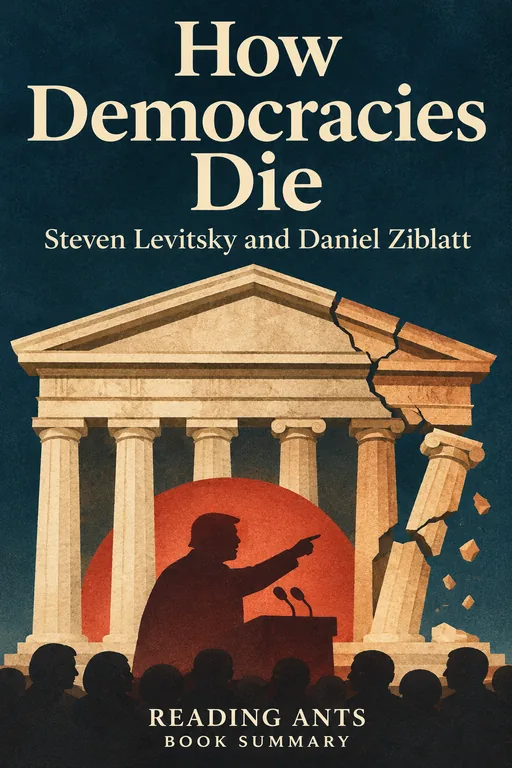
How Democracies Die
Two Harvard political scientists argue that democracies today usually die not from coups but from elected leaders who slowly weaken the rules, and that they survive when political parties and politicians respect unwritten norms of tolerance and restraint.
Overview
How Democracies Die was published in 2018 by Steven Levitsky and Daniel Ziblatt, who study democratic breakdown in Latin America and Europe. They wrote it in response to concern over the state of American politics. The book looks at historical cases, including Hitler’s rise in Germany, Mussolini in Italy, Chavez in Venezuela and others, and asks what the warning signs are and what can prevent a slide into authoritarianism. It then turns to the United States, where, they say, democratic norms that supported the constitution have been weakening.
Full Summary
1. Fateful alliances and the gatekeepers
The idea: The authors begin with the observation that many would-be authoritarians come to power through fair elections, helped by established politicians who think they can control them. They give the example of Mussolini and Hitler, who were invited into government by elites who underestimated them. The key to protecting democracy, they say, is the role of political parties as gatekeepers, which must keep extremists out of power, even at the cost of cooperating with opponents.
In real life: A club that elects someone who breaks its rules, hoping to control him, may regret it.
2. Four warning signs
The idea: Levitsky and Ziblatt offer a simple test for spotting an authoritarian politician. Warning signs include a weak commitment to democratic rules, such as willingness to ignore the constitution or to cancel elections; denial of the legitimacy of opponents, such as calling them criminals or enemies; toleration or encouragement of violence; and readiness to curtail the civil liberties of rivals and the media. If a politician shows even one of these, they say, it should raise concern.
In real life: A candidate who says the other side must not be allowed to win is signaling something.
3. Subverting democracy step by step
The idea: Modern autocrats, the authors say, often do not abolish democratic institutions but capture them. Once in power, they may take control of referees, such as courts and law enforcement, by filling them with loyalists, sideline the key players, such as media and business owners, through pressure, and change the rules to tilt the field, for example by rewriting the constitution or changing the election system. Each step may appear legal, and so it is hard to resist.
In real life: A referee who is replaced by a friend of one team changes the game.
4. The guardrails: mutual toleration and forbearance
The idea: The authors argue that the strength of American democracy depended on two unwritten norms. One is mutual toleration, the understanding that rival parties accept each other as legitimate competitors. The other is institutional forbearance, the habit of not using one’s legal powers to the fullest in order to hurt the other side. These norms, they say, act like the guardrails of democracy, and their decline makes the system more fragile.
In real life: Two teams may be allowed by the rules to play dirty, but sportsmanship keeps the game going.
5. The unraveling in the United States
The idea: Levitsky and Ziblatt tell how these norms were stronger in the mid-twentieth century, in part because racial exclusion in the South limited partisan conflict, and how they were weakened as politics became more polarized along racial and cultural lines in the decades after the civil rights era. They point to tactics such as blocking of nominations, the use of procedures to obstruct, and rhetoric that treats opponents as enemies, as signs of the erosion of norms.
In real life: When each side believes the other is a danger to the country, it becomes easier to bend the rules.
6. Saving democracy
The idea: In the final chapter, the authors discuss what to do. They say that democracy is best defended by parties that refuse to cooperate with extremists, and they urge Americans to restore the basic norms of toleration and restraint and to extend them to the whole of a diverse society. They advise Republicans to build a more diverse electorate without appealing to white nationalism, and they urge Democrats to take inequality seriously, since the health of democracy depends on it. They end with three possible futures for the country, and stress that the outcome depends on the choices of citizens and leaders.
In real life: People with different views may need to work together to protect the rules that allow them to disagree.
Why It Matters
How Democracies Die became a bestseller and a widely cited book in the debate about the health of democracy. Its focus on norms as well as laws changed how many people think about what protects a political system. The book’s warning signs have been widely discussed by journalists and scholars. It joined a stream of works on democratic backsliding, and was read by journalists, politicians and citizens. Even those who disagree with its application to the United States find its comparative framework useful. It reminds readers that institutions rely on shared habits.
Key Takeaways
- Democracies can die slowly. Elected leaders can erode them from within.
- Watch for warning signs. Weak commitment to rules, denial of opponents’ legitimacy, tolerance of violence and curbing of rights.
- Norms are guardrails. Toleration and restraint keep competition healthy.
- Parties are gatekeepers. They must refuse to empower extremists.
- Citizens matter. Democracy depends on those who defend its habits.
What We Can Learn
You can use the four warning signs when evaluating leaders in any organization, including your school or town. Practice the habits of toleration and restraint in disagreements, by treating opponents as legitimate and not as enemies. Be willing to support good rules, even when they work against your side. Take part in civic life by voting and participating in local groups. And learn about other countries’ experiences, which show that democratic decline can happen anywhere, and that it can be resisted.
Criticism and Counterpoints
Some critics say that the book overstates the role of norms, and underestimates deeper causes such as economic inequality and the influence of social media. Others argue that the authors’ analysis is partisan, as when a Wall Street Journal reviewer faulted them for demonizing Republican politicians, and that their definitions of norm violations are subjective. The historian Adam Tooze called them naive about power, and noted that they downplay the role of force in destroying and rebuilding democracies. Some also think that the book is too alarmist and that American institutions are more resilient. The authors do, however, offer advice to both major parties.
Who Should Read It
This book is for readers interested in politics, history and the future of democracy. It is short, clear and well organized, with many historical examples. Those who want to test its claims should read other views and comparative studies.
Want the whole book?
A summary is a taste, not the meal. Here is where to find the full book.
You reached the end 🎉
Nicely done. Mark this one as read, and we will suggest what to read next.
Read this next
On Tyranny
Timothy Snyder
Historian Timothy Snyder draws twenty practical lessons from the history of fascism, communism and other dictatorships of the twentieth century, to help ordinary citizens defend freedom in democratic societies today.
🏛️ History
The Origins of Totalitarianism
Hannah Arendt
Hannah Arendt examines how antisemitism, imperialism and the breakdown of society in Europe prepared the ground for the totalitarian regimes of Nazi Germany and Stalin's Soviet Union, and what made these regimes new and uniquely terrible.
🏛️ History
The End of History and the Last Man
Francis Fukuyama
Francis Fukuyama argues that the end of the Cold War suggests that liberal democracy may be the final stage of political development, and asks whether people who live in such a system will be satisfied or will long for new struggles.
🏛️ History
Why Nations Fail
Daron Acemoglu and James A. Robinson
Nations become rich or stay poor mainly because of their institutions: countries that share power and reward ordinary people's effort prosper, while those run by narrow elites for their own benefit stay poor.
💰 Money & Economics
Democracy in America
Alexis de Tocqueville
After touring the United States in the 1830s, the young Frenchman Alexis de Tocqueville wrote a penetrating study of American democracy, praising its energy and liberty, and warning about its dangers, such as the tyranny of the majority and a retreat into private life.
⚖️ Politics & Society
The Prince
Niccolo Machiavelli
A Renaissance diplomat advises rulers to judge their actions by results rather than morality, arguing that a successful leader must sometimes be cunning and ruthless to win and keep power.
⚖️ Politics & SocietyWant something different?
Pick another topic and we will show you three books to start with.