 Reading Ants
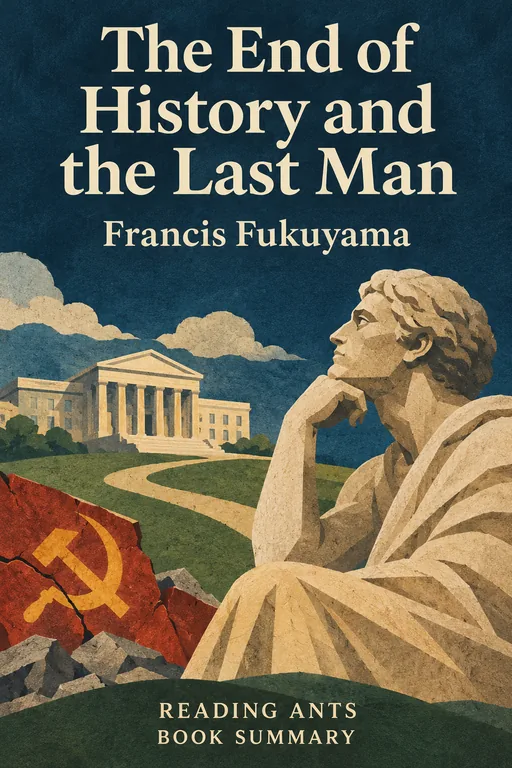
The End of History and the Last Man
Francis Fukuyama argues that the end of the Cold War suggests that liberal democracy may be the final stage of political development, and asks whether people who live in such a system will be satisfied or will long for new struggles.
Overview
The End of History and the Last Man was published in 1992 by Francis Fukuyama, an American political scientist. It grew out of an essay, “The End of History?”, that he wrote in 1989, as communism was collapsing in Europe. The “end of history” does not mean that events stop happening, but that humanity may have reached the end of a long debate about the best way to organize society. Fukuyama draws on the German philosopher Hegel, and on a twentieth-century interpreter of Hegel, and on Nietzsche. He asks both whether liberal democracy has won, and whether it is good enough.
Full Summary
1. The triumph of liberal democracy
The idea: Fukuyama begins with a historical observation: in the twentieth century, many forms of government that claimed to be better than liberal democracy, such as monarchy, fascism and communism, failed or lost their appeal. Over the decades, more countries became democracies. He argues that no rival ideology now presents a serious challenge in the realm of ideas. In this sense, he says, liberal democracy has “won.”
In real life: After a long tournament, one team may look so strong that it is difficult to imagine a different winner.
2. A direction in history
The idea: The author argues that history has a direction, which can be seen in the growth of science and technology and of the economies they make possible. Modern science gives advantages in war and in wealth, so societies that do not adopt it fall behind. This process leads many societies toward similar economic and social forms, such as the market and the modern state, though it does not by itself explain why they become democracies.
In real life: Once a new tool such as the telephone becomes common, a society that refuses to use it is at a disadvantage.
3. The struggle for recognition
The idea: To explain the democratic part, Fukuyama turns to another human trait. He says that humans want not only food and safety, but also recognition: to be seen as having dignity and worth. Throughout history, the desire for recognition led to wars and masters and slaves. Drawing on the Hegel of Alexandre Kojève, he argues that liberal democracy is the first system to aim at equal recognition for everyone as a citizen with rights, which is why it is so attractive, though actual democracies do not always deliver it equally.
In real life: People often care more about being treated with respect than about the material things they receive.
4. Pride, ambition and equality
The idea: Fukuyama borrows an ancient Greek word, thymos, for the part of the soul that seeks recognition. It can take two forms: isothymia, the wish to be recognized as equal to others, and megalothymia, the wish to be recognized as greater than others. Democracy satisfies the first form, but largely redirects the second into business, politics and other competition, though imperfectly. Megalothymia, which cannot be fully tamed, has driven great leaders and great deeds as well as great crimes. He asks what happens to the ambitious in a society of equals.
In real life: A team that treats all members fairly may still have a few who want to stand out as the best.
5. The last man
The idea: The book’s title refers to Nietzsche’s idea of the “last man,” a comfortable person who has everything that he needs and has no higher aim. Fukuyama worries that people in a stable liberal democracy might become like this: content with peace and prosperity but lacking purpose. Some, he suggests, may become bored and seek excitement in risky or destructive ways, or in new struggles, perhaps through nationalism or other causes, which would challenge the system.
In real life: A person who has everything handed to them may start to wonder what they are living for.
6. Will democracy hold?
The idea: In the last chapters, Fukuyama says that liberal democracy has some weak points, but that it has fewer than the alternatives. He notes that no system is guaranteed to last, that its comforts may leave people without a sense of purpose, and that its stability depends on balancing material well-being with the human need for recognition and on giving people healthy outlets for their ambition. He does not say that conflicts will cease, but that the main choice of political system may have been settled.
In real life: A club can offer comfort and still lose its members if nobody feels it has a purpose.
Why It Matters
The End of History and the Last Man was among the most discussed political books of the 1990s, and the phrase “end of history” entered public language. It captured the optimism that followed the end of the Cold War, and gave a thoughtful framework for it. The book also introduced many readers to ideas from Hegel and Nietzsche. It has been widely cited, and widely criticized, especially in the years after terrorist attacks, wars and the rise of authoritarian powers. It remains an important text for those who want to understand debates about democracy, progress and the future of politics, and Fukuyama has continued to write about these questions.
Key Takeaways
- Ideas compete. In the twentieth century, liberal democracy outlasted its rivals.
- History may have a direction. Science and economics shape societies in similar ways.
- Recognition is a basic need. People want dignity as well as comfort.
- Satisfaction is not guaranteed. A comfortable life may lack meaning.
- Democracy needs more than prosperity. Its stability depends on recognition, purpose and healthy outlets for ambition.
What We Can Learn
Think about what you want beyond comfort, and what gives your life meaning. Notice how much of public life, from social media to politics, is about recognition, and how it can lead to both cooperation and conflict. Be involved in your community, since democratic freedoms are not self-sustaining. And remember that statements about the end of history are claims to test: ask whether recent events support or contradict them, and why. Finally, talk with people who disagree with you about what makes a good society, and listen for what they value most; the question of recognition is one that every person answers in their own way.
Criticism and Counterpoints
Critics point out that events since the early 1990s, such as the rise of authoritarian states like China and Russia, the spread of radical Islamism, and the decline of democracy in a number of countries, seem to contradict the idea that liberal democracy has triumphed. Many people misunderstood the title to mean that history had simply stopped, whereas Fukuyama meant the end of large ideological competition over the best form of government. Others argue that his view is too tied to Western ideas, or that he underestimates the importance of religion, nationalism and inequality. Fukuyama later published works that stressed the fragility of democratic institutions, and changed some of his views on foreign policy.
Who Should Read It
This book is for readers of political philosophy and world affairs who like big ideas. It is more abstract than a typical history, with many references to philosophers. Those who prefer concrete cases may like to read the original 1989 essay first, and then the book for the full argument.
Want the whole book?
A summary is a taste, not the meal. Here is where to find the full book.
You reached the end 🎉
Nicely done. Mark this one as read, and we will suggest what to read next.
Read this next
The Clash of Civilizations
Samuel P. Huntington
Samuel Huntington argues that, after the Cold War, the main source of conflict in the world will be cultural and religious differences between large civilizations, instead of political ideology or economics.
🏛️ History
The Road to Serfdom
Friedrich A. Hayek
Friedrich Hayek argues that when governments try to plan the whole economy from the center, they must gradually limit personal and political freedom, and that the road leads toward a dictatorship that nobody intended.
💰 Money & Economics
Why Nations Fail
Daron Acemoglu and James A. Robinson
Nations become rich or stay poor mainly because of their institutions: countries that share power and reward ordinary people's effort prosper, while those run by narrow elites for their own benefit stay poor.
💰 Money & Economics
The Origins of Totalitarianism
Hannah Arendt
Hannah Arendt examines how antisemitism, imperialism and the breakdown of society in Europe prepared the ground for the totalitarian regimes of Nazi Germany and Stalin's Soviet Union, and what made these regimes new and uniquely terrible.
🏛️ History
On Tyranny
Timothy Snyder
Historian Timothy Snyder draws twenty practical lessons from the history of fascism, communism and other dictatorships of the twentieth century, to help ordinary citizens defend freedom in democratic societies today.
🏛️ History
Sapiens: A Brief History of Humankind
Yuval Noah Harari
Humans came to rule the planet not because we are the strongest animals but because we can believe in shared stories (gods, nations, money, companies) that let millions of strangers cooperate.
🏛️ HistoryWant something different?
Pick another topic and we will show you three books to start with.