 Reading Ants
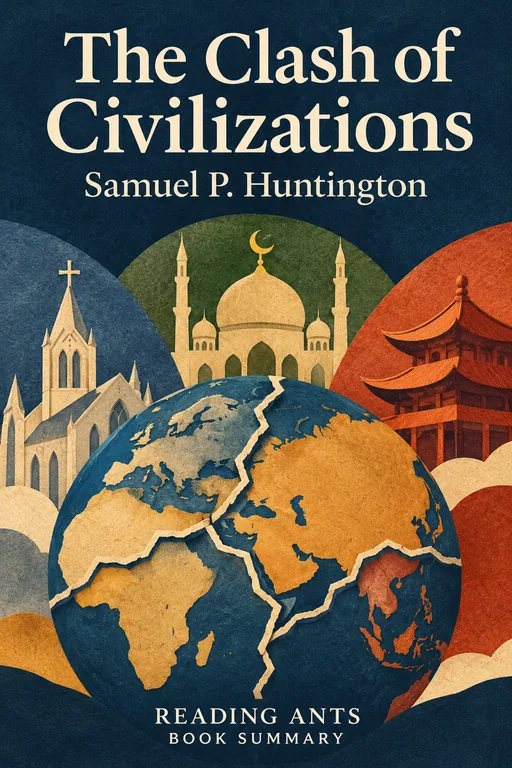
The Clash of Civilizations
Samuel Huntington argues that, after the Cold War, the main source of conflict in the world will be cultural and religious differences between large civilizations, instead of political ideology or economics.
Overview
The Clash of Civilizations and the Remaking of World Order was published in 1996 by Samuel P. Huntington, a professor of political science at Harvard University. It grew from an article that he wrote in 1993, which was widely discussed. Huntington wrote it in the years after the collapse of the Soviet Union, when many were asking what would shape world politics in the future. His answer is that civilizations, which are broad cultural groupings, such as the West, the Islamic world or China, will be the main frame for alliances and conflicts, while nation-states remain the principal actors. The book is controversial, and has been both praised and heavily criticized.
Full Summary
1. A new picture of the world
The idea: Huntington says that during the Cold War, the world was divided into blocs defined by ideology. With the end of that struggle, a new map is needed. He proposes that the world should be seen in terms of civilizations, defined by shared history, language, religion and customs. He names several, including the West, a group of Chinese or Sinic cultures, Japan, the Islamic world, Hindu India, Orthodox Christian lands, Latin America and, perhaps, Africa.
In real life: A school may be divided into groups of friends with common interests, and the lines between them matter more than the formal classes.
2. The shifting balance of power
The idea: The author argues that the West, led by the United States and Europe, was dominant for a long period, but that its relative power is declining as other civilizations grow in wealth and confidence. He points to the rise of East Asia, and to the increase in population and the religious revival in the Islamic world. He says that non-Western societies are modernizing, but not necessarily becoming more like the West, and that they keep their own values.
In real life: A country can use smartphones and global trade without giving up its own language, faith and traditions.
3. Identity and the rise of religion
The idea: Huntington says that as the world becomes more connected, people ask more intensely who they are. In many societies, this has led to renewed attention to religion and to cultural identity. He suggests that this is a response to the stress of rapid change. People look for belonging, and the civilization to which they belong provides a deep source of it. He thinks that this will shape alliances and rivalries.
In real life: A student who moves to a new school may hold on more strongly to the customs of home.
4. Fault lines and wars
The idea: The most striking part of the argument is that the most dangerous conflicts will be at the “fault lines” between civilizations, where groups of different cultures live side by side. He cites the wars in the former Yugoslavia, and conflicts in the Caucasus and elsewhere as examples. He argues that such wars tend to be long and violent, and that other members of each civilization tend to support their own side, so that local fights can widen.
In real life: A quarrel between two neighbors may spread if each side’s relatives take sides.
5. Torn countries and the West’s role
The idea: Huntington describes “torn” countries, such as Turkey, Mexico and Russia, which are caught between civilizations and have leaders who want to change their identity. He also discusses “core states,” the leading powers of each civilization, and says that conflicts spread when kin countries rally to their side. He says that the West should not assume that its ideals are universal, and that trying to impose them on others may cause resentment. He advises that it should strengthen its own unity, protect its distinct culture and avoid taking part in conflicts in other civilizations.
In real life: A group that tries to force its own habits on another may create more opposition than cooperation.
6. Toward a multicivilizational world
The idea: In the last part, Huntington warns that a clash between civilizations could lead to a major war, and that the key to avoiding it is for the leading state of each civilization to refrain from interfering in conflicts in other civilizations, to negotiate with the other leading states to halt local wars, and to look for the values and practices that civilizations share. He calls for each civilization to accept that the world is made up of many cultures. He finishes by arguing that clashes of civilizations are the greatest threat to world peace, and that an international order based on civilizations is the surest safeguard against world war.
In real life: Neighbors with different customs can still agree on basic rules for sharing a street.
Why It Matters
The Clash of Civilizations was one of the most discussed books about world affairs of the 1990s, and its title became a catchphrase. After the attacks of September 11, 2001, and the wars that followed, many commentators referred to Huntington’s thesis, either in support or in opposition. The book influenced debates about immigration, religion, identity and foreign policy, and it was widely read around the world. It also started a global conversation, with many scholars and leaders responding with alternative ideas, such as dialogue among civilizations. Whether his predictions were right or wrong, the book remains a point of reference for anyone who wants to understand how culture and politics are linked.
Key Takeaways
- Culture shapes politics. Shared identity affects alliances and conflicts.
- The West is not the whole world. Other societies modernize in their own ways.
- Identity matters. People turn to religion and heritage in a changing world.
- Boundaries between cultures can be dangerous. Wars often occur where communities meet.
- Humility is needed. Imposing one’s values on others can backfire.
What We Can Learn
The book invites us to think about how much our beliefs and loyalties depend on where we come from, and to take other cultures seriously. At the same time, it is wise to be cautious about treating whole civilizations as single actors, since people within them have many views. In your own life, try to learn about the history and customs of neighbors and classmates who come from different backgrounds. Avoid assuming that conflict between groups is inevitable, and look for shared interests. And read opposing views, so that you can weigh them for yourself.
Criticism and Counterpoints
Many scholars have criticized Huntington’s thesis. They say that civilizations are not single, unified blocs, but are internally diverse, with deep conflicts within them, such as the wars among Muslim states or among European countries. They argue that most violence occurs inside civilizations and not between them, and that economic and political interests often matter more than culture. Edward Said and others claimed that the thesis simplifies the world and could encourage prejudice, particularly against Muslims. Others note that many of his predictions have not come true. Supporters say that the book rightly drew attention to the role of culture.
Who Should Read It
This book is for readers interested in world politics, culture and history, and for those who want to understand a debate that has shaped discussions of the past thirty years. It is academic in tone, but clearly argued. Those who want a balanced view should read responses from critics, and those who prefer a general history of the world may want to begin there.
Want the whole book?
A summary is a taste, not the meal. Here is where to find the full book.
You reached the end 🎉
Nicely done. Mark this one as read, and we will suggest what to read next.
Read this next
The End of History and the Last Man
Francis Fukuyama
Francis Fukuyama argues that the end of the Cold War suggests that liberal democracy may be the final stage of political development, and asks whether people who live in such a system will be satisfied or will long for new struggles.
🏛️ History
Orientalism
Edward W. Said
Edward Said argues that Western writers, scholars and governments created an image of "the Orient," especially the Middle East, as exotic, backward and in need of rule, and that this image served European power.
🏛️ History
The World Is Flat
Thomas L. Friedman
New York Times columnist Thomas Friedman argues that technology and new business practices have leveled the global playing field, so that people anywhere can compete and collaborate with anyone else, and he asks how individuals and countries should respond.
⚖️ Politics & Society
Collapse: How Societies Choose to Fail or Succeed
Jared Diamond
Jared Diamond studies societies that collapsed and societies that survived, and argues that environmental damage, climate change, enemies, trade and the way a society responds to problems decide whether it fails or succeeds.
🏛️ History
Prisoners of Geography
Tim Marshall
Tim Marshall argues that mountains, rivers, seas and plains shape the choices that countries and leaders can make, so understanding geography helps explain world events.
⚖️ Politics & Society
Sapiens: A Brief History of Humankind
Yuval Noah Harari
Humans came to rule the planet not because we are the strongest animals but because we can believe in shared stories (gods, nations, money, companies) that let millions of strangers cooperate.
🏛️ HistoryWant something different?
Pick another topic and we will show you three books to start with.