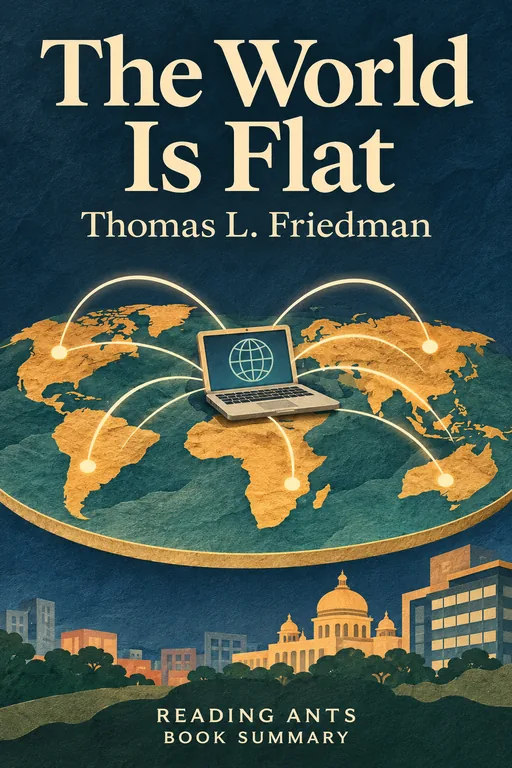
New York Times columnist Thomas Friedman argues that technology and new business practices have leveled the global playing field, so that people anywhere can compete and collaborate with anyone else, and he asks how individuals and countries should respond.
Overview
The World Is Flat: A Brief History of the Twenty-First Century was published in 2005 by Thomas L. Friedman, a journalist known for writing about foreign affairs. The idea came to him on a trip to Bangalore, India, where he saw the work of technology firms that served customers around the world, and a business leader said that the playing field was being leveled. Friedman uses the image of a flat world, as opposed to Columbus’s discovery that the world is round, to describe the way that distance and borders matter less. The book mixes interviews, anecdotes and arguments, and was revised and expanded in later editions.
Full Summary
1. The flat world idea
The idea: Friedman says that a convergence of events around the year 2000 created a global platform for collaboration. He describes how, as a result, a person with a computer and connection in India, China or Brazil could take part in the same work as someone in New York or London. He calls this Globalization 3.0, in which individuals, not just countries or companies, are the main actors. The world has been made smaller and flatter, and the effects are only beginning.
In real life: A student in a small town can now learn from the same online lectures as someone in a big city.
2. The ten flatteners
The idea: The author lists ten forces that flattened the world. They include the fall of the Berlin Wall, which opened up markets; the arrival of the web browser; workflow software that allows different computers to work together; the rise of open-source collaboration; outsourcing, moving tasks to cheaper places; offshoring, moving whole factories; supply-chaining, as practiced by large retailers; insourcing, in which a company such as UPS takes over extra services, like repairs, for other companies; informing, such as search engines; and the “steroids,” digital, mobile and personal tools.
In real life: A package ordered online reaches you quickly, because of a chain of connected systems.
3. Outsourcing and the Indian engineers
The idea: Friedman gives examples of how tasks that were once done in rich countries, such as call-center work, tax preparation and software programming, were moved to India, where skilled workers are paid less. He says that this has helped India’s economy, and also lowered costs for Western firms. Many of the stories come from Bangalore, which he calls India’s Silicon Valley. He suggests that, in many cases, the work that can be done anywhere will be done where it is cheapest or best.
In real life: A company may have its customer service answered in a different country.
4. What it means for workers
The idea: The book argues that, in a flat world, workers face more competition, and also more opportunity. Jobs that are routine can be done by someone elsewhere or by a machine. To be secure, he says, a person should aim to be an “untouchable,” meaning someone whose job cannot be outsourced. He describes four kinds: workers who are special, such as global stars; workers who are specialized, such as skilled professionals; workers who are anchored, because the job must be done face to face in one place; and workers who are really adaptable. He stresses the need to keep learning how to learn.
In real life: Learning skills such as creativity and teamwork may be more valuable than just following instructions.
5. What it means for countries
The idea: Friedman says that countries must prepare by investing in education, infrastructure and an open business climate. He argues that a flat world also makes it less likely that nations that are interdependent will go to war, an idea that he calls the Dell theory of conflict prevention, based on the idea that countries that are part of the same supply chain have so much to lose that they will think hard before going to war. He adds that this does not make wars impossible. He also warns that those who fail to adapt will fall behind.
In real life: Two businesses that rely on each other tend to avoid fights.
6. The dangers: inequality, terror and the environment
The idea: The final part considers problems. A flat world, he says, does not mean that everyone is equal, and many people in poorer parts of the world are left out. He is concerned that the same tools that allow collaboration can be used by terrorists, and that economic growth will increase pressure on energy and the climate. He calls for countries to provide a safety net and education, so that more people can benefit from globalization.
In real life: A tool that helps many people can also be misused by a few.
Why It Matters
The World Is Flat was a huge bestseller, and a defining book of the early era of globalization. Its metaphor of a flat world entered everyday language, and it influenced debates in business, education and politics about outsourcing, competition and the skills that young people need. The book encouraged students and leaders to think about preparing for a connected world. It was also widely criticized, and the debate that followed deepened the discussion of globalization’s benefits and costs. It remains a snapshot of the optimism and concerns of the mid-2000s.
Key Takeaways
- Technology has connected the world. Individuals can compete and collaborate globally.
- Routine work is vulnerable. Specialized, creative and adaptable skills are valuable.
- Education and learning are essential. Lifelong learning keeps people competitive.
- Countries must adapt. Investment in people and infrastructure matters.
- Risks come along. Inequality, security and the environment need attention.
What We Can Learn
You can use the book to think about what skills you will need in a world where tasks can be done anywhere. Cultivate curiosity, the ability to learn and to work with others, and a mix of technical and human skills. Take advantage of online resources to learn from people in other places. Be aware of the global supply chains behind the products you use. And pay attention to those who are left out, since opportunity is not equal. Ask critical questions about whose interests are served by globalization.
Criticism and Counterpoints
Critics say that Friedman exaggerates the flattening, since the world remains very uneven, with large gaps in income, access to technology and opportunity, and that most economic activity remains local. Economists such as Joseph Stiglitz and Richard Florida argued that he underestimates the importance of place and the losers in globalization, including workers in rich countries whose jobs moved overseas. Others point out that his writing relies on anecdotes from conversations with executives, and that his enthusiasm for business is uncritical. Others argue that his Dell theory of conflict prevention is too optimistic.
Who Should Read It
This book is for readers interested in business, technology and world affairs. It is easy to read and full of stories, though long. Those who want a more balanced analysis should also read critics of globalization.
Want the whole book?
A summary is a taste, not the meal. Here is where to find the full book.
You reached the end 🎉
Nicely done. Mark this one as read, and we will suggest what to read next.
Read this next
The Clash of Civilizations
Samuel P. Huntington
Samuel Huntington argues that, after the Cold War, the main source of conflict in the world will be cultural and religious differences between large civilizations, instead of political ideology or economics.
🏛️ History
The End of History and the Last Man
Francis Fukuyama
Francis Fukuyama argues that the end of the Cold War suggests that liberal democracy may be the final stage of political development, and asks whether people who live in such a system will be satisfied or will long for new struggles.
🏛️ History
Chip War
Chris Miller
Chris Miller tells the story of how tiny computer chips became the foundation of modern life and military power, and why their supply, concentrated in a few places and companies, has become a major issue between the United States and China.
💰 Money & Economics
The Undercover Economist
Tim Harford
Tim Harford shows how economic ideas explain everyday puzzles, from why coffee costs what it does to why used cars are risky and why poor countries struggle, in a lively and friendly style.
💰 Money & Economics
21 Lessons for the 21st Century
Yuval Noah Harari
Historian Yuval Noah Harari examines the biggest challenges facing humanity today, from artificial intelligence and fake news to nationalism, religion and meaning, and asks how we can think clearly and stay sane in a fast-changing world.
🏛️ History
The Prince
Niccolo Machiavelli
A Renaissance diplomat advises rulers to judge their actions by results rather than morality, arguing that a successful leader must sometimes be cunning and ruthless to win and keep power.
⚖️ Politics & SocietyWant something different?
Pick another topic and we will show you three books to start with.