 Reading Ants
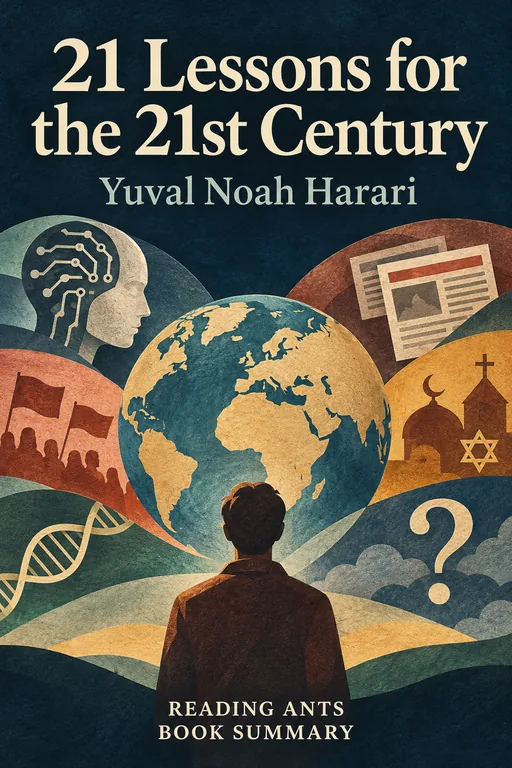
21 Lessons for the 21st Century
Historian Yuval Noah Harari examines the biggest challenges facing humanity today, from artificial intelligence and fake news to nationalism, religion and meaning, and asks how we can think clearly and stay sane in a fast-changing world.
Overview
21 Lessons for the 21st Century was published in 2018, following Harari’s earlier books Sapiens, about the past, and Homo Deus, about the future. This book turns to the present. It is made up of short essays, grouped into five parts about technology, politics, despair and hope, truth, and resilience. Harari does not offer easy answers, but sets out the issues and suggests ways of thinking about them. He writes in a clear and conversational style, with many examples, and he often invites readers to question their own beliefs.
Full Summary
1. Technology may upend work and power
The idea: Harari argues that artificial intelligence and automation could change the job market faster than people expect. Machines might replace many workers, not only in factories but also in professions such as driving, banking and law. He worries that some people may become economically useless, and calls for societies to prepare, with new kinds of education and support. The people who control the key technologies and data could gain enormous power.
In real life: A student today has to expect that the skills needed for a job might change several times in a lifetime.
2. Data, algorithms and freedom
The idea: Harari says that modern liberal societies rest on the belief that individuals know themselves best and make free choices. But if computers, fed by huge amounts of data, come to know us better than we know ourselves, they could predict and steer our choices. He asks whether this might undermine freedom, and who should own the data about people. He suggests that we need rules to keep this power under human control.
In real life: When a video app seems to know exactly what you want to watch next, it may be shaping what you want as much as responding to it.
3. Global problems need global answers
The idea: Harari discusses three problems that no nation can solve alone: the risk of nuclear war, climate change and technological disruption. He argues that nationalism, which can create loyalty and care within a country, is not enough to deal with such issues. He does not say that we must abolish nations, but that we need to keep a sense of belonging while also cooperating across borders. He also writes about terrorism, arguing that its real power comes from the fear it spreads, and about immigration.
In real life: A river that runs through several towns cannot be kept clean if each town ignores what the others do.
4. Religion, identity and community
The idea: The book includes essays about religion, secular values and the way people form groups. Harari says that stories, such as religions and nations, help people to cooperate in large numbers, even though they are products of imagination. He suggests that a good approach is to appreciate what these stories give us, but to keep a critical mind and to hold a basic commitment to reducing suffering and to truthfulness.
In real life: A school song or a team flag is only sound and cloth, but the shared meaning that people give it can bring them together.
5. Truth, fake news and humility
The idea: In a world of misinformation, Harari encourages readers to be skeptical and humble. He warns that no one knows as much as they think, and that our beliefs depend heavily on what the community around us thinks. He notes that lies and exaggerations have always existed, but that new technology makes it easier to spread them. He advises people to pay for quality information, and to be careful about sources.
In real life: Before you share a shocking story online, you can ask who wrote it and what evidence it offers.
6. Education and finding meaning
The idea: Harari says that in a world that changes so fast, the most important skill is the ability to learn and adapt, along with emotional intelligence and mental resilience. He suggests that schools should teach people to think critically, to communicate, to cooperate and to be creative, more than to memorize facts. He also talks about meaning, and says that people must be able to face change without losing their sense of purpose. He says that his own meditation practice has helped him, and presents meditation as a way to observe the mind and see reality more clearly.
In real life: A student who learns how to learn, and who stays calm when a plan fails, is better prepared than one who only memorizes.
Why It Matters
21 Lessons for the 21st Century was an international bestseller that brought many of the biggest questions about technology and politics to a wide audience. Harari’s mix of history, philosophy and current affairs made complex issues accessible and prompted discussion among readers, business leaders and policymakers. The book is part of a series of works by the author that has made him one of the most widely read thinkers of his generation. It matters because it encourages us to look at the present in the context of the long human story, and to ask what values we want to keep. It does not claim to have the final word, and invites readers to continue the conversation.
Key Takeaways
- Change is accelerating. Technology may transform jobs and politics quickly.
- Data is power. Whoever controls data and algorithms has great influence.
- Big problems cross borders. Nuclear risk, climate and technology need cooperation.
- Stay humble about truth. We know less than we think, and misinformation is easy to spread.
- Learn to adapt. Emotional resilience and flexible learning will be vital.
What We Can Learn
You can start with small habits: check where information comes from, take a break from screens and think about how technology is shaping your choices. In school or work, practice skills such as learning, communicating and working with others. Be open to people with different views, and be willing to say that you do not know. Think about what gives your life meaning besides what you do for a living. And consider how you can take part in public debate about how technology should be used, because these questions affect everyone.
Criticism and Counterpoints
Some critics say that the book is too sweeping, mixing many large topics in short essays that cannot cover them in depth. Experts in artificial intelligence and economics note that some of Harari’s predictions about jobs and about algorithms may be exaggerated, and that he sometimes presents opinions as if they were facts. Others disagree with his political views, or find that his advice to be skeptical is more convincing than his proposals. Historians and scientists have also disputed some of his claims in earlier books. Readers should use it as a stimulus to think, and not as a final authority.
Who Should Read It
This book is for readers who like big-picture thinking about the future and who want a thoughtful introduction to the issues of the age. It is well written and each essay can be read on its own. Those looking for a practical guide or detailed policy solutions may find it too general.
Want the whole book?
A summary is a taste, not the meal. Here is where to find the full book.
You reached the end 🎉
Nicely done. Mark this one as read, and we will suggest what to read next.
Read this next
Sapiens: A Brief History of Humankind
Yuval Noah Harari
Humans came to rule the planet not because we are the strongest animals but because we can believe in shared stories (gods, nations, money, companies) that let millions of strangers cooperate.
🏛️ History
Homo Deus
Yuval Noah Harari
Having largely tamed famine, plague and war, humanity may now aim for immortality, happiness and god-like powers, and new technologies and data-driven beliefs could change what it means to be human.
🏛️ History
Nexus
Yuval Noah Harari
Yuval Noah Harari traces the history of how humans have shared information, from stories and writing to printing and algorithms, and warns that artificial intelligence is a new kind of network that could reshape power and even threaten democracy.
🏛️ History
The Better Angels of Our Nature
Steven Pinker
Steven Pinker argues, with a mass of data, that violence has declined over the long course of history, and that this is one of the most important and least appreciated developments, explained by changes in institutions, culture and our better impulses.
🔬 Science
Factfulness
Hans Rosling with Ola Rosling and Anna Rosling Ronnlund
Hans Rosling shows that the world is better than most people think, and that ten built-in instincts, such as fear, blame and the habit of seeing gaps, distort how we see it and can be tamed with a fact-based mindset.
🔬 Science
Guns, Germs, and Steel
Jared Diamond
Some societies came to conquer others not because their people were smarter or better, but because geography gave them a head start in farming, animals, germs and technology.
🏛️ HistoryWant something different?
Pick another topic and we will show you three books to start with.