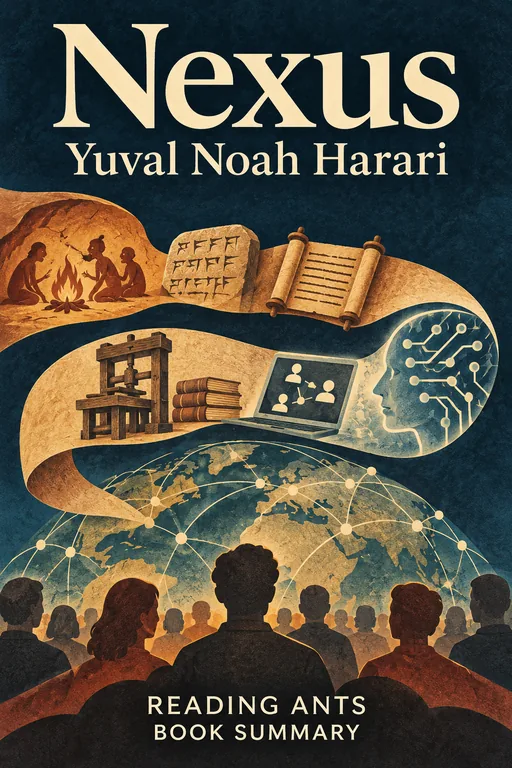
Nexus
Yuval Noah Harari traces the history of how humans have shared information, from stories and writing to printing and algorithms, and warns that artificial intelligence is a new kind of network that could reshape power and even threaten democracy.
Overview
Nexus: A Brief History of Information Networks from the Stone Age to AI was published in 2024 by Yuval Noah Harari. In his earlier books, he explained the human past and imagined the future. Here he focuses on information: how it flows between people, who controls it, and what it does. He opens with a puzzle: humans named themselves the wise species and have gathered enormous knowledge and power, yet they remain open to delusion and to destroying themselves. His central argument is that more information does not automatically lead to more truth or wisdom, and that the invention of artificial intelligence, which can make decisions and generate new ideas by itself, makes the question urgent. He tells the history through examples, from religion to the printing press to social media.
Full Summary
1. Information is about connection, not only truth
The idea: Harari opens with old warnings, the Greek myth of Phaethon and Goethe’s poem about a sorcerer’s apprentice, but argues that they blame individual pride and greed, when human power really comes from cooperation in large networks. He then challenges what he calls the naive view of information: that information represents reality, that more of it leads to truth, and that truth brings power and wisdom. He grants that this can be right, for example in the great fall in child deaths since Goethe’s day, which depended on collecting and sharing medical data. But he argues that most information does not describe reality at all. Its defining job is to connect people and things, and it can do so with errors, fantasies and fictions as well as facts. Astrology has shaped history for thousands of years, and the Bible, although it is a poor guide to matters such as human origins and the causes of epidemics, has bound billions of people into religious networks. Stories can bring millions of strangers together, because people need only believe the same story rather than know one another. Harari also rejects the opposite, populist view that information is only a weapon and that no objective truth exists, and he looks for a middle ground. A network of information is therefore powerful, but it can spread lies and fantasies as well as facts.
In real life: A rumor that spreads quickly through a school can bring a group together or tear it apart, whether or not it is true.
2. Documents, bureaucracies and holy books
The idea: Harari argues that every human network must do two things at once: discover what is true and keep order among large numbers of people. The two aims often conflict, because fiction can hold people together more easily than the truth, which is complex and sometimes painful. Stories came first, and he calls the written document the second great information technology. He says large networks, from ancient kingdoms to modern states, have depended on both mythmakers and bureaucrats, who tend to pull in opposite directions. The Bible shows this: its stories were vital to the Christian Church, but the book exists only because church officials selected, edited and spread them, and the Catholic and Protestant churches later struck different balances between myth and bureaucracy. He uses these examples to show that power comes not only from knowing facts but from the ability to keep order, which is why scientists and engineers usually answer to those who run the system.
In real life: A rulebook for a club helps everyone to follow the same rules, but someone has to decide what the rules mean.
3. Self-correcting systems
The idea: One of the main themes is the ability of an information network to correct its own mistakes. Harari compares institutions with weak self-correcting mechanisms, such as the Catholic Church, with those that have strong ones, such as scientific disciplines, which rely on tools like peer-reviewed journals. Independent courts are another example. He says that weak mechanisms can lead to disasters, such as the early modern witch hunts, while strong ones can sometimes unsettle a network from within; he even suggests the Catholic Church may have been the most successful institution in history despite, or because of, its weak mechanisms. He also contrasts democracies, where information flows through many independent channels, with totalitarian systems, which try to concentrate it in one center, and notes that each choice has advantages and drawbacks. A clear example is the United States Constitution, which openly presents itself as a human creation and so includes a way to amend it; less than a century after it was written, an amendment abolished slavery. Texts that claim a divine origin, such as the Ten Commandments, offer no such process.
In real life: A team that welcomes feedback after a bad game improves, while one that blames the referee does not.
4. Printing, witch hunts and the spread of ideas
The idea: The printing press helped to spread new ideas and science, but Harari points out that it also spread mass panic. He tells how the fear of witches grew in early modern Europe, a disaster he links to weak self-correction and which was helped by books that described witch-hunting, such as the Malleus Maleficarum, a manual that became a bestseller. He says that printing does not guarantee that truth will win, and that institutions able to test claims and correct errors, as science does, matter more than the technology itself.
In real life: A video that goes viral may be more exciting than a careful explanation, but that does not make it more accurate.
5. A new kind of power: artificial intelligence
The idea: Harari argues that AI differs from earlier technologies, because it is not simply a tool: it can make decisions and create new ideas on its own, and it can think in ways that people find alien. He points to the Go program AlphaGo, which made moves that expert players did not understand. Algorithms already shape what people read and watch, by deciding what to show, and computers already take part in decisions about mortgages, jobs and prison sentences. He contrasts older networks run by human brains, such as the Roman Empire, with a new network of silicon computers that can watch without sleeping, remember without forgetting and, in a sense, rule without dying. He says that this could lead to harmful results if the goals set for the machines are not aligned with human values (the alignment problem). His main example is social media systems that boost content that provokes anger because it keeps people engaged, including Facebook’s role in the violence against the Rohingya in Myanmar in 2016 and 2017.
In real life: If an app is designed only to keep you watching, it may show you more upsetting content because it holds your attention.
6. Dictators, democracies and the future
The idea: The final part considers how AI might affect politics. Harari asks how democracies can keep up a public conversation when people can no longer tell whether they are talking to a human or a chatbot, and how elected leaders can manage an economy that algorithms increasingly run. For dictatorships he asks both how AI could serve them, for instance as a tireless watcher, and how a human dictator could terrorize or censor an AI that might itself take power, since AI could even replace human decision-makers. He also worries about a world split by a Silicon Curtain, the title of the last chapter: a divide between rival powers racing to build AI, or even between humans and their new AI masters. But he does not say that the future is fixed. He calls for rules, such as banning bots from pretending to be human, and for strong institutions that can notice and correct errors so that people remain in charge.
In real life: Knowing whether a message was written by a person or a machine is a basic piece of information that you might want to have.
Why It Matters
Nexus arrived at a moment of intense public discussion about artificial intelligence, social media and misinformation. As a bestseller in several countries by an author with a large readership, it brought a historical view to a debate that often focuses on the latest tools. The book makes the case that how we organize information has always shaped who holds power, and that we are in a crucial period for deciding how AI will be governed. It was widely reviewed and discussed in the press. Whether one agrees with the author’s warnings, it offers a framework, about connection, self-correction and power, which is useful for thinking about the digital age.
Key Takeaways
- Information connects people. Stories and records create shared worlds.
- More data does not mean more truth. Lies and fantasies can spread as well.
- Self-correction is vital. Institutions that can find and fix their own errors are better protected against disasters.
- AI is an agent, not just a tool. It can decide and create independently.
- Choices remain. Laws and institutions can shape how AI is used.
What We Can Learn
Think about the information networks you belong to, such as your friends, school and online feeds, and ask who decides what you see. Get into the habit of checking sources, and of being open to correction. Support institutions that allow questions and challenge, such as a free press, independent courts and open science. Learn how recommendation systems work, and take breaks from them. And when you read about AI, ask who is accountable if something goes wrong. These habits help to keep human judgment at the center.
Criticism and Counterpoints
Some reviewers say that the book is too sweeping: The Guardian noted that it has many fascinating discussions that are too brief, and that it has blind spots, such as saying little about capitalism and the profit motive behind the companies building AI. Experts in the field have criticized Harari’s claim that it is naive to think more information leads to more truth or power. Some reviewers also feel that the book is better as a diagnosis and a call to action than as a detailed plan, and that its proposals for how to regulate AI are thin. Supporters respond that the book’s aim is to start a conversation, and that its warnings deserve attention.
Who Should Read It
This book is for readers who want to think about technology, politics and history, and who enjoy big-picture arguments. It is clearly written and gives many stories. Those who want technical details about AI, or specific policy designs, should look at specialist sources.
Want the whole book?
A summary is a taste, not the meal. Here is where to find the full book.
You reached the end 🎉
Nicely done. Mark this one as read, and we will suggest what to read next.
Read this next
21 Lessons for the 21st Century
Yuval Noah Harari
Historian Yuval Noah Harari examines the biggest challenges facing humanity today, from artificial intelligence and fake news to nationalism, religion and meaning, and asks how we can think clearly and stay sane in a fast-changing world.
🏛️ History
Sapiens: A Brief History of Humankind
Yuval Noah Harari
Humans came to rule the planet not because we are the strongest animals but because we can believe in shared stories (gods, nations, money, companies) that let millions of strangers cooperate.
🏛️ History
Homo Deus
Yuval Noah Harari
Having largely tamed famine, plague and war, humanity may now aim for immortality, happiness and god-like powers, and new technologies and data-driven beliefs could change what it means to be human.
🏛️ History
The Origins of Totalitarianism
Hannah Arendt
Hannah Arendt examines how antisemitism, imperialism and the breakdown of society in Europe prepared the ground for the totalitarian regimes of Nazi Germany and Stalin's Soviet Union, and what made these regimes new and uniquely terrible.
🏛️ History
On Tyranny
Timothy Snyder
Historian Timothy Snyder draws twenty practical lessons from the history of fascism, communism and other dictatorships of the twentieth century, to help ordinary citizens defend freedom in democratic societies today.
🏛️ History
Guns, Germs, and Steel
Jared Diamond
Some societies came to conquer others not because their people were smarter or better, but because geography gave them a head start in farming, animals, germs and technology.
🏛️ HistoryWant something different?
Pick another topic and we will show you three books to start with.