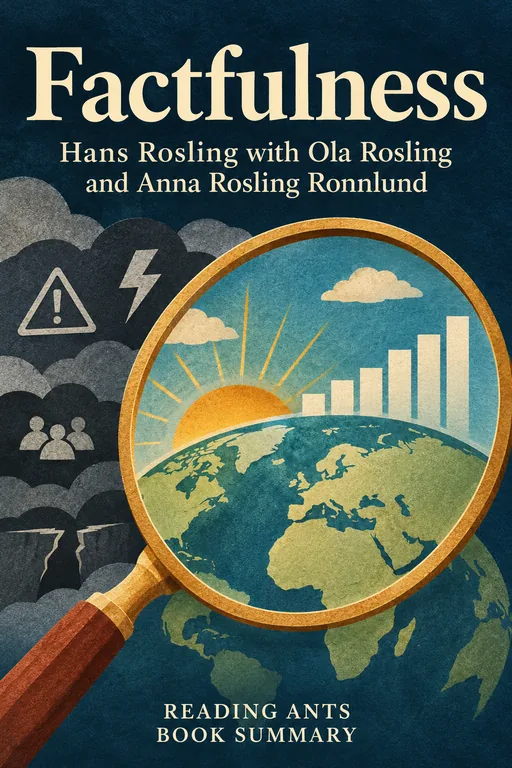
Factfulness
Hans Rosling shows that the world is better than most people think, and that ten built-in instincts, such as fear, blame and the habit of seeing gaps, distort how we see it and can be tamed with a fact-based mindset.
Overview
Factfulness: Ten Reasons We’re Wrong About the World, and Why Things Are Better Than You Think was written by Hans Rosling, a Swedish physician and professor of international health, together with his son Ola and daughter-in-law Anna. Rosling spent his life studying health and development, especially in Africa, and became famous for lively presentations with moving charts. He died of cancer in 2017, and the book was published after his death, in 2018. The book begins with a quiz of basic questions about the world, which most people, even experts, answer worse than a chimpanzee choosing at random. Rosling argues this is because of instincts that mislead us, and he offers ten of them with advice for each.
Full Summary
1. The gap instinct
The idea: The first instinct is to divide the world into two groups, rich and poor, “developed” and “developing,” with a huge gap between them. Rosling shows that most people in the world live in the middle, and the old gap has largely closed. He suggests dividing the world into four income levels, from people who cook over open fires and walk for water to people with cars and abundant choices, and notes that most of humanity lives on levels two and three. Thinking in two groups hides this.
In real life: A photo of a family living on Level 2, with a bicycle and a stove, tells more than “poor country” does.
2. The negativity instinct and the straight line instinct
The idea: The negativity instinct is our tendency to notice the bad more than the good. News reports focus on disasters, so we feel the world is getting worse, even as extreme poverty, child deaths and illiteracy have fallen dramatically over the last decades. Rosling stresses that things can be both bad and better. The straight line instinct is the assumption that trends continue in a straight line, such as population always rising, when many curves flatten or bend.
In real life: A country can still have serious problems and be much better off than it was thirty years ago.
3. The fear and size instincts
The idea: The fear instinct makes us pay attention to frightening things, such as plane crashes or terrorism, even when they are rare, while ignoring more common dangers. The size instinct leads us to misjudge numbers: a large number seems alarming, though it may be small when compared to a total. Rosling recommends comparing numbers and dividing by the population to see the real scale, and looking at rates, not only totals.
In real life: One thousand deaths sounds huge, but in a country of millions it may be a small proportion, and what matters is the trend.
4. The generalization and destiny instincts
The idea: The generalization instinct puts people and countries into simple categories, such as “Africa” or “Muslims,” and ignores differences within them. The destiny instinct is the belief that traits like culture or religion are fixed forever and determine a group’s future. Rosling counters with data showing that cultures and countries change, and that those who seemed stuck, such as South Korea or Bangladesh, have changed dramatically.
In real life: Treating all people in a large region as the same hides the variety and change within it.
5. The single perspective and blame instincts
The idea: The single perspective instinct is the tendency to favor one idea or expert, as if one tool could solve everything. Rosling says that we should use a mix of ideas and be wary of simple solutions. The blame instinct is the urge to find a villain for every problem, which can prevent us from seeing the systems that cause trouble. He recommends looking for causes, not culprits.
In real life: After an accident, asking what went wrong in the system often leads to better prevention than only blaming one person.
6. The urgency instinct and being factful
The idea: The urgency instinct is the sense that we must act immediately, which can lead to rash decisions. Rosling urges us to take a breath, get more data and ask for evidence before acting. He ends by encouraging readers to adopt “factfulness”: to keep an open, curious, humble attitude, to update their views when data change and to avoid drama. He describes how, in his own career, he learned to correct mistakes, drawing on his experiences as a doctor in Mozambique.
In real life: Taking time to check where a statistic comes from before sharing it helps keep misinformation from spreading.
Why It Matters
Factfulness became a global bestseller, endorsed by Bill Gates, who gave free copies to graduates, and by many teachers and leaders. It brought the use of data to improve our view of the world to millions of readers. It is credited with helping many people to be less cynical and more informed about global progress.
Rosling’s famous talks and the Gapminder Foundation, which he co-founded, continue to provide free tools for teaching about global trends.
The book also gives practical habits, such as checking numbers against a total and looking for trends, which students and journalists have adopted as simple rules of thumb for reading statistics.
Key Takeaways
- The world is improving. Many measures of well-being have risen steadily.
- Instincts can mislead. Fear, blame and gaps distort our views.
- Think in levels. Most people live in the middle, not at extremes.
- Check the scale. Compare numbers to the total.
- Stay curious and humble. Update your views when data change.
What We Can Learn
The book teaches that being informed means knowing the trends, not only the headlines. When we hear alarming news, we can ask whether the problem is getting better or worse, and how big it is compared with the whole.
It also encourages gentleness toward our own mistakes. The authors note that even experts get the quiz wrong, so being wrong is normal, and being willing to learn is what counts.
Finally, it reminds us that progress did not happen by itself. It came from people working on health, education, rights and technology, and so we can feel motivated to keep helping.
Criticism and Counterpoints
Some critics say the book is too optimistic, and that focusing on averages and long trends can downplay serious problems, such as climate change, inequality, conflict and the suffering of those still in extreme poverty. Others note that the book’s comparisons depend on how poverty and progress are defined, and that statistics can hide experience.
A few scientists have said that the claim that most people are worse than chimps at the quiz depends on how the questions were asked. Some also feel that the style is simplistic. Still, many appreciate it as a useful and cheerful corrective to constant bad news.
Who Should Read It
This book suits readers from about age ten up to adults. It is friendly and easy to follow, and the quiz is fun to try with family and friends. It is a good introduction to reading statistics critically.
Want the whole book?
A summary is a taste, not the meal. Here is where to find the full book.
You reached the end 🎉
Nicely done. Mark this one as read, and we will suggest what to read next.
Read this next
Enlightenment Now
Steven Pinker
Steven Pinker argues that the ideals of the Enlightenment, reason, science, humanism and progress, have made the world healthier, richer, safer and freer, and that they are worth defending against pessimism and attacks from many directions.
🔬 Science
The Black Swan
Nassim Nicholas Taleb
Rare, unpredictable events with huge impact, which Nassim Taleb calls Black Swans, shape history far more than we admit, and we should build lives and systems that can survive or even benefit from them instead of pretending to predict them.
🧩 Mind & Psychology
Thinking, Fast and Slow
Daniel Kahneman
Our minds run on two systems, a fast, intuitive one and a slow, careful one, and understanding how the fast system fools us can help us make better decisions about money, risk, work and happiness.
🧩 Mind & Psychology
Outliers
Malcolm Gladwell
Malcolm Gladwell argues that extraordinary success comes not only from talent and effort but from hidden advantages of timing, place, culture and opportunity, so we should look at the whole story behind every "self-made" success.
🧩 Mind & Psychology
A Short History of Nearly Everything
Bill Bryson
Bill Bryson sets out to understand how we know what we know about the universe, the Earth and life, and tells the story through the odd, brilliant and sometimes unlucky people who figured it out.
🏛️ History
A Brief History of Time
Stephen Hawking
One of the world's greatest physicists explains, with almost no math, what we know about the origin, structure and fate of the universe, from the Big Bang to black holes and the nature of time itself.
🔬 ScienceWant something different?
Pick another topic and we will show you three books to start with.