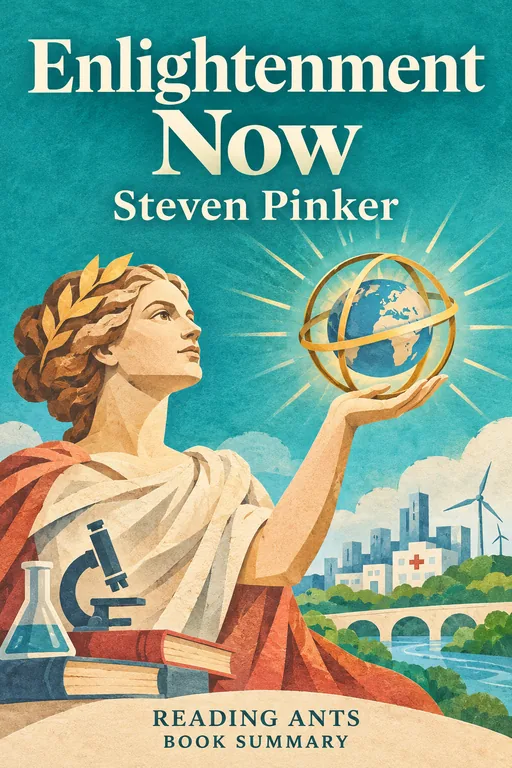
Steven Pinker argues that the ideals of the Enlightenment, reason, science, humanism and progress, have made the world healthier, richer, safer and freer, and that they are worth defending against pessimism and attacks from many directions.
Overview
Enlightenment Now: The Case for Reason, Science, Humanism, and Progress was published in 2018 by Steven Pinker, a professor of psychology at Harvard. It is a follow-up to his earlier book on the decline of violence, and extends his argument to many areas of human life. Pinker draws on a large body of statistics, presented in charts, to show that people’s lives have improved in many ways over the past two centuries. He then explains why he thinks this progress is due to Enlightenment ideas, and why those ideas are under threat. The book was a bestseller and widely debated.
Full Summary
1. The Enlightenment ideals
The idea: Pinker begins with the movement of the eighteenth century, in which thinkers such as Kant, Hume and Adam Smith urged people to use reason, to seek knowledge by science and to value the flourishing of all humans. He summarizes it as four themes: reason, science, humanism and progress. The idea is that we can understand the world, that we can improve human life, and that suffering matters. He says that these ideas are often taken for granted, but should be actively defended. The book has three parts, on the ideals, on the evidence for progress, and on the defense of reason, science and humanism. The first part adds a scientific framework built on three ideas, entropy, evolution and information, and surveys the counter-Enlightenment movements that oppose the ideals, such as Romantic and religious ones and the long tradition of declinism.
In real life: Instead of accepting that a problem has always been so, you ask how to fix it, which is an Enlightenment habit.
2. Health, wealth and lifespan
The idea: In a series of chapters, Pinker presents data on improvements. Global life expectancy has risen from about 29 in the mid-eighteenth century to over 71 in 2015, largely as child mortality fell, and smallpox has been eradicated. The share of the world’s population living in extreme poverty has fallen, over two centuries, from about 90 percent to about 10 percent. Famine and undernourishment have declined, and people have more access to food. He argues that these gains come from science, markets, trade and good government, and quotes an economist who ranks the improvement in health among the greatest achievements in human history. On inequality he argues that it is not the same as poverty, that rising inequality within some rich countries does not erase the gains, and that inequality across the world has been falling.
In real life: A child born today is far more likely to survive to adulthood than in the past: the book reports that global child mortality (deaths before age five) has fallen from about 18 percent to about 4 percent in recent decades.
3. Peace, safety, freedom and knowledge
The idea: Pinker also reviews trends in violence, including the decline of war between countries and of homicide, and the rise in safety from accidents, which he sets beside a separate chapter on terrorism. He traces the spread of democracy in waves. People live under more democratic governments than before, and, on average, are better educated, with higher rates of literacy and schooling. Equal rights have also advanced, for racial minorities, women and gay people. Later chapters ask whether life has improved beyond the usual economic measures, with more leisure and less time lost to housework, and he argues that people in richer countries are on the whole happier, contrary to the Easterlin paradox. He says that the progress is uneven, with setbacks, but that the long-run direction is positive.
In real life: The world taught only two-thirds as many girls to read as boys in 1975, and taught them in equal numbers by 2014.
4. Why people believe things are getting worse
The idea: The author tries to explain the gap between the data and public perceptions. He points to the news, which reports events and not the absence of events, and to the availability heuristic, which makes vivid events seem more common. He also notes negativity bias, the idea that bad is stronger than good in our minds. And good things build up slowly, out of step with the news cycle, so that gradual progress rarely makes headlines. He argues that pessimism is also fashionable among intellectuals, who can gain an air of seriousness from it.
In real life: A plane crash always makes the news, but car crashes, which kill far more people, almost never do.
5. Existential threats and the environment
The idea: On the environment, Pinker argues for a humanistic, pragmatic environmentalism, sometimes called ecomodernism, in which problems are solved by knowledge and technology and not by rejecting progress. He supports technologies such as nuclear power as part of the answer to climate change, and says that he is optimistic about meeting the challenge, but conditionally and not complacently. In the chapter on existential threats he says that climate change and nuclear war are real dangers that need great effort, but he argues that doomsday thinking has downsides, since sowing fear about hypothetical disasters can itself endanger us. He is skeptical of scenarios in which artificial intelligence enslaves humanity, arguing that intelligence is not the same as a wish to dominate. He says that environmental progress has been achieved through treaties and innovation, as in the case of acid rain and the ozone layer.
In real life: A 1987 treaty banning chlorofluorocarbons, ratified by 197 countries, set the ozone layer on course to heal.
6. Defending reason, science and humanism
The idea: In the last part, Pinker takes on opposition to Enlightenment values. The final three chapters defend reason, science and humanism against enemies that include angry populists and religious fundamentalists but also factions of intellectual culture. He argues that reason cannot be coherently denied, as in the postmodern view that it is only a tool of power, and that political ideology and tribal thinking undermine it. He defends science against politicization from the left and the right and against the charge of scientism, and he presents humanism, the aim of human flourishing, as a basis for morality that does not need religion. He ends by retelling the story of progress and urging readers to keep applying knowledge and sympathy to human problems.
In real life: Checking facts before sharing a story is an act of reason.
Why It Matters
Enlightenment Now was one of the most discussed books of its year, and became a leading statement of the case for progress, alongside Hans Rosling’s Factfulness. It encouraged many readers to look at data on global trends, and to question gloomy assumptions. Bill Gates praised it publicly as his new favorite book. It also provoked intense criticism, which made it a central text in debates about progress, politics and the role of science. Pinker’s use of charts has been widely discussed. The book remains influential for those who want an optimistic, evidence-based view of the world.
Key Takeaways
- Life has improved. Health, wealth and safety have increased on average.
- Reason and science drive progress. They solve problems.
- News gives a skewed view. Bad news travels, good trends are quiet.
- Problems are soluble. Climate and other threats can be addressed.
- Defend Enlightenment values. They require active support.
What We Can Learn
You can use the book to check your assumptions against data, for example by looking at long-term trends in health and poverty. Be cautious about headlines that stress only bad news, but do not conclude that nothing is wrong. Support science and education, and take part in solving problems. Remember that improvements often came from people who worked on them, not by accident. And be willing to listen to critics, since Pinker’s thesis is debated, and the facts of progress sit alongside real injustice and suffering.
Criticism and Counterpoints
Critics say that Pinker presents selective data, and that averages hide large inequalities and suffering, and that he is too quick to dismiss ethical concerns, as in his handling of the Tuskegee syphilis study, which he calls unethical by today’s standards but says is often misreported. Historians argue that he oversimplifies the Enlightenment, treating a varied movement as a single block. The philosopher John Gray says that he promotes scientism, and other critics call his account of the humanities shallow. Others say that his claim that progress is due to Enlightenment values is hard to prove. Supporters say that the data on health and poverty are strong.
Who Should Read It
This book is for readers who like data, history and big ideas, and who are open to an optimistic view. It is long, but well organized. Those who want a critical perspective should read the responses to Pinker’s work.
Want the whole book?
A summary is a taste, not the meal. Here is where to find the full book.
You reached the end 🎉
Nicely done. Mark this one as read, and we will suggest what to read next.
Read this next
The Better Angels of Our Nature
Steven Pinker
Steven Pinker argues, with a mass of data, that violence has declined over the long course of history, and that this is one of the most important and least appreciated developments, explained by changes in institutions, culture and our better impulses.
🔬 Science
Factfulness
Hans Rosling with Ola Rosling and Anna Rosling Ronnlund
Hans Rosling shows that the world is better than most people think, and that ten built-in instincts, such as fear, blame and the habit of seeing gaps, distort how we see it and can be tamed with a fact-based mindset.
🔬 Science
Humankind: A Hopeful History
Rutger Bregman
Rutger Bregman argues that people are, deep down, more decent than cynics believe, and that many famous stories used to prove human selfishness and cruelty are false or misleading.
🏛️ History
Not the End of the World
Hannah Ritchie
Data scientist Hannah Ritchie argues that, although environmental problems are serious, they can be solved, and that being realistic and hopeful, rather than doomy or dismissive, is the way to be the first generation to build a sustainable world.
🔬 Science
The End of History and the Last Man
Francis Fukuyama
Francis Fukuyama argues that the end of the Cold War suggests that liberal democracy may be the final stage of political development, and asks whether people who live in such a system will be satisfied or will long for new struggles.
🏛️ History
A Brief History of Time
Stephen Hawking
One of the world's greatest physicists explains, with almost no math, what we know about the origin, structure and fate of the universe, from the Big Bang to black holes and the nature of time itself.
🔬 ScienceWant something different?
Pick another topic and we will show you three books to start with.