 Reading Ants
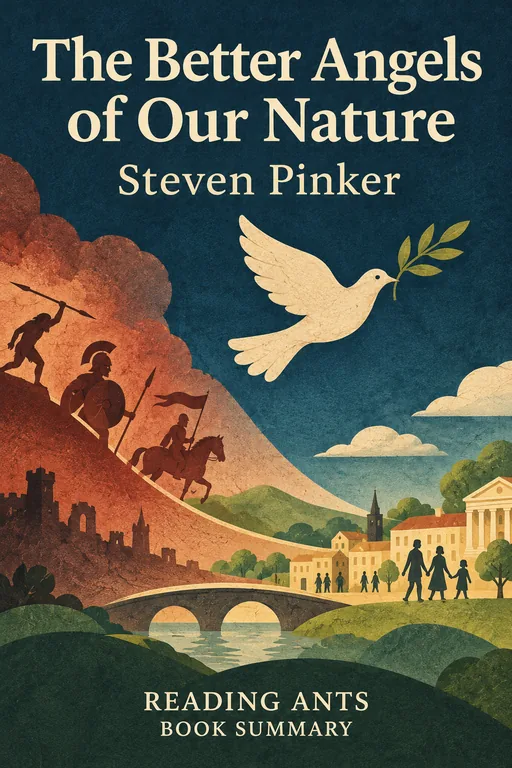
The Better Angels of Our Nature
Steven Pinker argues, with a mass of data, that violence has declined over the long course of history, and that this is one of the most important and least appreciated developments, explained by changes in institutions, culture and our better impulses.
Overview
The Better Angels of Our Nature: Why Violence Has Declined was published in 2011 by Steven Pinker, a Harvard psychologist. The title comes from a line in Abraham Lincoln’s first inaugural address. At about eight hundred pages, the book collects evidence from archaeology, history and statistics, on topics from prehistoric warfare to modern crime. Pinker says that, though the news feels violent, the chance that an individual will die violently is much lower than in the past. He then looks at the causes, in the “inner demons” and “better angels” of human nature.
Full Summary
1. A violent prehistory
The idea: Pinker begins with the evidence about the earliest human societies, which suggest that a large share of people in hunter-gatherer groups and early farming societies died in warfare and feuds, far more than in the twentieth century, when measured as a proportion of the population. He cites skeletons with signs of violence and studies of small-scale societies. This undermines the notion of the peaceful noble savage. He says that the state of nature was often brutal.
In real life: Before there were police and courts, disputes were often settled by revenge.
2. The Pacification Process
The idea: The first big decline, he says, came with the rise of states and governments that held a monopoly on violence, and about five thousand years ago, tribes began to be governed by authorities. Pinker argues that governments that monopolize force ended much of the raiding and blood feuding of tribal life, since people no longer had to avenge wrongs themselves.
In real life: When you can go to a judge, you do not need to settle things with a fight.
3. The Civilizing Process and the Humanitarian Revolution
The idea: The second decline, the Civilizing Process, began in the late Middle Ages. Pinker describes a steep fall in European homicide rates, which he links to the sociologist Norbert Elias’s idea that, as states, courts and commerce grew, people learned self-control, good manners and empathy. The third, in the Enlightenment, saw the abolition of practices such as judicial torture, sadistic punishment, slavery, dueling and superstition-based killing like witch hunts, thanks to the spread of literacy, reason and a sense of universal humanity.
In real life: Public executions, once a form of entertainment, now seem horrifying to most.
4. The Long Peace and the New Peace
The idea: In the twentieth century, despite the two world wars, Pinker argues that major wars between great powers have become rare since 1945, a period he calls the Long Peace, and that since the end of the Cold War, the number of wars and the number of deaths in war have declined, the New Peace. He attributes this partly to nuclear deterrence, trade, democracy and international organizations. He admits that the data on war are noisy, and that a large war could change the picture.
In real life: Countries that trade heavily with each other have more to lose from war.
5. The Rights Revolutions
The idea: Pinker describes the movements for civil rights, women’s rights, gay rights, children’s rights and animal welfare, since the mid-twentieth century. He says that attitudes have changed, and that violence against minorities, women and children, though still a problem, has fallen in many countries. He relates this to expanding circles of empathy, and to a growing sense that violence is a problem to be solved, not part of life.
In real life: Corporal punishment in schools, once common, is now banned in many countries.
6. Inner demons and better angels
The idea: In the second half, Pinker turns to psychology. He describes five “inner demons” that lead to violence: predation, dominance, revenge, sadism and ideology. And he describes four “better angels” that restrain us: empathy, self-control, the moral sense and reason. He argues that history has given more power to the angels, through the spread of literacy and communication, the rise of commerce, the empowerment of women and the growth of institutions, which together have changed incentives and attitudes.
In real life: Reading stories can help us to imagine other people’s feelings and thus to be kinder.
Why It Matters
The Better Angels of Our Nature was a bestseller and a landmark in the debate about progress. It challenged the common belief that the world is getting more dangerous, and brought attention to long-term trends in data, influencing writers and policymakers. It was praised by many as a major work of synthesis, and criticized by others, especially about the interpretation of the statistics and the explanation of causes. Pinker followed it with Enlightenment Now, which broadens the case for progress. The book has had a lasting effect on discussions of violence, history and human nature.
Key Takeaways
- Violence has declined. Over the long run, rates of killing have fallen.
- Governments and law matter. The state’s monopoly on force reduced private violence.
- Culture and empathy changed. Manners, reading and ideas made us less cruel.
- Peace is not guaranteed. The trend could reverse.
- Our nature has demons and angels. Institutions strengthen the angels.
What We Can Learn
You can use the book to put alarming news in a longer perspective, and to look for data. Be thankful for the institutions, such as courts and police, and norms of law that keep people safe. Cultivate empathy through reading and meeting people. Do not assume that progress is automatic: it depends on people who defend rights and peace. And be careful with statistics, asking how they were collected. At the same time, remember that a decline in average rates does not mean that suffering is gone.
Criticism and Counterpoints
Many scholars have criticized the book. Statisticians such as Nassim Taleb argue that the data on rare, extreme events like world wars cannot support the claim of a trend, since the “Long Peace” may be a lull. Historians and anthropologists dispute the estimates of violence in prehistory and in non-state societies, and the claim that states reduced violence, noting the harm done by states and by colonialism. Others argue that the book relies on battle-death statistics that understate civilian deaths, or that it defines violence too narrowly to include structural harms such as poverty and inequality. Pinker responds to these points in later writing.
Who Should Read It
This book is for readers who like big-picture history and data, and who are open to challenging claims. It is long and includes disturbing descriptions of violence. Those who prefer a shorter introduction to the ideas can read Enlightenment Now.
Want the whole book?
A summary is a taste, not the meal. Here is where to find the full book.
You reached the end 🎉
Nicely done. Mark this one as read, and we will suggest what to read next.
Read this next
Enlightenment Now
Steven Pinker
Steven Pinker argues that the ideals of the Enlightenment, reason, science, humanism and progress, have made the world healthier, richer, safer and freer, and that they are worth defending against pessimism and attacks from many directions.
🔬 Science
Humankind: A Hopeful History
Rutger Bregman
Rutger Bregman argues that people are, deep down, more decent than cynics believe, and that many famous stories used to prove human selfishness and cruelty are false or misleading.
🏛️ History
Behave
Robert M. Sapolsky
Neuroscientist Robert Sapolsky asks why humans do the best and worst things they do, and answers by working backward in time, from the second before an act to the seconds, hours, years and millennia that shaped it.
🧩 Mind & Psychology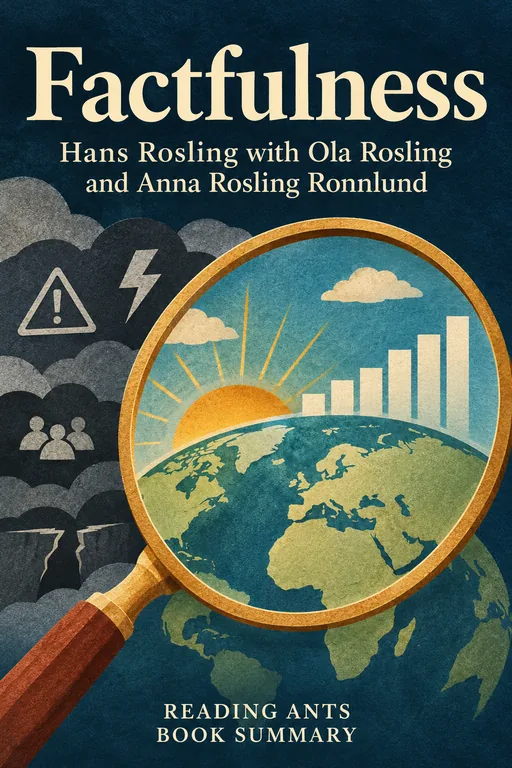
Factfulness
Hans Rosling with Ola Rosling and Anna Rosling Ronnlund
Hans Rosling shows that the world is better than most people think, and that ten built-in instincts, such as fear, blame and the habit of seeing gaps, distort how we see it and can be tamed with a fact-based mindset.
🔬 Science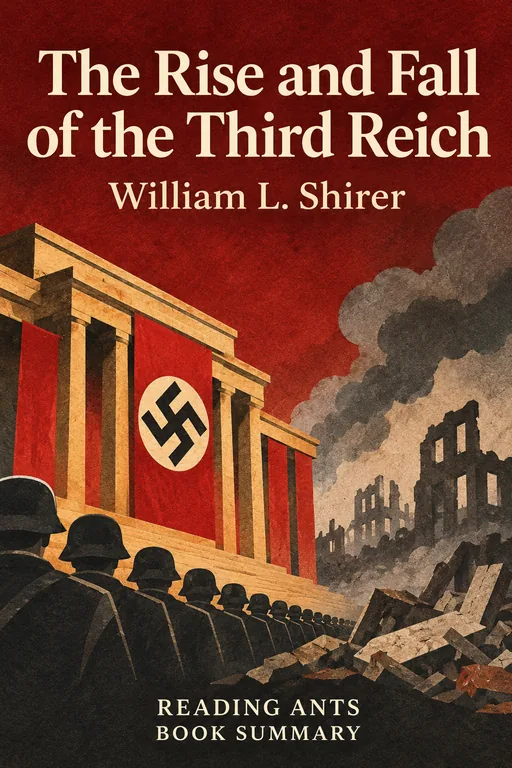
The Rise and Fall of the Third Reich
William L. Shirer
Journalist William Shirer tells the story of how Adolf Hitler came to power in Germany, built a dictatorship, started the Second World War and carried out genocide, until the regime's defeat in 1945.
🏛️ History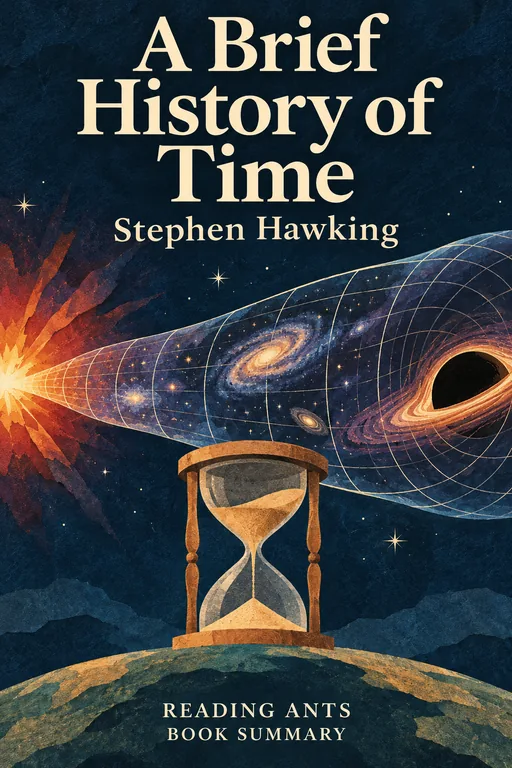
A Brief History of Time
Stephen Hawking
One of the world's greatest physicists explains, with almost no math, what we know about the origin, structure and fate of the universe, from the Big Bang to black holes and the nature of time itself.
🔬 ScienceWant something different?
Pick another topic and we will show you three books to start with.