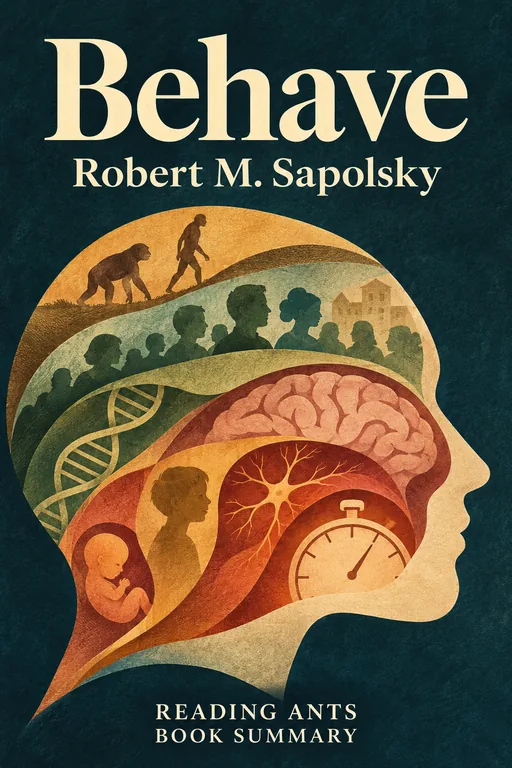
Behave
Neuroscientist Robert Sapolsky asks why humans do the best and worst things they do, and answers by working backward in time, from the second before an act to the seconds, hours, years and millennia that shaped it.
Overview
Behave: The Biology of Humans at Our Best and Worst was published in 2017 by Robert Sapolsky, a professor at Stanford University who has spent decades studying stress and primates. The book is long, funny and wide-ranging. Its main subjects are aggression, competition and violence, and also cooperation, empathy and kindness. Its structure is a series of chapters, each stepping further back in time from a single act: what happened in the brain a second before a behavior, then the previous seconds to minutes, hours to days, and days to months, followed by adolescence, childhood and the womb, the person’s genes, the culture they live in, and the evolution of the species. His argument is that no single factor explains behavior, and that all of these factors are intertwined.
Full Summary
1. The brain a second before
The idea: Sapolsky begins with the brain regions involved in the moment of an act. The amygdala is involved in fear and aggression, and the frontal cortex, including its prefrontal part, helps us to do the harder, right thing and control impulses. The limbic system relates to emotions, and the dopamine system to reward and, even more, to its anticipation. He shows that these regions interact, and that the amygdala, for example, is also about anxiety, uncertainty and vigilance, not only fear and aggression. Context matters.
In real life: When you stop yourself from snapping at someone, your prefrontal cortex is helping.
2. Seconds to minutes and hours to days before
The idea: The next scale looks at what has just happened: sights, smells and sounds that can unconsciously influence us, and our bodily state at the time. Over hours and days, hormones such as testosterone, oxytocin and stress hormones affect behavior, but not in simple ways. Testosterone, for example, does not simply cause aggression, and oxytocin is not simply a hormone of kindness. Their effects depend on the context and on who is involved.
In real life: A hungry person, or one whose self-control has been used up by hard mental work, may be less generous and more aggressive than usual.
3. Childhood, adolescence and the brain’s long development
The idea: The author describes how early life, including life in the womb, shapes the brain. Stress and neglect in childhood can alter the stress response for life, and the quality of parenting matters. The frontal cortex, including the prefrontal part, is the last part of the brain to mature, not fully online until the mid-twenties, which helps to explain the risk-taking of adolescents. Sapolsky stresses that the brain is plastic, and that experience leaves lasting marks, for better and worse.
In real life: A teenager’s impulsiveness is partly biological, since the brain’s braking system is still developing.
4. Genes, culture and evolution
The idea: The book discusses how genes interact with environment. The effect of a gene can depend on a person’s experiences, so a gene variant may matter only in certain environments. Culture shapes behavior in many ways, such as in cultures of honor, where an insult or a threat to one’s family or reputation is expected to be answered, often with violence. Over longer spans, evolution shaped our tendencies, such as caring for kin and cooperating with others, but Sapolsky cautions against simple stories about what is “natural,” noting that humans fit no tidy template: we are neither chimpanzees nor bonobos, and neither a classic pair-bonding species nor a classic competitive one.
In real life: Growing up in a place where insults must be answered may shape a person’s reactions.
5. Us versus them
The idea: A major part of the book is about how humans divide the world into us and them. The brain responds quickly to group differences, and in some cases shows less empathy for those outside our group. These categories are flexible: in experiments, people can be divided into arbitrary groups, and feel loyalty to them. He describes how dehumanization makes violence easier, and how contact under the right conditions, shared goals and seeing people as individuals can reduce prejudice.
In real life: Cheering for a team makes you feel connected to strangers wearing the same colors.
6. Morality, punishment and free will
The idea: In the final chapters, Sapolsky considers how people decide what is right, noting that both reasoning and intuition or emotion play large roles, and asks about punishment and justice. He argues that, since behavior is the result of a long chain of causes beyond a person’s control, free will is squeezed into ever smaller spaces as science advances, and that this should lead us to rethink blame and punishment. He does not say that dangerous people should go free, because society must still be protected and offenders rehabilitated if possible, but he argues that punishment as something people deserve, or as a virtue in itself, should be abandoned. He also urges humility in how the justice system acts on what we do not yet know.
In real life: Knowing that someone had a very hard childhood may change how we see their mistakes.
Why It Matters
Behave received wide praise from scientists and general readers for its range and humor. It brought together findings from neuroscience, endocrinology, psychology, genetics and anthropology in a single narrative, and showed that behavior cannot be explained by one factor, such as genes or upbringing. Its message that we should look at the full context, and its challenge to ideas of simple blame, feed into debates about punishment, responsibility and free will. The book was a New York Times bestseller and won the Los Angeles Times Book Prize. Sapolsky later wrote Determined, which develops his argument against free will. The book remains a major popular work in the science of behavior.
Key Takeaways
- Behavior has many causes. Brain, hormones, childhood, genes and culture all contribute.
- Context matters. The same biology can lead to different acts.
- The brain changes with experience. Early life leaves lasting marks.
- Us-versus-them thinking is flexible. Groups can be redrawn.
- Compassion is warranted. Understanding causes may reduce blame.
What We Can Learn
You can use the book to look at your own reactions with curiosity, and to notice how tiredness, hunger and stress affect your mood. When someone acts badly, you may ask what might have led them there, without excusing the harm. Try to see people as individuals, and look for common goals, to counter divisions. Take care of the basics, such as sleep and food, that support self-control. Remember that the teenage brain is still developing, and be patient with young people. And be cautious about simple explanations of complex behavior.
Criticism and Counterpoints
Readers may find the book overwhelming in detail, with many studies and digressions, and its length of about 800 pages, with notes and appendices, can make it hard to follow. Some of the research it draws on, especially in social psychology and brain imaging, has been challenged in the debates about replication. Philosophers who hold compatibilist views, in which responsibility and determinism can coexist, disagree with his rejection of free will. Others may find that because the book keeps stressing that its findings are averages with many exceptions, it gives few firm rules about any one person. Reviewers have also called it an exemplary, accessible work of popular science.
Who Should Read It
This book is for curious adults and older teenagers who like science, and are ready for a long and sometimes technical read. It contains discussions of violence and atrocities as subjects of study. Those who want a shorter introduction to the brain might begin with a lighter book.
Want the whole book?
A summary is a taste, not the meal. Here is where to find the full book.
You reached the end 🎉
Nicely done. Mark this one as read, and we will suggest what to read next.
Read this next
The Righteous Mind
Jonathan Haidt
Jonathan Haidt argues that moral judgments come mainly from intuition and emotion, not reason, that people's moral instincts rest on several foundations that differ across political groups, and that understanding this can help us to disagree without hating each other.
🧩 Mind & Psychology
Thinking, Fast and Slow
Daniel Kahneman
Our minds run on two systems, a fast, intuitive one and a slow, careful one, and understanding how the fast system fools us can help us make better decisions about money, risk, work and happiness.
🧩 Mind & Psychology
The Better Angels of Our Nature
Steven Pinker
Steven Pinker argues, with a mass of data, that violence has declined over the long course of history, and that this is one of the most important and least appreciated developments, explained by changes in institutions, culture and our better impulses.
🔬 Science
Humankind: A Hopeful History
Rutger Bregman
Rutger Bregman argues that people are, deep down, more decent than cynics believe, and that many famous stories used to prove human selfishness and cruelty are false or misleading.
🏛️ History
The Brain That Changes Itself
Norman Doidge
Psychiatrist Norman Doidge tells stories of patients and scientists who show that the adult brain is not fixed but can reorganize itself, a property called neuroplasticity, and what this means for healing and learning.
🧩 Mind & Psychology
Predictably Irrational
Dan Ariely
Behavioral economist Dan Ariely uses entertaining experiments to show that people's decisions are shaped by predictable mental quirks, such as relativity, the lure of "free" and social norms, rather than by cool, rational calculation.
🧩 Mind & PsychologyWant something different?
Pick another topic and we will show you three books to start with.