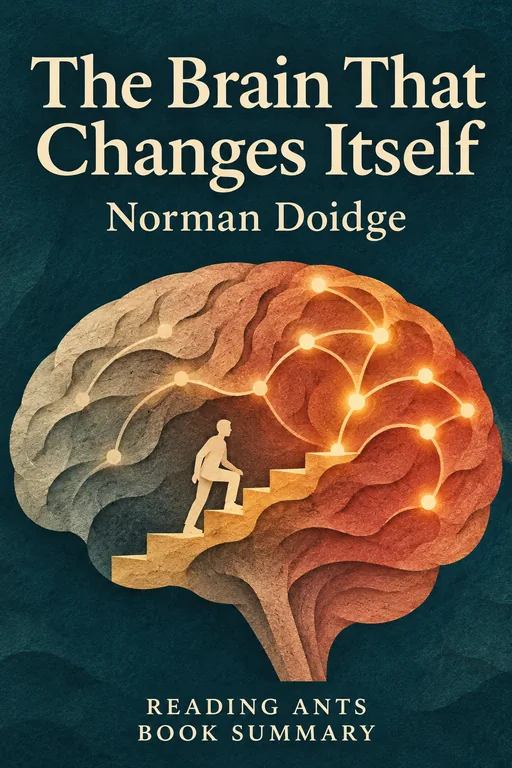
The Brain That Changes Itself
Psychiatrist Norman Doidge tells stories of patients and scientists who show that the adult brain is not fixed but can reorganize itself, a property called neuroplasticity, and what this means for healing and learning.
Overview
The Brain That Changes Itself: Stories of Personal Triumph from the Frontiers of Brain Science was published in 2007 by Norman Doidge, a psychiatrist and psychoanalyst who is also a researcher and writer. For centuries, mainstream science treated the adult brain as a machine with fixed parts, one that could not repair or reorganize itself. Doidge describes researchers who challenged this view, and patients who recovered in remarkable ways. The book is built on case studies, each showing a different aspect of plasticity. It was widely read and discussed.
Full Summary
1. A woman who fell all her life
The idea: Doidge begins with Cheryl Schiltz, who lost nearly all of her balance system after an antibiotic given for an infection following surgery damaged her inner ear. She felt as if she were falling all the time, and she often did fall. Researcher Paul Bach-y-Rita fitted her with a hat containing a motion sensor, linked to a thin strip of electrodes on her tongue that signaled the position of her head. Wearing it, the sense of falling left her. The surprise came when she took it off: the calm lasted for a while, first seconds, then minutes, then hours, then days, and in the end she no longer needed the device at all. Bach-y-Rita’s explanation was that the brain can “unmask” old, unused pathways and strengthen them. The chapter also covers his earlier device that let people blind from birth perceive images through touch, and his father’s recovery from a severe stroke, which set him on his path. The lesson is that the brain can substitute one sense for another, and that the senses are not as rigidly wired as scientists once thought.
In real life: A person who loses sight may come to rely on touch and hearing more, as the brain reallocates its resources.
2. Building herself a better brain
The idea: Barbara Arrowsmith Young grew up with a mix of brilliant abilities and severe learning disabilities, including trouble with spatial reasoning, clocks, grammar and logic. Reading about a Russian soldier whose head wound left him with similar problems, and about studies of rats raised in stimulating surroundings, she designed her own mental exercises, such as drilling herself on cards showing clock faces. Her thinking and understanding improved sharply. She later opened the Arrowsmith School in Toronto, where students do exercises aimed at their specific weak brain functions. Doidge presents this as a case of training a weak area directly rather than only working around it.
In real life: Working at what you find hardest, in small steps and with feedback, can change what you are able to do.
3. Redesigning the brain
The idea: The author describes the work of Michael Merzenich, who found that the brain’s maps of the body change with experience. In monkeys, when a nerve from the hand was cut or a finger removed, neighboring maps expanded into the unused space, and monkeys trained to judge touch with a fingertip developed a larger map for that fingertip. Merzenich concluded that brain maps compete for space, and that the rule is use it or lose it. He drew on the idea, often summarized as neurons that fire together wire together, to explain how maps form. Doidge also draws out how this competition makes habits hard to break and why a native language dominates a second one. Attention matters: Merzenich found that lasting change happened only when his animals paid close attention. With colleagues, he later helped build the computer program Fast ForWord for children with language problems, which trains them to hear fast speech sounds, and reports progress in many children, including some with autism. A later company, Posit Science, offers exercises for older adults. In his view, the brain is shaped by what we do.
In real life: Practicing a stringed instrument enlarges the brain map for the fingers of the left hand.
4. Tastes and loves
The idea: A chapter on sexual attraction and love argues that human tastes in these areas are acquired and can change, because the brain is plastic. People vary widely in what attracts them, tastes can shift over a lifetime, and even the ideal of romantic love has changed across history. Doidge links this to critical periods in childhood, when experiences can shape later tastes. It treats the topic frankly, including fetishes, pornography and the influence of childhood experience, and this summary leaves the details aside.
In real life: What we are drawn to is shaped partly by experience, not only by fixed instinct.
5. Recovering from stroke
The idea: Doidge reports on the work of Edward Taub, who first showed in monkeys that a limb can be lost to “learned nonuse,” where an animal gives up on an arm that failed to work in the first months after an injury. In constraint-induced therapy, the good arm is restrained with a mitt or sling so that the patient is forced to use the weak one, and the patient practices tasks in small steps for hours each day over a couple of weeks. Doidge describes the surgeon Michael Bernstein, who regained use of his hand, and a man who was still helped decades after a childhood stroke. Studies showed the brain map for the weak hand growing back. The same approach has been tried for loss of speech and for children with cerebral palsy. The book also tells how Taub’s monkeys became the center of a bitter fight with animal rights activists, and how one late experiment on them showed an unusually large reorganization of the brain. The key is intense and repeated practice.
In real life: Repeating an exercise many times can help a hand to work again.
6. Obsessions and pain
The idea: Jeffrey Schwartz developed a method in which people with obsessive-compulsive disorder learn to label an urge as a symptom of the disorder and to refocus their attention on a different, pleasant activity, which, over time, can change the brain circuits involved. Brain scans of his patients before and after treatment showed the overactive circuits settling down. Doidge calls the following chapter on pain the dark side of plasticity, because the brain can learn pain. V. S. Ramachandran studied phantom limbs, where people who lost an arm still feel it, and found that the brain map of the face can take over the map of the missing hand. His mirror box, which shows the good limb’s reflection in place of the missing one, relieved phantom pain in some patients, and the same idea was tried on a chronic pain condition in real limbs.
In real life: When a worry loops, shifting to another activity can weaken the habit.
7. Imagination, culture and aging
The idea: Alvaro Pascual-Leone found that people who only imagined practicing a piano exercise showed brain changes similar to people who actually practiced it, which Doidge takes as proof that thought can change the brain. The book also describes machines that let animals and a paralyzed man control a cursor or robotic arm by thought. Another chapter argues that psychoanalysis can be understood as a plasticity-based therapy. Doidge argues that culture shapes the brain, and that technologies like television and computers may change us, with an appendix on the topic. A chapter on aging describes how exercise and learning new things may help preserve thinking skills, and notes that the evidence is suggestive rather than proven. The book ends with Michelle Mack, born with only half of her brain, whose remaining half took over many of the missing half’s jobs.
In real life: Learning a new skill at any age gives your brain a workout.
Why It Matters
The Brain That Changes Itself helped to bring the concept of neuroplasticity to a wide public, and changed how many people think about injury, learning and aging. It encouraged hope for those with brain damage and learning problems, and inspired interest in rehabilitation, brain training and education. The book was praised for its storytelling. A later volume, The Brain’s Way of Healing, continued the topic. The core idea, that the brain changes throughout life, is now widely accepted in neuroscience, though some of the more dramatic claims have been questioned.
Key Takeaways
- The brain can reorganize. It is not a fixed machine.
- Practice shapes the brain. Repetition and attention drive change.
- Use it or lose it. Unused abilities may fade.
- Recovery can be possible. Intensive therapy can help after injury.
- Habits can be retrained. Plasticity works for both good and bad patterns.
What We Can Learn
You can use the idea that you can shape your brain by choosing what to practice. Take up a new skill, such as a language or an instrument, and give it regular attention. When you are trying to change a habit, expect it to take repeated effort. Look after your brain with sleep, exercise and social contact. If you or someone you know has had a brain injury or a stroke, ask a doctor about rehabilitation. At the same time, be wary of promises of miracle cures.
Criticism and Counterpoints
One review called the book somewhat scattershot, though engaging. Because it is built on individual stories, it cannot show how typical the dramatic recoveries are, and in many conditions recovery is limited. Critics also dispute some of his larger claims, such as his argument that psychoanalysis can be understood as a form of plasticity-based therapy, and his remarks on culture and technology are more speculative than the clinical cases. Many experts, however, agree that the basic idea, that the brain can change, is sound, and that the book’s message of hope is justified when applied with care.
Who Should Read It
This book is for readers interested in the brain, medicine and learning, and for people dealing with injury or disability. It is gripping and clear. Those who want rigorous evidence should look to the scientific literature, and consult medical professionals about specific treatments.
Want the whole book?
A summary is a taste, not the meal. Here is where to find the full book.
You reached the end 🎉
Nicely done. Mark this one as read, and we will suggest what to read next.
Read this next
Behave
Robert M. Sapolsky
Neuroscientist Robert Sapolsky asks why humans do the best and worst things they do, and answers by working backward in time, from the second before an act to the seconds, hours, years and millennia that shaped it.
🧩 Mind & Psychology
Mindset: The New Psychology of Success
Carol S. Dweck
Psychologist Carol Dweck shows that people who believe abilities can grow, a growth mindset, learn, cope with failure and achieve more than people who believe their talents are fixed.
🌱 Self-Improvement
A Mind for Numbers
Barbara Oakley
Barbara Oakley, who changed from a language student and soldier to an engineering professor, explains how the brain learns difficult subjects like math and science, and gives practical techniques for studying more effectively.
🔬 Science
Moonwalking with Einstein
Joshua Foer
Journalist Joshua Foer, who covered a memory contest and then trained for a year to win it, tells how ordinary people can develop extraordinary memories using ancient techniques, and what memory means for how we learn and live.
🧩 Mind & Psychology
Make It Stick
Peter C. Brown, Henry L. Roediger III and Mark A. McDaniel
A writer and two cognitive scientists explain, with research and stories, that effective learning is often effortful, and that retrieval practice, spacing, interleaving and other "desirable difficulties" help knowledge to stick, while popular habits such as rereading do not.
🌱 Self-Improvement
Thinking, Fast and Slow
Daniel Kahneman
Our minds run on two systems, a fast, intuitive one and a slow, careful one, and understanding how the fast system fools us can help us make better decisions about money, risk, work and happiness.
🧩 Mind & PsychologyWant something different?
Pick another topic and we will show you three books to start with.