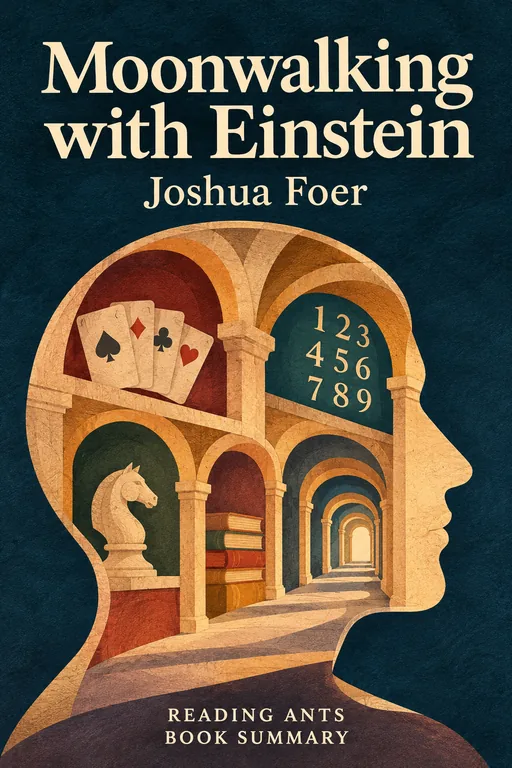
Journalist Joshua Foer, who covered a memory contest and then trained for a year to win it, tells how ordinary people can develop extraordinary memories using ancient techniques, and what memory means for how we learn and live.
Overview
Moonwalking with Einstein: The Art and Science of Remembering Everything was published in 2011 by Joshua Foer, a science journalist. While reporting on the US Memory Championship, he met competitors who could memorize long lists of numbers and whole decks of cards, and who treated this as a skill that comes from technique and practice. Intrigued, he trained for a year under the British memory grandmaster Ed Cooke and won the American championship himself in 2006. The book interweaves his story with the history of memory, scientific research and portraits of unusual people, including a man who could barely form new memories, the savant Kim Peek, and the memory competitor Daniel Tammet.
Full Summary
1. Meeting the mental athletes
The idea: Foer describes his first visit, as a journalist, to the 2005 US Memory Championship, where competitors performed feats of memorizing numbers and cards. He expected to find people with unusual brains, but learned that the top competitors use techniques that others can learn. One world champion, Ben Pridmore, told him that plenty of people can do such things. The sport of memory, he came to believe, is less about raw ability than about technique and practice. This sparks his own curiosity, and he decides to investigate how far a normal person might go, with Ed Cooke as his coach.
In real life: A person who seems to have a “gift” may simply have a method.
2. The memory palace
The idea: The core technique that Foer learns is the method of loci, or the memory palace, an ancient trick that was also used by Roman rhetoricians. You imagine a familiar place, such as your home, and walk through it, placing vivid images of things that you want to remember at specific spots along the route. When you want to recall, you take the walk again. The brain, which is good at remembering places and images, is used to store abstract information. Tradition traces it back to the Greek poet Simonides.
In real life: To remember a shopping list, you might picture each item at a different place along your street.
3. Making it memorable: bizarre images
The idea: The images placed in the palace work best when they are vivid, funny, rude or strange, since the mind remembers what is unusual and emotional. Foer learns systems, such as the Major System and the PAO (person-action-object) system, that convert numbers and playing cards into people and actions that can be placed in a palace. The title of the book refers to one of the vivid images he used while training. Practice makes the process faster and more natural.
In real life: Imagining a giant banana dancing on your front steps can help you to remember to buy bananas.
4. How memory works and what is lost
The idea: Foer explores the science of memory, including the story of a man who lost almost all of his ability to form new memories, and that of Kim Peek, a man with a prodigious memory who inspired the film Rain Man. He also examines Daniel Tammet, whose explanations of his own feats Foer comes to doubt, suspecting that Tammet uses the same basic techniques as other memory competitors. He also discusses the history of memory in culture: in the ancient world, memorizing was a respected skill, but after writing, printing and now digital devices, we store less in our heads. He argues against the low reputation of memorization in modern education, and he considers what is lost when we outsource memory.
In real life: Relying on a phone for all phone numbers means that you remember none.
5. The plateau and deliberate practice
The idea: During his training, Foer turns to the idea of deliberate practice as the path to expertise. The key is to work at the edge of one’s ability, to pay attention to errors, to get feedback and to push beyond comfortable habits. Ordinary skills level off once they become automatic, but experts keep improving by actively practicing what they do badly. He argues that psychological barriers are the largest obstacle to better performance, and he applies this to memory.
In real life: To improve at a sport, you must work on what is hardest, not just play for fun.
6. The contest and the meaning of memory
The idea: In the last part, Foer competes in the 2006 US championship and wins, setting a new US record in the speed cards event. He then represents the United States at the World Memory Championships in London, where he places thirteenth and wins a bronze medal in the names-and-faces event, though he does not become a grandmaster of memory. He reflects on the experience and on what memory means for culture and for how we live, and he suggests that we should pay attention to the experiences we want to keep.
In real life: A life of routine can feel shorter, because it leaves few distinct memories.
Why It Matters
Moonwalking with Einstein debuted at number three on the New York Times bestseller list, stayed on it for eight weeks, and was a finalist for the 2012 Royal Society Winton Prize for Science Books. It brought memory palaces and other memory techniques to a wide audience. It illustrated the idea that skills can be learned with the right methods, and that practice, not just talent, matters. The book is also a historical and philosophical reflection on what memory means in the age of search engines and smartphones. Film rights were optioned by Columbia Pictures soon after publication. It is a lively example of participatory journalism, in which the author becomes a participant.
Key Takeaways
- Memory can be trained. Ordinary people can learn extraordinary recall.
- Use places and images. The memory palace turns abstract items into vivid scenes.
- Strangeness helps. Unusual images stick.
- Deliberate practice breaks plateaus. Work at the edge of your skill.
- Memory shapes experience. Attention to what we want to remember enriches life.
What We Can Learn
You can try building a memory palace for something you want to learn, such as a list of vocabulary words or the order of presidents. Use vivid, funny images. Practice a little each day, and test yourself. When you feel that you are not improving, change how you practice, by focusing on your weak points. Pay attention to your experiences, so that days do not blur together. And remember that technology is useful, but exercising memory is good for the mind.
Criticism and Counterpoints
Some critics say that memory techniques are useful for lists and facts but do not improve understanding or creativity, and that the memory sports are of limited value for real life. Foer’s own story is a single case, not a controlled study. Reviewers also disagreed about his treatment of Daniel Tammet: one critic in the New York Times found his attack on Tammet inexplicable, and another in The Observer dismissed the book as reality television in book form. Still, many reviewers called it engaging and captivating.
Who Should Read It
This book is for anyone interested in memory, learning and the brain, and for those who like narrative journalism. It is engaging and funny. Those who want a practical manual of memory techniques will find more detail in books devoted to the topic.
Want the whole book?
A summary is a taste, not the meal. Here is where to find the full book.
You reached the end 🎉
Nicely done. Mark this one as read, and we will suggest what to read next.
Read this next
A Mind for Numbers
Barbara Oakley
Barbara Oakley, who changed from a language student and soldier to an engineering professor, explains how the brain learns difficult subjects like math and science, and gives practical techniques for studying more effectively.
🔬 ScienceMake It Stick
Peter C. Brown, Henry L. Roediger III and Mark A. McDaniel
A writer and two cognitive scientists explain, with research and stories, that effective learning is often effortful, and that retrieval practice, spacing, interleaving and other "desirable difficulties" help knowledge to stick, while popular habits such as rereading do not.
🌱 Self-Improvement
The Brain That Changes Itself
Norman Doidge
Psychiatrist Norman Doidge tells stories of patients and scientists who show that the adult brain is not fixed but can reorganize itself, a property called neuroplasticity, and what this means for healing and learning.
🧩 Mind & Psychology
Why Don't Students Like School?
Daniel T. Willingham
Cognitive scientist Daniel Willingham uses research on how the mind works to explain why thinking is hard, why knowledge matters and how teachers and students can make learning more effective and enjoyable.
🎓 Parenting & Education
The Art of Thinking Clearly
Rolf Dobelli
Swiss author Rolf Dobelli collects about a hundred short chapters on common thinking errors, such as confirmation bias, survivorship bias and the sunk-cost fallacy, to help readers make fewer foolish decisions.
🧩 Mind & Psychology
Thinking, Fast and Slow
Daniel Kahneman
Our minds run on two systems, a fast, intuitive one and a slow, careful one, and understanding how the fast system fools us can help us make better decisions about money, risk, work and happiness.
🧩 Mind & PsychologyWant something different?
Pick another topic and we will show you three books to start with.