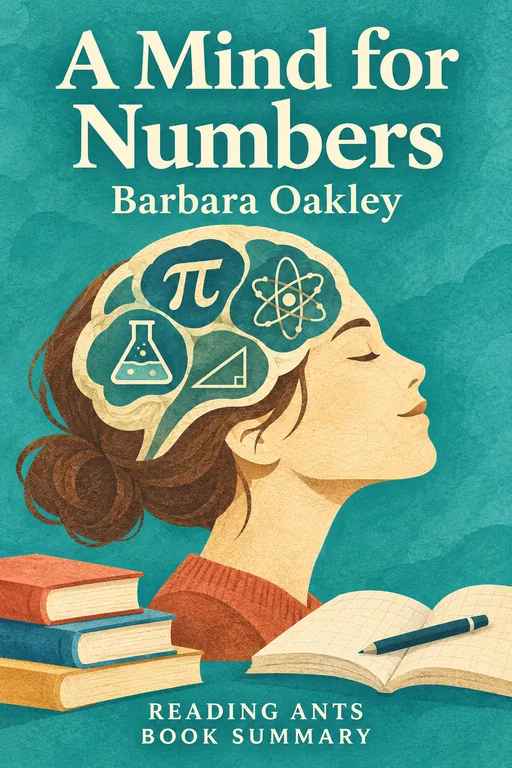
Barbara Oakley, who changed from a language student and soldier to an engineering professor, explains how the brain learns difficult subjects like math and science, and gives practical techniques for studying more effectively.
Overview
A Mind for Numbers: How to Excel at Math and Science (Even If You Flunked Algebra) was published in 2014 by Barbara Oakley, a professor of engineering at Oakland University. As a young person, she did poorly in high school math and science, enlisted in the army, and studied Russian and other languages. When her army career showed her how much she needed technical skills, she retrained herself in science and engineering, which led her to study how people learn. The book draws on neuroscience and psychology, and is made up of short chapters with diagrams, exercises and tips. It is the companion book to a hugely popular online course called Learning How to Learn, which she teaches with the neuroscientist Terrence Sejnowski.
Full Summary
1. Two modes of thinking: focused and diffuse
The idea: Oakley says that the brain works in two modes. In focused mode, we concentrate on a problem, using what we know. In diffuse mode, the mind is relaxed and makes broad connections in the background, as when we take a walk or shower. Hard problems often need both, so after working intensely, taking a break lets the diffuse mode work, and a solution may pop up. She compares it to a pinball machine, where the ideas can bounce around in different ways.
In real life: You may solve a tough problem while walking, after trying hard at your desk.
2. Chunking: building mental units
The idea: The author describes chunking, the process of combining pieces of information into a meaningful unit, so that they can be handled as one. A beginner sees separate pieces, but an expert sees whole patterns. To form a chunk, you focus your attention, understand the basic idea, and practice it until it becomes familiar, and learn when to use it. She gives advice on how to build chunks, and notes that chunks connect, so that new learning builds on the old.
In real life: A reader who recognizes whole words, not letters, reads much faster.
3. Practice, repetition and overcoming procrastination
The idea: Oakley says that learning needs repeated practice over time, and that spaced repetition, reviewing material across several days, beats cramming. She also explains procrastination as a response to discomfort, in which the brain avoids a task that it finds unpleasant. A remedy is the Pomodoro technique: remove distractions, set a timer for twenty-five minutes of focused work, and then reward yourself. You only have to work on the task, not finish it, which makes it easier to start.
In real life: Studying for twenty minutes a day for a week is better than a single long session.
4. Memory tricks and recall
The idea: The book discusses how to improve memory. Recalling material, by testing yourself without looking at the page, is more effective than simply rereading, which creates an illusion of knowing. She recommends connecting new material to what you already know, and using metaphors and visual images to make ideas memorable. Sleep is important for memory and brain function. She also covers memory techniques such as the memory palace.
In real life: Closing the book and writing what you remember is better practice than reading it again.
5. Illusions of learning and test-taking
The idea: Oakley warns about illusions of competence. Looking over a solution and thinking that you could do it is not the same as being able to do it yourself. She advises working problems without help, and checking your answers. For test-taking, she suggests starting with the hard problems for a short time, to engage the diffuse mode, then moving to easy ones, and learning to manage test anxiety.
In real life: Watching a teacher solve a problem does not mean you can solve it alone.
6. Creativity, teamwork and mindset
The idea: In the last chapters, Oakley discusses creativity in math and science, which she says needs imagination as well as analysis, since a problem can often be solved in more than one way. She encourages working with others, who may explain things in a different way, and warns that overconfidence is a trap that teamwork can help catch. She also stresses that the brain can change with practice, and that people who think that they are bad at math can learn it with effort.
In real life: Explaining a concept to a friend shows what you understand and what you do not.
Why It Matters
A Mind for Numbers has been very influential among students, teachers and parents. Its message that anyone can learn hard subjects, with the right techniques, is encouraging, and its tips are easy to try. The book and the online course, which became one of the most popular in the world, reached millions of learners. It brought ideas from cognitive science, such as spaced practice and retrieval, into general awareness. It also challenged the idea that talent in math is fixed, and encouraged people who had given up on science. The book remains a standard recommendation for study skills.
Key Takeaways
- Use focused and diffuse thinking. Alternate hard work with rest.
- Build chunks. Understand, practice and connect ideas.
- Space your practice. Repetition over days beats cramming.
- Test yourself. Recall is better than rereading.
- Avoid illusions of competence. Work problems on your own, without peeking at the solution.
What We Can Learn
You can start with the Pomodoro method for your next study session, and a simple routine: study, take a break, and then try to recall what you learned. Review old material regularly. Get enough sleep, which is when much learning is consolidated. Explain what you learn to a friend or family member. If you feel that you are bad at a subject, remember that effort and good methods can change that. And treat mistakes as part of learning. Keep a short log of what worked in each study session, and adjust your plan every week.
Criticism and Counterpoints
Some readers feel that the book’s advice is largely a repackaging of well-known study techniques. The neuroscience is also presented in a deliberately simple way, and the focused and diffuse modes are best taken as a helpful metaphor, not a full account of how the brain works. Oakley is an engineer, not a neuroscientist, though the book includes a foreword by the neuroscientist Terrence Sejnowski and a preface by the learning researcher Jeffrey Karpicke. Still, many of the practical tips, such as testing yourself and spacing your practice, are supported by research.
Who Should Read It
This book is for students of all ages, and for parents and teachers, especially those who struggle with math and science. It is easy to read, with short chapters. Those who want a deeper treatment of the research can read Make It Stick.
Want the whole book?
A summary is a taste, not the meal. Here is where to find the full book.
You reached the end 🎉
Nicely done. Mark this one as read, and we will suggest what to read next.
Read this next
Make It Stick
Peter C. Brown, Henry L. Roediger III and Mark A. McDaniel
A writer and two cognitive scientists explain, with research and stories, that effective learning is often effortful, and that retrieval practice, spacing, interleaving and other "desirable difficulties" help knowledge to stick, while popular habits such as rereading do not.
🌱 Self-Improvement
Moonwalking with Einstein
Joshua Foer
Journalist Joshua Foer, who covered a memory contest and then trained for a year to win it, tells how ordinary people can develop extraordinary memories using ancient techniques, and what memory means for how we learn and live.
🧩 Mind & Psychology
Why Don't Students Like School?
Daniel T. Willingham
Cognitive scientist Daniel Willingham uses research on how the mind works to explain why thinking is hard, why knowledge matters and how teachers and students can make learning more effective and enjoyable.
🎓 Parenting & Education
The Brain That Changes Itself
Norman Doidge
Psychiatrist Norman Doidge tells stories of patients and scientists who show that the adult brain is not fixed but can reorganize itself, a property called neuroplasticity, and what this means for healing and learning.
🧩 Mind & Psychology
Mindset: The New Psychology of Success
Carol S. Dweck
Psychologist Carol Dweck shows that people who believe abilities can grow, a growth mindset, learn, cope with failure and achieve more than people who believe their talents are fixed.
🌱 Self-Improvement
A Brief History of Time
Stephen Hawking
One of the world's greatest physicists explains, with almost no math, what we know about the origin, structure and fate of the universe, from the Big Bang to black holes and the nature of time itself.
🔬 ScienceWant something different?
Pick another topic and we will show you three books to start with.