 Reading Ants
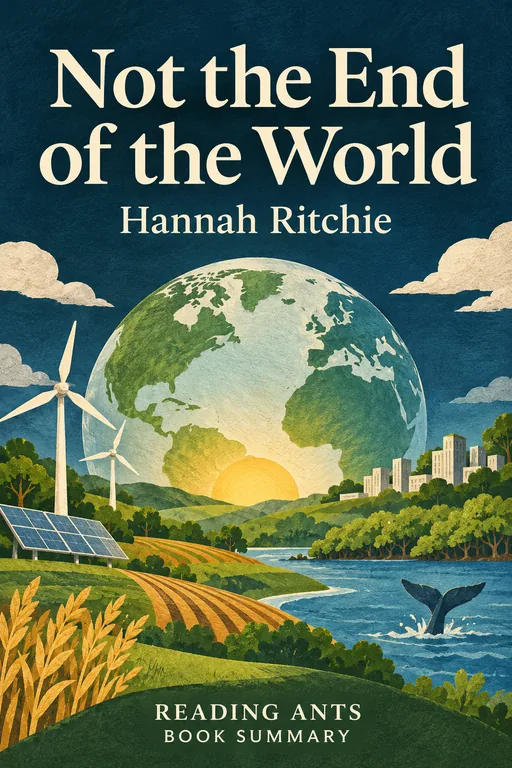
Data scientist Hannah Ritchie argues that, although environmental problems are serious, they can be solved, and that being realistic and hopeful, rather than doomy or dismissive, is the way to be the first generation to build a sustainable world.
Overview
Not the End of the World: How We Can Be the First Generation to Build a Sustainable Planet was published in 2024 by Hannah Ritchie, who is the deputy editor and a lead researcher at the website Our World in Data, and a senior researcher at the University of Oxford. She says that, as a student, she once felt overwhelmed by environmental problems and nearly gave up, and that data on long-term trends changed her view. The book examines seven big environmental problems: air pollution, climate change, deforestation, food, biodiversity loss, ocean plastics and overfishing. For each, she shows what the data say, and what can be done. Her tone is calm and practical.
Full Summary
1. Between doom and complacency
The idea: Ritchie argues that the two common reactions to environmental news, despair and denial, are both unhelpful, and she begins with her own experience of feeling overwhelmed. The truth, in her view, is that humanity faces real and urgent problems, but that there is a lot of progress and many solutions, and that the data show that things are not all getting worse. Her aim is a stance that keeps both urgency and hope, and she wants to give people a sense that action works. She urges readers to look at long-term data rather than the daily news. She explains that the world has never been truly sustainable, since a sustainable world must meet human needs as well as protect nature, and she points to large gains in human well-being, such as the fall in child mortality and extreme poverty over the past two centuries. She rejects shrinking the population or the economy (“depopulation” and “degrowth”) as realistic answers, and looks instead to technology and better practices.
In real life: Believing that a problem is hopeless makes people stop trying, while believing it does not exist does the same.
2. Air pollution
The idea: The author notes that air pollution kills millions of people each year, both from outdoor smog and from indoor cooking with solid fuels. But pollution tends to rise as countries industrialize and then fall as they adopt rules and technology, and rich countries have cut it greatly. She tells how Beijing, notorious for smog around the 2008 Olympics, had much cleaner air by the 2022 Winter Olympics after public demand and government action, and she points to international successes such as the Montreal Protocol on ozone-damaging chemicals. She argues that poorer countries can do the same. She emphasizes that solutions are known, such as clean cooking fuels, an end to crop burning, scrubbing sulfur from fossil fuels, cleaner transport and renewable energy, and that the main need is to apply them more widely.
In real life: London, which suffered the deadly Great Smog of 1952, now has much cleaner air.
3. Climate change
The idea: Ritchie describes a world that is 6 degrees warmer as devastating, and says that only a few years ago she believed that such a path, or at least 4 or 5 degrees, was almost certain. She says that renewables, such as solar and wind power, have become much more cost-effective. She notes that current policies point to roughly 2.5 to 2.9 degrees of warming by 2100, and that national pledges, if met, would bring this nearer to 2.1 degrees. She is cautiously optimistic that warming can be held close to two degrees above pre-industrial levels, while noting that few climate scientists expect the 1.5 degree goal to be met without a major breakthrough. The outlook is better than the worst-case scenarios, but still requires urgent action. She also points out that deaths from natural disasters have fallen over time, which shows that people can solve problems, and that rich countries should help the poorest, who have contributed very little to emissions yet are hit hardest.
In real life: Solar and wind power have become far more affordable than they once were.
4. Deforestation and biodiversity
The idea: The author explains that rich countries such as France and the UK cleared large areas of forest long ago, but that many wealthy countries later saw forests recover as farming became more productive. Global deforestation has fallen since its peak in the 1980s. The main cause of deforestation today is agriculture, and beef alone accounts for a large share. She says that eating less meat, especially beef, can reduce deforestation and let us use less land. She also points out that palm oil is a very productive crop per hectare, so switching to other oils because of its bad reputation could cause more deforestation. She corrects the popular claim that the Amazon supplies a fifth of the world’s oxygen, since the forest uses nearly all that it produces, while still stressing that tropical forests are rich in species and under threat. On biodiversity loss, she explains that the widely quoted fall of around two thirds in wildlife populations since 1970 is an average across monitored populations, not a loss of two thirds of all animals, and that about half of those populations are actually growing. The problem is still serious, as shown by the northern white rhino, of which only two females remain, but she argues that protection and the restoration of habitat can help species recover.
In real life: Forests in temperate countries such as France have grown back after centuries of clearing.
5. Food, plastic and the oceans
The idea: Ritchie looks at the environmental cost of food, and says that one of the most effective personal changes is to eat less meat and dairy, especially beef, since livestock use a vast amount of land and produce greenhouse gases. She says that what you eat matters more than whether it is local or organic. She argues that the world already grows more than enough food to feed everyone, so hunger is a problem of distribution and poverty and is solvable, and she disputes the claim that only a few dozen harvests are left because of soil loss. On ocean plastic, she questions the famous prediction that there will be more plastic than fish by 2050, but says that plastic pollution is a real harm to wildlife and that the biggest solution is investment in waste management, so that plastic does not leak into rivers and seas. On overfishing, she explains that the claim that the oceans would be empty by 2048 came from a misreading of a study that measured falling catches, and that, although about a third of fish stocks are overfished, good management, quotas and fish farming can help stocks to recover.
In real life: Replacing some beef meals with chicken or beans lowers your food footprint.
6. Being the first sustainable generation
The idea: Throughout the book, Ritchie argues that no society has yet achieved a truly sustainable way of living, with a high standard of living and low environmental impact, but that it is now possible, and that we have the chance to be the first generation to do it. She stresses that national and global action is essential, alongside the choices of individuals, such as how they eat, travel and vote. She advises people to focus on the choices with the biggest effect, such as what they eat, rather than on things like buying local or organic.
In real life: Cutting a large source of waste matters more than a lot of small tweaks.
Why It Matters
Not the End of the World was widely praised as an antidote to climate despair, by showing that facts provide grounds for realistic hope. Ritchie’s background in data, and her clear use of charts and statistics, lend credibility. The book fits into a debate about how to talk about the environment. It tests several widely repeated claims, such as the Amazon’s share of the world’s oxygen, the number of harvests left, and the date when the oceans will be empty, and helps readers to tell effective actions from misconceptions. It has drawn praise from well-known figures such as Margaret Atwood and Bill Gates, and gives readers a way to act without being overwhelmed.
Key Takeaways
- Both doom and denial are unhelpful. A realistic hope motivates action.
- Many problems have solutions. Clean energy and better practices work.
- Progress is real. Air quality and forests have improved in places.
- Food choices matter. Eating less meat has a large effect.
- Focus on the big levers. Prioritize actions with the most impact.
What We Can Learn
You can use the book to look at the numbers behind environmental news, and to focus on high-impact actions, such as how you travel, what you eat and how you vote. Share facts with friends who are anxious, and encourage them to take action. Be wary of guilt over small matters, and of claims that nothing can be done. Support policies and technologies that reduce emissions and protect nature. And remember that being hopeful and being realistic go together.
Criticism and Counterpoints
Some environmentalists say that the book is too optimistic, and that it underplays the speed and scale of the harm already done, the limits to growth, and the need for deeper changes to the economy and consumption. Others argue that its focus on technology and data neglects issues such as inequality and political power. One reviewer found it slightly over-optimistic given how worrying the future looks. Ritchie responds that her claim is not that all is well, but that action works.
Who Should Read It
This book is for readers who care about the environment, and especially those who feel anxious or paralyzed. It is clear and well organized. Those who want a more critical view of the economic system may wish to read other authors as well.
Want the whole book?
A summary is a taste, not the meal. Here is where to find the full book.
You reached the end 🎉
Nicely done. Mark this one as read, and we will suggest what to read next.
Read this next
How to Avoid a Climate Disaster
Bill Gates
Bill Gates argues that the world must reach net-zero greenhouse gas emissions by 2050, and lays out a practical plan that depends on new technology, lower "green premiums," smart policy and large investment.
🔬 Science
The Uninhabitable Earth
David Wallace-Wells
Journalist David Wallace-Wells sets out, without softening, the range of harms that unchecked global warming could bring, from heat and hunger to disasters and conflict, in order to make readers understand the stakes of the choices we make.
🔬 Science
Enlightenment Now
Steven Pinker
Steven Pinker argues that the ideals of the Enlightenment, reason, science, humanism and progress, have made the world healthier, richer, safer and freer, and that they are worth defending against pessimism and attacks from many directions.
🔬 Science
Factfulness
Hans Rosling with Ola Rosling and Anna Rosling Ronnlund
Hans Rosling shows that the world is better than most people think, and that ten built-in instincts, such as fear, blame and the habit of seeing gaps, distort how we see it and can be tamed with a fact-based mindset.
🔬 Science
Silent Spring
Rachel Carson
The careless spraying of powerful chemical pesticides like DDT was poisoning birds, fish, soil, water and people, and humans must learn to live with nature instead of waging war on it.
🔬 Science
A Brief History of Time
Stephen Hawking
One of the world's greatest physicists explains, with almost no math, what we know about the origin, structure and fate of the universe, from the Big Bang to black holes and the nature of time itself.
🔬 ScienceWant something different?
Pick another topic and we will show you three books to start with.