 Reading Ants
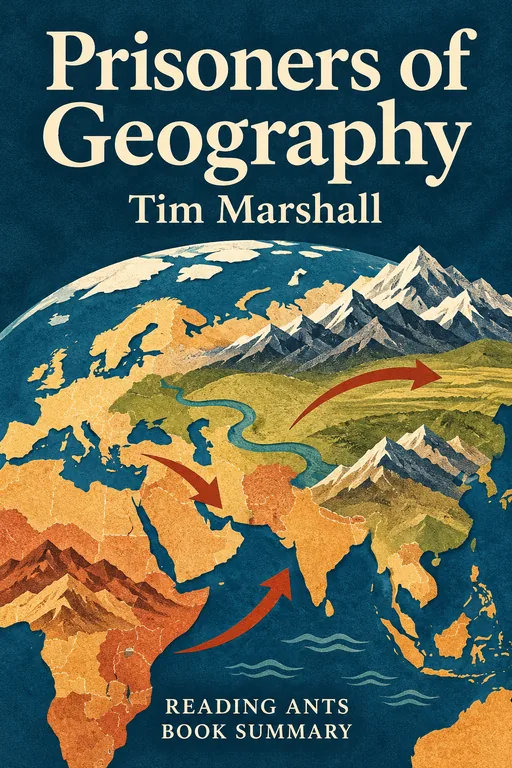
Prisoners of Geography
Tim Marshall argues that mountains, rivers, seas and plains shape the choices that countries and leaders can make, so understanding geography helps explain world events.
Overview
Prisoners of Geography: Ten Maps That Explain Everything About the World was written by Tim Marshall, a British journalist and former diplomatic editor at Sky News, who reported from many war zones. It was published in 2015 and became a surprise bestseller. Marshall explains that leaders are “prisoners” of geography in the sense that terrain, climate and location limit and direct their options, whatever their intentions. He devotes a chapter to each of ten regions or areas: Russia, China, the United States, Western Europe, Africa, the Middle East, India and Pakistan, Korea and Japan, Latin America and the Arctic. He uses clear maps and short histories to show how the past still shapes the present.
Full Summary
1. Russia: the flat land and the search for ports
The idea: Marshall begins with Russia, a huge country whose western approach crosses the wide, flat North European Plain, which has few natural barriers to invasion. Over the centuries, armies from Napoleon’s France to Nazi Germany crossed it, and that vulnerability, he says, explains Russia’s wish for buffer zones. Another obsession is access to warm-water ports, since much of Russia’s coast freezes in winter. This helps explain the importance Russia attaches to places like Crimea and to its influence in nearby countries.
In real life: A country that feels exposed on its borders may act defensively, even in ways others see as aggressive.
2. China: unity and the sea
The idea: China’s core, the Han heartland, is fertile and densely populated, but the country is ringed by deserts, mountains and jungle, which have protected it. Marshall explains that Chinese leaders have long worried about keeping the huge country united and fed, and about border regions such as Tibet and Xinjiang. Today, he argues, China looks to the sea to secure trade routes, which brings it into competition with other powers in the South China Sea and with the United States.
In real life: Ships carrying much of the world’s goods pass through narrow waters, so control over those areas matters.
3. The United States: blessed by geography
The idea: The United States, in Marshall’s account, has extraordinary natural advantages: huge areas of fertile land, a vast system of navigable rivers, such as the Mississippi, long coastlines on two oceans and friendly neighbors to the north and south. These helped it grow rich and secure with little fear of invasion. They also allowed it to project power across the world through its navy and bases.
In real life: A country with easy ways to move goods by water starts with a major economic advantage.
4. Western Europe, Africa and the Middle East
The idea: In Western Europe, Marshall points to rivers, harbors and fertile land that helped to create wealth and competing states. In Africa, he says, the lack of navigable rivers to the interior and the difficult terrain and disease held back trade and unity, and borders drawn by colonial powers ignored ethnic and cultural realities, which contributes to conflict. In the Middle East, similar artificial borders, set after World War I, combine with deserts, religious divides and the importance of oil and water to create instability.
In real life: Borders that cut across communities, drawn by outsiders, can produce tensions that last for generations.
5. India and Pakistan, Korea and Japan, Latin America
The idea: In South Asia, mountains to the north and the sea to the south give India a certain security, but it faces tension with Pakistan and concerns about China. The Korean peninsula, divided into North and South Korea, and the island nation of Japan are both shaped by living close to the larger powers of China and Russia. In Latin America, the Andes, the Amazon jungle and other natural barriers make transport and trade between regions difficult, which has held back the continent’s development.
In real life: A country that struggles to move goods inside its own borders finds it harder to build wealth.
6. The Arctic
The idea: The last chapter looks to the future of the Arctic, where melting ice is opening new sea routes and access to oil, gas and minerals. Countries such as Russia, Canada, the United States, Norway and Denmark are competing over who controls these areas, and who can use them. Marshall suggests that the Arctic may become an important stage for international tension, as climate change changes the map.
In real life: Shorter shipping routes across the top of the world could change which ports and countries gain from global trade.
Why It Matters
Prisoners of Geography became a popular guide to world politics, praised for making a complicated subject easy to follow. It stayed on bestseller lists for many months, spawned a young readers’ edition and a sequel on space, and was widely used in classrooms. The book is often recommended to readers who want to understand the news.
Its popularity reflects a revived interest in geography, and in explaining current events by looking at the physical context, an approach that complements the focus on ideology and leaders. Journalists, students and travelers often keep the book handy as a quick guide to why a region has the tensions it does.
Key Takeaways
- Geography shapes choices. Mountains, rivers and coasts limit and direct countries.
- Past patterns repeat. Old fears and ambitions persist.
- Borders matter. Artificial lines can cause lasting conflicts.
- Access to the sea is power. Ports and routes drive strategy.
- The map is changing. Climate change is opening new frontiers.
What We Can Learn
The book teaches us to look at a map before making sense of the news. Asking questions like where the mountains, rivers and ports are can reveal why a country acts the way it does.
It also encourages empathy: if we understand what a country fears or needs, we may better see why it behaves as it does, even if we disagree with its actions.
Finally, it shows how human choices can sometimes overcome geography. Technology, trade and cooperation can change how much geography limits us, which is why the book suggests that the map matters but is not the only factor.
Criticism and Counterpoints
Critics say that the book tends toward geographical determinism, giving too much importance to terrain and not enough to politics, culture, leadership and ideas. Many historians point out that countries with similar geographies have developed in very different ways, and that technology has reduced some geographic constraints.
The book is also a broad survey, and some experts feel that the chapters oversimplify complicated regions, especially Africa and the Middle East, and that it has a Western-centered viewpoint. A few readers also dispute some claims about specific events. As a starting point, however, many find it clear and stimulating.
Who Should Read It
This book suits teenagers and adults curious about world affairs. It is easy to read, and each chapter stands alone. Readers who want more depth on any region will need other books.
Want the whole book?
A summary is a taste, not the meal. Here is where to find the full book.
You reached the end 🎉
Nicely done. Mark this one as read, and we will suggest what to read next.
Read this next
The Silk Roads
Peter Frankopan
Instead of seeing history as centered on Europe, this book argues that the regions linking East and West, Central Asia and the Middle East, were the true center of the world, where trade, religion, empire and ideas met.
🏛️ History
Guns, Germs, and Steel
Jared Diamond
Some societies came to conquer others not because their people were smarter or better, but because geography gave them a head start in farming, animals, germs and technology.
🏛️ History
Sapiens: A Brief History of Humankind
Yuval Noah Harari
Humans came to rule the planet not because we are the strongest animals but because we can believe in shared stories (gods, nations, money, companies) that let millions of strangers cooperate.
🏛️ History
The Prince
Niccolo Machiavelli
A Renaissance diplomat advises rulers to judge their actions by results rather than morality, arguing that a successful leader must sometimes be cunning and ruthless to win and keep power.
⚖️ Politics & Society
The Communist Manifesto
Karl Marx and Friedrich Engels
Marx and Engels declare that all history is the history of class struggle, that capitalism has created a working class that will overthrow it, and that communism will end class divisions.
⚖️ Politics & Society
Democracy in America
Alexis de Tocqueville
After touring the United States in the 1830s, the young Frenchman Alexis de Tocqueville wrote a penetrating study of American democracy, praising its energy and liberty, and warning about its dangers, such as the tyranny of the majority and a retreat into private life.
⚖️ Politics & SocietyWant something different?
Pick another topic and we will show you three books to start with.