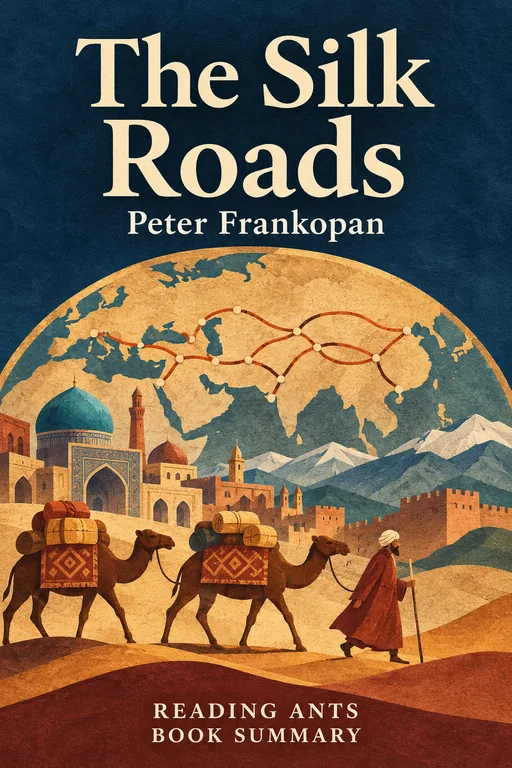
The Silk Roads
Instead of seeing history as centered on Europe, this book argues that the regions linking East and West, Central Asia and the Middle East, were the true center of the world, where trade, religion, empire and ideas met.
Overview
The Silk Roads: A New History of the World was written by Peter Frankopan, a historian at the University of Oxford, and published in 2015. Frankopan argues that the traditional picture of world history, which follows Greece, Rome and then Western Europe, leaves out the lands in between, from the Mediterranean to Persia, Central Asia, India and China. By following networks of trade and travel, he shows how goods, faiths, diseases and technologies moved across these regions and shaped the modern world. The “Silk Roads” of the title are not one road but a web of routes carrying much more than silk.
Full Summary
1. The crossroads of early empires
The idea: Frankopan starts with the ancient world, showing that powerful empires, such as the Persians, rose in the lands between east and west. These empires built roads, collected taxes and encouraged trade, so that goods and ideas could travel long distances. He reminds readers that Alexander the Great marched through these regions and that the Roman world was strongly linked with Persia and the East through trade and rivalry.
In real life: Spices, glass and metals that moved across the ancient world reached markets thousands of miles from where they were made.
2. Religions on the move
The idea: The author describes how major religions spread along trade routes. Merchants and travelers carried Buddhism from India into Central Asia and China, Christianity into Persia and beyond, and later Islam across a vast area. Frankopan argues that religious ideas often traveled together with commerce, and that cities along the routes became places of exchange where different peoples lived side by side.
In real life: A trader who settles in a foreign city often brings not only goods but also customs and beliefs.
3. The rise of Islam and the Mongols
The idea: In the following centuries, the world changed with the rise of Islam in the seventh century, whose armies and merchants built a large empire linking Asia, Africa and Europe. Later, the Mongol Empire, founded by Genghis Khan in the thirteenth century, united much of Eurasia, which brought terrible destruction but also made travel and trade easier for a time. Frankopan notes that the spread of the plague in the fourteenth century probably traveled along these networks.
From the book: He argues that the Mongol conquests reshaped the map and opened routes for people such as the Venetian traveler Marco Polo.
In real life: Disease can spread along the same roads as trade, which is why plagues often followed busy routes.
4. Europe looks east
The idea: Frankopan explains that medieval Europe was, in many ways, a backwater compared with the wealthy cities of the East, and that Europeans were eager to reach Asian goods such as spices and silk. This hunger led them to seek new sea routes, which ended up in the voyages of exploration and the colonization of the Americas. In this telling, Europe’s rise was driven by the wish to reach the wealth of the East.
In real life: The search for a sea route to India helps explain why European sailors crossed the Atlantic.
5. Empires, oil and conflict
The idea: The later chapters bring the story into the modern age. Frankopan traces the rivalries among empires in Central Asia and the Middle East, including Britain and Russia in the nineteenth century, and shows how the discovery of oil in the twentieth century made the region central to world affairs. He links these events to the two world wars and to later conflicts, arguing that the world’s major crises have often been fought over the lands along the old routes.
In real life: Modern disputes over pipelines and trade corridors echo older contests for control of the routes.
6. The new Silk Roads
The idea: The final chapters look at the present. Frankopan notes that China, Russia, Iran and other countries are building new links, such as pipelines, railways and ports, and that the center of economic power is shifting again toward Asia. He suggests that the Western-centered view of history is being replaced by a more balanced picture in which the lands of the old Silk Roads are important again.
In real life: Recent infrastructure projects in Asia are often compared with the old trade routes.
Why It Matters
The Silk Roads became a bestseller and was translated into many languages. It encouraged readers and teachers to look beyond Europe when studying history, and to see how connected the world has long been. The book arrived at a time when new trade routes and the rise of Asian economies made the old crossroads newly relevant, and it helped popularize the idea of “world history” that does not treat the West as the center.
It also opened discussion about how we tell history, including whose stories are told and why some regions are overlooked.
Key Takeaways
- The center was in the middle. Central Asia and the Middle East linked East and West.
- Trade carried more than goods. Faiths, ideas and diseases traveled along the routes.
- Europe looked east. The wish to reach Asian wealth drove exploration.
- Resources shaped conflict. Control of routes and oil caused rivalries.
- History can be told differently. A new viewpoint changes the story.
What We Can Learn
The book invites us to change our point of view. When we place a different region at the center of the map, familiar events look different, and we notice connections we had missed.
It also shows how ideas and goods move together. Foods, inventions and beliefs that we think of as belonging to one culture often came from many places, and remembering this can make us more curious and more humble.
Finally, it reminds us that crossroads can be both opportunity and danger. Places where many peoples meet can bring prosperity and creativity, but also conflict, and that pattern continues today.
Criticism and Counterpoints
Some historians argue that the book stretches the “Silk Roads” idea too far, using the term for almost any contact between regions across thousands of years, and that it sometimes leaps between periods quickly, giving little depth to each. Others say it exaggerates the importance of the region in explaining the rise of the West, or leaves out Africa, Southeast Asia and the Americas.
Critics have also found factual slips and uneven treatment, with more attention to some periods and less to others, and have noted that the later chapters, which cover the twentieth century, are more argumentative. Supporters answer that a broad book like this must simplify and that its main service is to challenge a narrow view of the past.
Who Should Read It
This book suits teenagers and adults who enjoy history and big-picture views of the world. It is long and covers many places and names, so it can be read in parts. Readers new to world history may find it helpful to keep a map nearby.
Want the whole book?
A summary is a taste, not the meal. Here is where to find the full book.
You reached the end 🎉
Nicely done. Mark this one as read, and we will suggest what to read next.
Read this next
Sapiens: A Brief History of Humankind
Yuval Noah Harari
Humans came to rule the planet not because we are the strongest animals but because we can believe in shared stories (gods, nations, money, companies) that let millions of strangers cooperate.
🏛️ History
Guns, Germs, and Steel
Jared Diamond
Some societies came to conquer others not because their people were smarter or better, but because geography gave them a head start in farming, animals, germs and technology.
🏛️ History
The Travels of Marco Polo
Marco Polo and Rustichello da Pisa
A Venetian merchant's account of his long journey to Asia and his years in the service of the Mongol emperor Kublai Khan, which opened the eyes of medieval Europeans to the wealth, cities and customs of the East.
🏛️ History
The Histories
Herodotus
Herodotus, often called the father of history, tells how the Greeks and the Persians came into conflict and fought the great wars of the early fifth century BCE, with long, colorful detours into the lands, customs and legends of the known world.
🏛️ History
History of the Peloponnesian War
Thucydides
Thucydides, an Athenian general turned historian, records the long war between Athens and Sparta in the fifth century BCE and uses it to study power, fear, politics and how human nature behaves in crisis.
🏛️ History
The Muqaddimah
Ibn Khaldun
Ibn Khaldun, a North African scholar of the fourteenth century, sets out a pioneering theory of how societies are organized, how states rise and fall, and how economies work, as an introduction to a larger history of the world.
🏛️ HistoryWant something different?
Pick another topic and we will show you three books to start with.