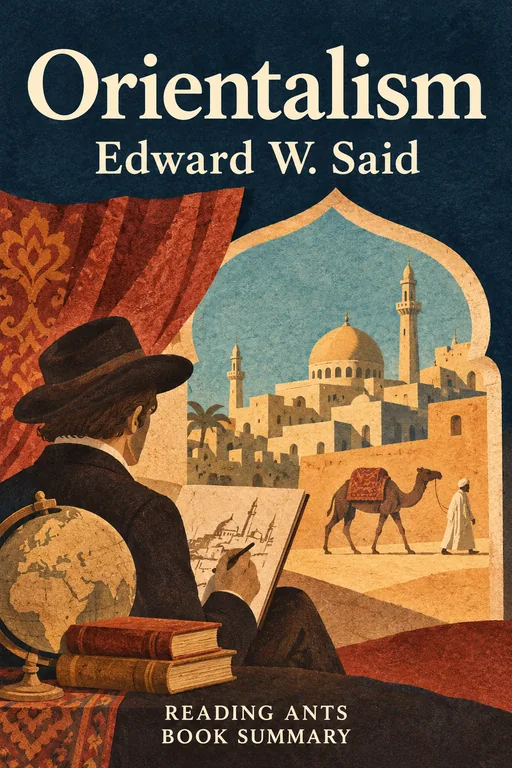
Edward Said argues that Western writers, scholars and governments created an image of "the Orient," especially the Middle East, as exotic, backward and in need of rule, and that this image served European power.
Overview
Orientalism was published in 1978 by Edward W. Said, a Palestinian American professor of literature at Columbia University. In the book, Said examines how the Western tradition of studying the East, which was called Orientalism, grew together with European empires. He says that it was not a neutral science but a way of speaking about, and controlling, another part of the world. The book draws on writers such as Flaubert and on scholars, travelers and officials. It became one of the founding works of what is now called postcolonial studies.
Full Summary
1. What Orientalism is
The idea: Said uses the word in three overlapping senses: an academic field, a style of thinking that sets “the Orient” against “the Occident,” and a way for Western institutions to dominate and speak about the East. He argues that the Orient is not simply a place, but an idea created in the West, often as a contrast to what Europeans thought of themselves: the West as rational and progressive, the East as emotional, timeless and in need of guidance.
In real life: A stereotype describes a group in a way that fits a story the speaker wants to tell, and not the real diversity of people.
2. Knowledge and power
The idea: Said says that the production of knowledge is tied up with power. Those who study another society, and who write the books that others rely on, shape how it is seen. When European powers ruled over parts of Asia and North Africa, scholars and officials produced descriptions that justified that rule. He draws on the ideas of other thinkers about how language and institutions support authority.
In real life: Whoever writes the textbooks has a great deal of influence over what people believe.
3. A long tradition
The idea: Said traces how Europeans described the Orient from ancient Greek writings to the Middle Ages, and then to the modern period, when Napoleon’s expedition to Egypt in 1798 brought a team of scholars to study the country. He says that from then on, a body of knowledge grew that treated the East as an object to be catalogued and controlled, and that this tradition shaped later writers.
In real life: A collection of facts can look neutral, while the choice of what to collect and how to organize it reflects a point of view.
4. Writers, travelers and imagination
The idea: The book analyzes the works of novelists, poets and travelers of the nineteenth century, who described the East as a place of mystery, sensuality and danger. Said argues that these images were repeated so often that they came to seem true, and that even sympathetic writers took part in the pattern. He also shows how political figures used the same assumptions in their speeches and policies.
In real life: A film that shows the same kind of character again and again shapes what viewers expect of real people.
5. Orientalism in the modern world
The idea: In the last chapter, which begins around 1870, Said follows Orientalism through the age of colonial expansion and into the twentieth century, when the leading Western power in the Middle East changed from Britain and France to the United States. Building on ideas from Michel Foucault about discourse and from Antonio Gramsci about cultural hegemony, which he introduces at the start of the book, he argues that the same basic attitudes, which he calls latent Orientalism, continued in the work of academics, in the media and in foreign policy, now directed at Arab peoples and Muslims, who were often shown as threatening or irrational. He says that this affected how the Palestinians, in particular, were seen.
In real life: Old assumptions can reappear in new forms, such as headlines that reduce a whole region to a single problem.
6. A call for a different kind of knowledge
The idea: Said does not claim that every Western scholar of the East was wrong or that Orientalism alone decides what can be said about the Orient; he praises some Orientalist works as genuine scholarship. Instead, he hopes his book will encourage a new way of dealing with other cultures, one that treats people as fully human and gives up what he calls, borrowing a phrase from Raymond Williams, the dominative mode.
In real life: Getting to know a person’s story, in their own words, is better than relying on a label.
Why It Matters
Orientalism is one of the most influential academic books of the late twentieth century. It helped to launch postcolonial studies, a field that examines the cultural legacy of empire, and it encouraged scholars in many disciplines to ask how their own subjects were shaped by power and prejudice. The term “Orientalism” has entered public discussion, and is used to point out stereotypes in art, news and politics. The book also stimulated fierce debate, which itself helped to shape the study of the Middle East and of representation. Whether or not one agrees with all of its arguments, it changed how many people think about how knowledge is produced and about the way that images of other cultures are made.
Key Takeaways
- Representations matter. The way a culture is described shapes how people treat it.
- Knowledge and power are connected. Study and rule often go together.
- Stereotypes can look scholarly. Even learned writing may repeat biased ideas.
- The East was imagined by the West. The Orient was defined as the opposite of Europe.
- Respect begins with listening. Better understanding comes from hearing people’s own voices.
What We Can Learn
You can use the book’s insights when you read news, watch movies or study history. Ask who is speaking, who is described, and whether those described have a voice. Notice stereotypes about any group, and consider what interests they serve. When you learn about another culture, try to read works by writers from that culture. And be willing to examine your own assumptions: we all absorb images from our surroundings, and thoughtful reflection helps us to see people more fairly.
Criticism and Counterpoints
Many scholars have criticized the book. Some historians say that Said treats “the West” as more uniform than it was, and that he leaves out German and other scholarship that did not serve empire, and the many Orientalists who admired the cultures they studied. Others argue that he treats stereotyping of outsiders as a mainly Western habit, when people in many societies, including in the East, have done something similar. Critics such as Bernard Lewis disputed his claims and his reading of sources. Some also say that the book’s style is dense and polemical. Said responded to critics in later writings, and the debate continues.
Who Should Read It
This book is for students and readers interested in culture, politics, literature and the legacy of empire. It is demanding and academic in style, so many readers start with the introduction, or with a guide. Those who want a simple factual history of the Middle East will need other books, but those who want to think about how images shape reality will find it stimulating.
Want the whole book?
A summary is a taste, not the meal. Here is where to find the full book.
You reached the end 🎉
Nicely done. Mark this one as read, and we will suggest what to read next.
Read this next
The Clash of Civilizations
Samuel P. Huntington
Samuel Huntington argues that, after the Cold War, the main source of conflict in the world will be cultural and religious differences between large civilizations, instead of political ideology or economics.
🏛️ History
King Leopold's Ghost
Adam Hochschild
Adam Hochschild tells how King Leopold II of Belgium took over the Congo as his personal possession, enriched himself through forced labor and terror, and was finally exposed by a global campaign of ordinary people.
🏛️ History
The Wretched of the Earth
Frantz Fanon
Frantz Fanon, a psychiatrist who joined the Algerian struggle for independence, analyzes how colonialism damages both societies and minds, and argues that liberation will involve violence and must lead to a genuinely new humanity.
⚖️ Politics & Society
Heart of Darkness
Joseph Conrad
A sailor named Marlow tells his friends of a journey up the Congo River to find a mysterious ivory trader named Kurtz, and of the horror and moral darkness he finds at the end of it.
📜 Classics
The Origins of Totalitarianism
Hannah Arendt
Hannah Arendt examines how antisemitism, imperialism and the breakdown of society in Europe prepared the ground for the totalitarian regimes of Nazi Germany and Stalin's Soviet Union, and what made these regimes new and uniquely terrible.
🏛️ History
Sapiens: A Brief History of Humankind
Yuval Noah Harari
Humans came to rule the planet not because we are the strongest animals but because we can believe in shared stories (gods, nations, money, companies) that let millions of strangers cooperate.
🏛️ HistoryWant something different?
Pick another topic and we will show you three books to start with.