 Reading Ants
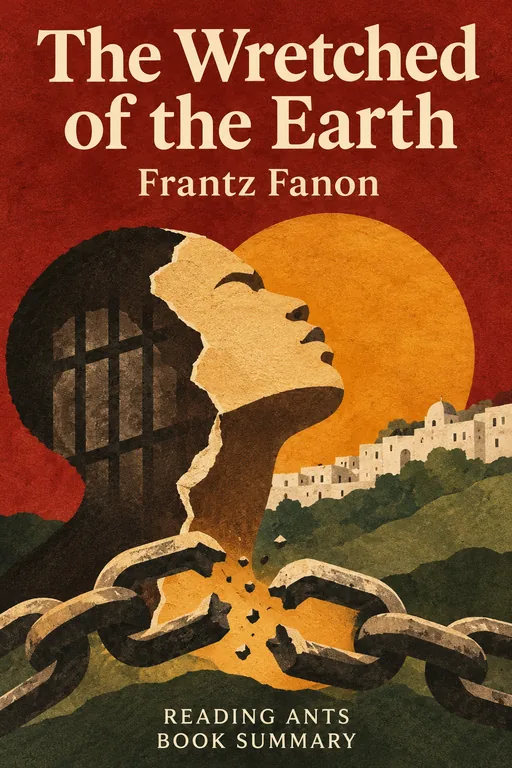
The Wretched of the Earth
Original title: Les Damnés de la Terre
Frantz Fanon, a psychiatrist who joined the Algerian struggle for independence, analyzes how colonialism damages both societies and minds, and argues that liberation will involve violence and must lead to a genuinely new humanity.
Overview
The Wretched of the Earth was published in French in 1961, shortly before the death of its author, Frantz Fanon, at the age of thirty-six. Fanon was born in Martinique, trained as a psychiatrist in France and worked in a hospital in Algeria, where he joined the National Liberation Front in its war against French rule. The book, with a preface by Jean-Paul Sartre, became a handbook for anti-colonial movements. It has five chapters and a conclusion. The chapters cover violence, spontaneity, the pitfalls of national consciousness, national culture and mental disorders caused by colonial war; the conclusion calls for a new humanism. It is a forceful and controversial work.
Full Summary
1. The colonial world and violence
The idea: Fanon describes the colonial world as divided in two, with the settlers’ town, clean and lit, and the native quarter, crowded and hungry, separated by a line that is kept by police and soldiers. He says that colonialism is itself founded on violence, and so the colonized can end it only by violence of their own. He presents this as a way in which the colonized recover their dignity and humanity, though the claim is the most debated in the book.
In real life: A system that depends on force to maintain unequal treatment is hard to change only by polite requests.
2. Spontaneity and organization
The idea: The second chapter looks at the role of the peasants, who Fanon believed to be the most revolutionary class in colonies, since they have nothing to lose. He is skeptical of urban political parties led by educated elites, who tend to bargain with the colonial power. He praises the spontaneity of rural uprisings, but says that they must be given political direction and education, so that the fighters understand what they are fighting for.
In real life: A protest with energy but no plan may fade, while one with clear aims can last.
3. The pitfalls of national consciousness
The idea: Fanon warns that, after independence, a native middle class may take the place of the colonial rulers, and imitate them, enriching itself without changing the lives of the people. He describes this as a failure of the national bourgeoisie. A real liberation, he says, requires political education of the masses, and a government that serves everyone. He foresees the rise of one-party rule and corruption in newly independent states.
In real life: Replacing one set of rulers with another who behave in the same way does not bring real change.
4. On national culture
The idea: The author discusses the way that colonized intellectuals search for a national culture, in order to prove that their people had a past before the colonizers. He says that a true culture is not found in the revival of old traditions, but in the struggle for freedom, which creates new forms of art and thought. He cautions against nostalgia, and calls for a culture that looks to the future.
In real life: A community’s identity is shown in what it builds today, not only in what it preserves.
5. Colonial war and mental disorders
The idea: In the last chapter, Fanon draws on his experience as a doctor to describe cases of patients who suffered psychological harm in the Algerian war, including Algerians who had been tortured or whose families had suffered violence, Algerian children, and Europeans such as a policeman who had tortured prisoners. He argues that colonial war damages the minds of all those caught up in it, and that mental illness cannot be treated apart from the social conditions that produce it.
In real life: Living in constant fear and cruelty can affect a person’s health in ways that medicine alone cannot cure.
6. A new humanism
The idea: In the conclusion, Fanon urges the Third World not to imitate Europe, which he says has caused immense suffering, but to build a new kind of humanity, based on solidarity and justice. He calls on the colonized to work out new concepts and to create a society in which every person counts. The book ends with the hope of a human being who is no longer defined by oppression.
In real life: Instead of copying a model that has failed, a group may decide to invent its own way.
Why It Matters
The Wretched of the Earth became one of the most influential works of anti-colonial thought, and was read by activists in Africa, Asia, Latin America and the United States, including participants in the Black Power movement. It helped to shape the discussion of decolonization, race, identity and the psychological effects of oppression, and is a foundational text for postcolonial studies. Its predictions about the problems of newly independent states proved prescient in many cases. At the same time, its discussion of violence has made it controversial, and it continues to provoke debate about the means and ends of liberation.
Key Takeaways
- Colonialism rested on violence. It harmed bodies, societies and minds.
- Elites may betray independence. A new ruling class can reproduce old inequalities.
- Political education matters. Movements need understanding, not only anger.
- Culture is made in struggle. Nostalgia is not enough.
- Build something new. Liberation should aim at a more humane society.
What We Can Learn
You can use Fanon’s work to think about how history shapes inequality today. Ask who benefits when conditions stay the same, and what happens after a change of leadership. Learn about the history of decolonization in other places and read the voices of people who lived it. Notice the mental and emotional effects of injustice. At the same time, read critically, particularly on violence, and compare Fanon with advocates of nonviolent resistance, such as Gandhi and King. Because the topics are heavy, discuss them with a teacher or trusted adult.
Criticism and Counterpoints
Critics argue that Fanon’s justification of violence is dangerous, and that it has been used to excuse brutality by regimes and groups. Others say that his picture of the peasantry as the revolutionary force did not match the reality in many countries, and that his view of the colonized as a unified group overlooks divisions. Some scholars point out that his idea of a unified national consciousness does not fit the history of Algeria, where the population was largely demobilized after independence, and that his work is sometimes more rhetorical than empirical. Feminist critics note that he pays limited attention to women. Others say that his warnings were right.
Who Should Read It
This book is for mature readers interested in colonial history, politics and philosophy. It is passionate, dense and sometimes disturbing. Readers should be prepared for its views on violence, and it helps to read it with an introduction and with other perspectives on decolonization.
Want the whole book?
A summary is a taste, not the meal. Here is where to find the full book.
You reached the end 🎉
Nicely done. Mark this one as read, and we will suggest what to read next.
Read this next
Orientalism
Edward W. Said
Edward Said argues that Western writers, scholars and governments created an image of "the Orient," especially the Middle East, as exotic, backward and in need of rule, and that this image served European power.
🏛️ History
King Leopold's Ghost
Adam Hochschild
Adam Hochschild tells how King Leopold II of Belgium took over the Congo as his personal possession, enriched himself through forced labor and terror, and was finally exposed by a global campaign of ordinary people.
🏛️ History
Pedagogy of the Oppressed
Paulo Freire
Brazilian educator Paulo Freire argues that traditional teaching treats students as empty containers to be filled, and proposes instead a dialogue-based education in which oppressed people learn to read both the word and the world, and to change it.
⚖️ Politics & Society
Long Walk to Freedom
Nelson Mandela
Nelson Mandela tells his own story, from a village childhood to twenty-seven years in prison to becoming South Africa's first democratically elected president, and shows how patience, courage and forgiveness helped end apartheid.
👤 Real Lives
The Souls of Black Folk
W. E. B. Du Bois
In fourteen eloquent essays, W. E. B. Du Bois examines the lives, struggles and hopes of Black Americans at the start of the twentieth century, and argues that the great problem of the age is the color line.
⚖️ Politics & Society
The Prince
Niccolo Machiavelli
A Renaissance diplomat advises rulers to judge their actions by results rather than morality, arguing that a successful leader must sometimes be cunning and ruthless to win and keep power.
⚖️ Politics & SocietyWant something different?
Pick another topic and we will show you three books to start with.