 Reading Ants
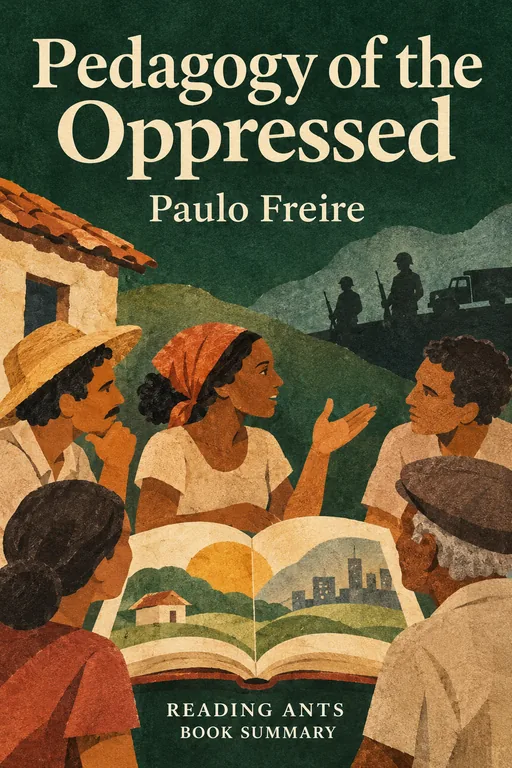
Pedagogy of the Oppressed
Original title: Pedagogia do Oprimido
Brazilian educator Paulo Freire argues that traditional teaching treats students as empty containers to be filled, and proposes instead a dialogue-based education in which oppressed people learn to read both the word and the world, and to change it.
Overview
Paulo Freire wrote Pedagogy of the Oppressed in Portuguese in the late 1960s, while in exile after the 1964 military coup in Brazil. It was first published in Spanish in 1968, with an English translation in 1970. Freire had worked on literacy campaigns among poor adults in northeastern Brazil, and was jailed and then forced into exile after the coup. The book combines educational theory, philosophy and political thought, and draws on Marxist thought, Christian ideas and the writings of Frantz Fanon. It became a foundational text of critical pedagogy, and is among the most cited books in the social sciences.
Full Summary
1. Oppression and the fear of freedom
The idea: Freire begins with the claim that people are meant to become more fully human, and that oppression, which prevents this, harms both the oppressed and the oppressors. The oppressed may absorb the image that the oppressor has of them, and be afraid of freedom, which brings responsibility. Liberation, he says, cannot be given as a gift, and must be won by the oppressed themselves, through a process of becoming aware of their situation.
In real life: A person told for years that they are not capable may come to believe it and fear trying.
2. The banking model of education
The idea: Freire criticizes the usual approach to schooling, which he calls the banking concept. The teacher deposits information in the minds of students, who receive, memorize and repeat it. The teacher is the knower and the students are those who know nothing. This model, he says, discourages critical thinking, and teaches people to adapt to the world as it is, which serves those who benefit from the existing order.
In real life: A class where students only copy notes and repeat them on a test may not learn to ask questions.
3. Problem-posing education and dialogue
The idea: In place of banking, Freire proposes a problem-posing education, in which teachers and students learn together through dialogue about real problems in their lives. The teacher is also a learner, and the students are co-investigators. Dialogue, he says, requires love, humility, faith in people and trust. Through it, learners come to see reality as something that can be changed, not a fixed fact.
In real life: A group that studies the causes of a local problem, such as unsafe roads, learns more than one that merely hears a lecture on it.
4. Generative themes and conscientization
The idea: Freire describes a method for developing a curriculum from the lives of the learners. Educators study the community and find generative themes, issues that are deeply felt, and use them as the content of discussion. The aim is conscientization, which means developing a critical awareness of the social conditions that shape one’s life, and of one’s power to act. In his literacy programs, learning to read words was linked with reading the world.
In real life: A farmer who learns to read by studying words about land and wages is learning about his own life.
5. Antidialogical and dialogical action
The idea: In the last chapter, Freire contrasts two ways of acting. Antidialogical action, used by oppressors, seeks to conquer, divide, manipulate and impose culture. Dialogical action, which should be used by revolutionary leaders, builds cooperation, unity, organization and cultural synthesis. He warns that leaders who treat people as objects to be led, and not as partners, reproduce oppression. A real revolution must be done with the people, not for them.
In real life: A leader who consults the community will usually earn more trust than one who tells people what to do.
6. Praxis: reflection and action
The idea: A key concept in the book is praxis, the union of reflection and action directed at changing the world. Freire says that action without reflection is mere activism, and reflection without action is empty talk. Education should therefore lead people to analyze their situation, and to take action together. He holds a hopeful view of human beings as unfinished, capable of learning and of transforming themselves and their world.
In real life: Reading about a problem and then organizing a project to address it combines thought and action.
Why It Matters
Pedagogy of the Oppressed is one of the most influential books on education of the twentieth century, and has been translated into many languages. It inspired literacy campaigns, community education and popular movements in Latin America, Africa and elsewhere, and helped found the field of critical pedagogy. Its ideas about dialogue, participation and the teacher as a learner have influenced many teachers around the world, even those who do not share its politics. The critique of the banking model remains widely quoted. The book also contributed to debates about the role of schools in either reproducing or challenging social inequality.
Key Takeaways
- Education is never neutral. It either supports or questions the existing order.
- Avoid the banking model. Students are not empty containers.
- Learn through dialogue. Teachers and students teach each other.
- Link learning to life. Start from problems that matter to learners.
- Combine reflection with action. Praxis is the way to change.
What We Can Learn
If you are a student, ask questions, and try to connect what you learn to your own experience. If you teach or lead, listen to those you serve and learn from them. Notice when learning is reduced to memorizing, and look for ways to make it more active. Consider joining others to study and act on a problem in your community. At the same time, read the book critically, as its language is dense, and its politics are debated. Compare it with other views of education.
Criticism and Counterpoints
Critics say that the book is written in dense, abstract language that is hard for the very people it speaks of, and that it is repetitive. Some argue that its portrait of traditional education is a caricature, and that direct instruction and knowledge are important, especially for disadvantaged students. Others criticize its Marxist framework or its assumptions about the nature of the oppressed and oppressors. Feminist readers noted that it used male language and ignored gender. Some say that attempts to apply the method in schools have had mixed results. Still, its influence is widely acknowledged.
Who Should Read It
This book is for teachers, community organizers, students of education and anyone interested in the relationship between learning and social change. It is demanding and benefits from a guide or study group. Those looking for practical lesson plans will find it more philosophical than expected.
Want the whole book?
A summary is a taste, not the meal. Here is where to find the full book.
You reached the end 🎉
Nicely done. Mark this one as read, and we will suggest what to read next.
Read this next
The Wretched of the Earth
Frantz Fanon
Frantz Fanon, a psychiatrist who joined the Algerian struggle for independence, analyzes how colonialism damages both societies and minds, and argues that liberation will involve violence and must lead to a genuinely new humanity.
⚖️ Politics & Society
Creative Schools
Ken Robinson and Lou Aronica
Sir Ken Robinson and Lou Aronica argue that schools are held back by a factory-style model of standardized testing, and call for an approach built on personalization, creativity and the real interests of students and teachers.
🎓 Parenting & Education
The Absorbent Mind
Maria Montessori
Maria Montessori, a doctor and educator, explains that young children take in the world around them effortlessly, like a sponge, and that adults should prepare an environment in which they can learn freely through activity and concentration.
🎓 Parenting & Education
The Souls of Black Folk
W. E. B. Du Bois
In fourteen eloquent essays, W. E. B. Du Bois examines the lives, struggles and hopes of Black Americans at the start of the twentieth century, and argues that the great problem of the age is the color line.
⚖️ Politics & Society
Why Don't Students Like School?
Daniel T. Willingham
Cognitive scientist Daniel Willingham uses research on how the mind works to explain why thinking is hard, why knowledge matters and how teachers and students can make learning more effective and enjoyable.
🎓 Parenting & Education
The Prince
Niccolo Machiavelli
A Renaissance diplomat advises rulers to judge their actions by results rather than morality, arguing that a successful leader must sometimes be cunning and ruthless to win and keep power.
⚖️ Politics & SocietyWant something different?
Pick another topic and we will show you three books to start with.