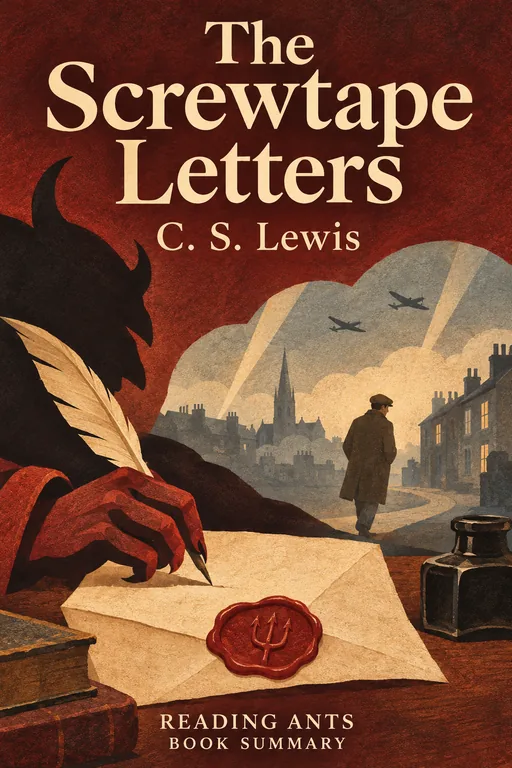
The Screwtape Letters
In a series of letters from an experienced devil to his nephew, a junior tempter, C. S. Lewis humorously reveals how everyday temptations can lead an ordinary person away from goodness, and by contrast shows what a good life looks like.
Overview
The Screwtape Letters was published in 1942 by C. S. Lewis, and first appeared as a weekly series in an Anglican newspaper. It consists of thirty-one letters, written by Screwtape, a senior devil in the bureaucracy of Hell, to his nephew Wormwood, who has been assigned to tempt a young Englishman during the Second World War. The letters give advice on how to lead the young man, called “the patient,” away from God. The twist is that the devils think of God as “the Enemy” and good as bad, so the reader must read in reverse. The book is a satire, and combines humor with moral insight.
Full Summary
1. Keep him thinking about everything but God
The idea: Screwtape begins by instructing Wormwood that the best way to lead the patient to damnation is not by great arguments, but by keeping his mind on trivial things. If the patient starts thinking seriously about big questions, Wormwood should lead him back to the ordinary bustle of everyday life, which feels more “real”. Screwtape says that people are more easily led astray by distraction than by grand evil.
In real life: It is easier to waste an evening on a screen than to decide to do something worthwhile.
2. Sow doubt and keep faith vague
The idea: The devil advises Wormwood to keep the young man’s religion vague, and to encourage the idea that faith is mainly an emotion or a fashion. When the patient becomes a Christian and starts attending church, Wormwood should make him notice the faults and oddities of the other parishioners, which will make him critical. Screwtape says that the humdrum reality of a congregation is a useful tool for temptation. Later letters suggest encouraging him to keep switching churches, and to prefer a faith that adds something new to the basics.
In real life: It is easy to avoid commitment to a group by focusing on its flaws.
3. Prayer, self-regard and pride
The idea: Many of the letters aim to stop the patient from praying honestly. Screwtape suggests that Wormwood turn the patient’s attention inward, onto himself or onto a mental picture, so that his prayers are no longer addressed to a real Person. Another advice is to lead him into pride, even over his humility, so that when he thinks “I am becoming humble,” pride takes over. The devils study the weak points of human character, such as vanity and self-satisfaction.
In real life: A person who says, “I am so humble,” has missed the point.
4. War, fear and ordinary life
The idea: The setting is wartime, with bombing and fear. Wormwood is delighted by the war, but Screwtape cautions him not to expect too much, since war can also make people think seriously about life and death. He sees chances in fear and hatred, and he warns that the patient might feel love or humility instead of hatred. He also urges Wormwood to keep the patient living in the future, since worrying about what may happen takes the mind away from present duty. Meanwhile the patient makes friends with a couple who mock Christianity, and Screwtape wants their influence to work on him gradually.
In real life: Spending a day worrying about tomorrow prevents you from doing what you can do today.
5. Love and temptation
The idea: The patient meets a young woman and her family, who are devout, and begins to fall in love. This troubles Screwtape, who is alarmed by the girl’s virtue and by her devout, loving household. He looks for ways to turn the courtship to his own use, such as making the patient proud of belonging to a circle of devout Christians, and confusing romantic feeling with lasting love, in the hope of trouble later in the marriage.
In real life: Small irritations can damage a relationship if they are allowed to grow.
6. The patient’s end
The idea: In spite of Wormwood’s efforts, the young man grows in faith and courage, and dies in an air raid, ending up in heaven. Screwtape writes a last furious letter, reproaching Wormwood and reminding him that the punishment for failure is to be devoured by other devils, Screwtape included. The final point is that the devils fail because the human being, with the help of grace, resists. The book ends with the confidence that a person can choose goodness, even in a world of temptation.
In real life: A person’s character is built through many small choices, and one decision can turn the course of a life.
Why It Matters
The Screwtape Letters is one of the best-known works of Christian literature of the twentieth century, and became one of Lewis’s most popular books. Its clever idea, to write from the point of view of a devil, allows Lewis to point out the subtle ways in which we deceive ourselves, such as through distraction, pride and gradual compromise. It is admired for its psychological insight and wit, and has been used in sermons, classes and discussion groups. It has had admirers as varied as US politicians, a Supreme Court justice and novelists. Lewis dedicated it to his friend J. R. R. Tolkien. It continues to be read, including by those who do not share his faith.
Key Takeaways
- Small steps lead astray. Temptation often comes through gradual changes.
- Distraction is a powerful tool. Trivial things can keep us from what matters.
- Pride hides in humility. Self-regard can be subtle.
- Ordinary virtues matter. Love, faith and courage are strong defenses.
- Choice remains. People can resist and grow.
What We Can Learn
Even if you read it as a satire only, the book can help you to see your own habits. Notice how often you drift from your aims through small distractions, and how you excuse yourself. Look for pride in unexpected places, such as in comparing your efforts to those of others. Pay attention to the little unkindnesses that can wear down friendships. And try to do what you know to be right in small matters, since they shape you. If you are religious, the book can deepen your examination of conscience; if not, it can still provide insights into human nature.
Criticism and Counterpoints
Some readers find the book’s picture of Hell as a bureaucracy amusing, but others find it a repetitive or trivial approach to evil. Some critics note that the book reflects a particular, traditional Christian view, and that its comments about church and society are specific to its time. A few readers have said that the viewpoint of a devil is disturbing, and Lewis himself said that writing it was not fun. Others note that it is not a systematic theology, but a collection of insights.
Who Should Read It
This book is for readers who enjoy satire and moral reflection, and who like Lewis’s other works. It is short, though reading it needs some attention to its irony. Those who dislike religious topics may not enjoy it, but many find its humor and insight rewarding.
Want the whole book?
A summary is a taste, not the meal. Here is where to find the full book.
You reached the end 🎉
Nicely done. Mark this one as read, and we will suggest what to read next.
Read this next
Mere Christianity
C. S. Lewis
C. S. Lewis, the author of the Narnia stories, explains and defends the central beliefs that most Christians share, using reason, plain language and vivid examples.
🕊️ Philosophy & Religion
The Divine Comedy
Dante Alighieri
Lost in a dark wood in the middle of his life, the poet Dante journeys through Hell, Purgatory and Heaven, guided first by the poet Virgil and then by his beloved Beatrice, on a quest to understand sin, redemption and divine love.
🎭 Epics, Drama & Poetry
The Lion, the Witch and the Wardrobe
C. S. Lewis
Four children step through a wardrobe into the magical land of Narnia, where a wicked witch has made it always winter, and with the help of the great lion Aslan they fight to set the land free.
🧸 Children's Books
Paradise Lost
John Milton
Milton's epic poem tells how Satan rebelled against God, was cast into hell, tempted Adam and Eve to disobey, and caused humanity's expulsion from the Garden of Eden.
🎭 Epics, Drama & Poetry
The Brothers Karamazov
Fyodor Dostoevsky
When a vulgar, greedy landowner is murdered, his three very different sons, a passionate soldier, a rational intellectual and a gentle novice monk, are drawn into a mystery that is also a debate about faith, doubt, guilt and freedom.
🌍 World Literature
The Art of War
Sun Tzu
The greatest victory is the one won without fighting, achieved through careful planning, knowing both yourself and your opponent, and using deception, flexibility and timing.
🕊️ Philosophy & ReligionWant something different?
Pick another topic and we will show you three books to start with.