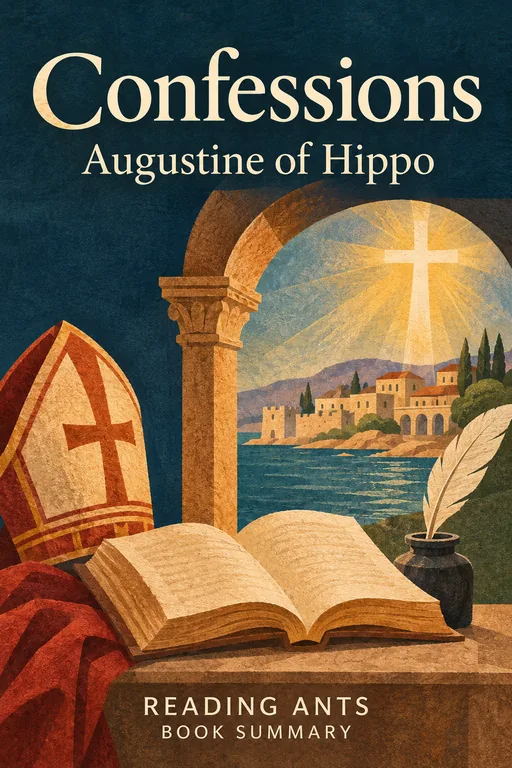
Confessions
Original title: Confessiones
Augustine, a bishop in Roman North Africa, tells the story of his restless youth and his conversion to Christianity, in a long prayer addressed to God that is also a deep inquiry into memory, time and the human heart.
Overview
Confessions was written around the year 400 by Augustine of Hippo, one of the most influential Christian thinkers. Born in North Africa in 354, he became a teacher of rhetoric, and later the bishop of the city of Hippo. The book has thirteen parts. The first nine are an account of his life up to his conversion and the death of his mother. The last four turn to philosophical and theological questions. Throughout, Augustine speaks to God, not only to readers, and the word “confession” has two senses: admitting his faults and praising God. The work is often called the first autobiography in the Western tradition.
Full Summary
1. A restless child
The idea: Augustine describes his childhood in the small North African town of Thagaste, as the son of a pagan father and a devout Christian mother, Monica. He remembers being a clever but willful boy, who disliked school and was beaten for it. He notes his early sins, which seem small but reveal his nature. He makes a point of the fact that even a baby is selfish, and he uses these memories to ask how evil enters a human life.
In real life: Looking back at your own childhood may show how early habits and desires began to form.
2. The pear tree
The idea: One of the most famous episodes is the theft of pears, when Augustine was sixteen. He and some friends robbed a neighbor’s tree, though they were not hungry, and threw most of the fruit to pigs. Augustine analyzes why he did it, and concludes that he enjoyed the sin itself, and the company of those who shared it. He uses the incident to reflect on the strange attraction of wrongdoing, and on the way that peer pressure can lead us to do things we do not want.
In real life: A person who joins in a prank because friends are doing it may later wonder why.
3. Pursuit of success and wisdom
The idea: Augustine goes to Carthage to study, where he indulges in pleasures, takes a partner with whom he has a son, Adeodatus, and falls in love with philosophy after reading Cicero’s Hortensius. He joins a religious group called the Manichaeans, who offered an answer to the problem of evil, and stays for about nine years. Gradually, he becomes dissatisfied with their teaching. He moves to Rome and then to Milan, seeking a career as a teacher of rhetoric.
In real life: A person may spend years in a group or a path before realizing that it does not answer their deepest questions.
4. Ambrose, doubt and the search for truth
The idea: In Milan, Augustine hears the sermons of Bishop Ambrose, and is impressed by his eloquence and his intelligent way of reading the Bible. He also reads works of Platonist philosophers, which help him to think of God as spiritual and of evil as a lack of good, and not a substance. His mother joins him, and prays for his conversion. Augustine feels torn between his desires, including ambition and relationships, and his growing sense of the truth.
In real life: Sometimes a new idea does not change us at once, but makes it impossible to go back to the old way of thinking.
5. The garden in Milan
The idea: The turning point comes in a garden in Milan, where Augustine, in anguish about his divided will, hears a child’s voice, as though chanting a phrase that he takes to mean “take up and read.” He picks up a book of letters by the apostle Paul and reads a passage which tells him to put aside self-indulgence and to follow Christ. At that moment, he says, the doubts vanish. Some months later he is baptized in Milan, along with his son Adeodatus and his friend Alypius.
In real life: A change of life can come after years of inner struggle, in a moment that seems small from the outside.
6. Monica and the questions of memory and time
The idea: On the journey home to Africa, Augustine’s mother dies at Ostia, the port near Rome, and he writes of her faith and their last conversation, in which they glimpse the eternal. In the last four books, Augustine turns from his past to his present state and to philosophical problems. He explores memory, which he compares to a vast storehouse in which the mind holds its experiences. He asks what time is, a question that he says he understands until he is asked to explain it. He concludes with a meditation on creation and rest, reading the opening chapters of Genesis.
In real life: Asking “What is time?” or “How do I remember?” can make something familiar feel mysterious.
Why It Matters
Confessions is one of the great books of Western literature. It shaped Christian thought for centuries, and influenced writers and philosophers from the Middle Ages to modern times. The idea of an inner life, in which a person examines his or her motives, owes much to Augustine’s example. His analysis of memory, time and the will has been studied by philosophers, and his statement that the human heart is restless until it finds rest in God is among the most quoted lines in religious writing. For readers of any belief, it is a rare and honest self-portrait from late antiquity.
Key Takeaways
- Self-examination is valuable. Honest reflection reveals our motives and flaws.
- Desires can pull in different directions. Inner conflict is part of human life.
- Peer pressure can lead us astray. The pear theft shows this.
- Memory and time are mysteries. Familiar things can raise deep questions.
- Searching can end in rest. For Augustine, faith answered his restlessness.
What We Can Learn
You do not need to share Augustine’s beliefs to benefit from the practice of honest self-examination. Try writing about a time you did something that you cannot explain, and ask what you wanted. Notice the influence of friends on your choices. Be patient with long searches for meaning, and with the way that change can come slowly and then suddenly. And pay attention to the people who pray, hope and care for you, as Monica did for her son. Reading a great spiritual autobiography can also help you to see your own journey in a wider context.
Criticism and Counterpoints
Some readers find Augustine’s account of his own sins, including his relationships, to be exaggerated or too harsh, and criticize his attitude toward sexuality and the body, which influenced later Christian teaching in ways that many consider unhealthy. Historians note that the book is not a neutral memoir, but a work shaped by his later theology, and that it may reflect a selective memory. Philosophers may find the later books difficult or speculative. Others have questioned his teaching on original sin and on predestination. The work is best read both as literature and as a historical document.
Who Should Read It
This book is for readers interested in religion, philosophy and the history of ideas, and for anyone who likes a candid look at a person’s inner life. The text is long, and some of the later books are demanding. Many readers begin with the first nine books, and modern translations make it more accessible.
Want the whole book?
A summary is a taste, not the meal. Here is where to find the full book.
You reached the end 🎉
Nicely done. Mark this one as read, and we will suggest what to read next.
Read this next
Meditations
Marcus Aurelius
The private notebook of a Roman emperor, reminding himself daily to accept what he cannot control, to act with justice and kindness, and to remember that life is short.
🕊️ Philosophy & Religion
Mere Christianity
C. S. Lewis
C. S. Lewis, the author of the Narnia stories, explains and defends the central beliefs that most Christians share, using reason, plain language and vivid examples.
🕊️ Philosophy & Religion
Apology (The Trial and Death of Socrates)
Plato
Plato's account of the speech that Socrates gave when he was put on trial in Athens in 399 BCE shows a philosopher who refuses to give up questioning, even if it costs him his life.
🕊️ Philosophy & Religion
The Art of War
Sun Tzu
The greatest victory is the one won without fighting, achieved through careful planning, knowing both yourself and your opponent, and using deception, flexibility and timing.
🕊️ Philosophy & Religion
Tao Te Ching
Laozi
The deepest wisdom is to live in harmony with the Tao, the natural way of the universe, by being humble, gentle and simple, and by acting without force.
🕊️ Philosophy & Religion
The Analects
Confucius
A good life and a good society are built on personal virtue: being kind, respectful and honest, learning constantly, honoring family, and leading others by example rather than by force.
🕊️ Philosophy & ReligionWant something different?
Pick another topic and we will show you three books to start with.