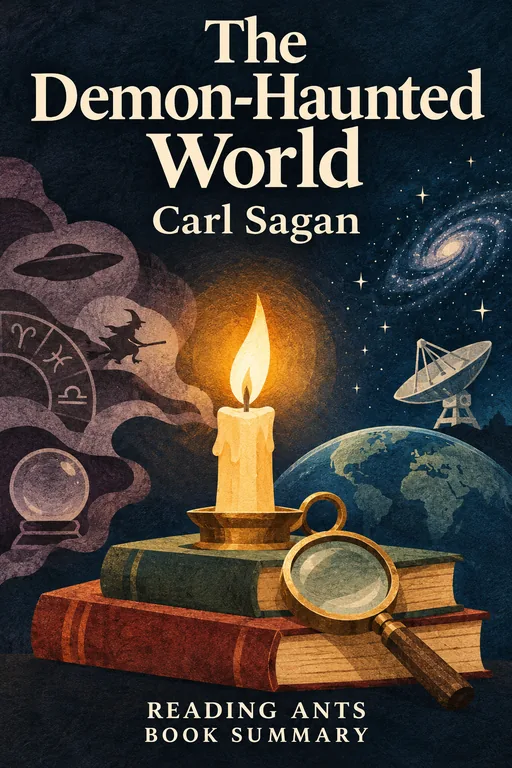
Carl Sagan defends science as a candle in the dark against superstition and pseudoscience, and offers a "baloney detection kit" of tools for thinking critically and for testing claims.
Overview
The Demon-Haunted World: Science as a Candle in the Dark was published in 1995 by Carl Sagan, an astronomer and one of the best-known science communicators of the twentieth century. It was one of his last books, and he died the following year after a long illness. Sagan was worried that many people believed in claims such as alien abduction, astrology and faith healing, and that science education was failing. The book mixes personal stories, history and arguments, and takes on topics from UFOs to witch hunts, and from the scientific method to democracy.
Full Summary
1. The most precious thing we have
The idea: Sagan starts by describing science as a way of thinking, more than a body of facts. It involves curiosity, skepticism and a willingness to change our minds when the evidence demands. It is, he says, a candle in the dark, which can be blown out by superstition and ignorance. He laments that most people have little understanding of how science works, even though modern life depends on it, which he calls a prescription for disaster and which leaves people open to pseudoscience and superstition.
In real life: A person who understands how a medicine is tested can better judge a claim for a cure.
2. Alien abduction and the appeal of the unusual
The idea: The author examines claims of encounters with aliens, and the reports of people who believe that they have been abducted. He treats the witnesses with respect, but explains that experiences such as sleep paralysis, vivid dreams and suggestion may explain them. He notes that old myths of demons, incubi and visitors have taken a modern form. He argues that the existence of strong feelings is not proof that the claims are true.
In real life: A vivid dream may feel real, but that does not mean that it happened.
3. The baloney detection kit
The idea: The most famous chapter lists tools for skeptical thinking. They include seeking independent confirmation of the facts, encouraging debate, not trusting arguments from authority alone, considering more than one hypothesis, not being too attached to one’s own idea, quantifying where possible, checking every link in a chain of argument, and using Occam’s razor, which says to prefer the simpler explanation. A key rule is that a claim must be falsifiable: it must be possible to test and show it to be wrong.
In real life: If a friend says that a product cures everything, ask what evidence there is and whether it could be tested.
4. Common fallacies
The idea: Sagan also lists mistakes in reasoning to avoid. They include ad hominem, attacking the person instead of the argument; the argument from authority; appeals to ignorance, which says that a claim is true because it has not been disproved; the slippery slope; and false dichotomy, offering only two options. He says that these are used to persuade, and that we should recognize them. He adds that the kit can be misused or applied by rote, and that it is useful for checking our own arguments before we present them.
In real life: “You can’t prove it’s not true” is not a reason to believe something.
5. Witch hunts, history and the costs of credulity
The idea: Sagan describes how, in earlier centuries, belief in demons and witches led to the persecution and killing of many people, often women, and how a few critics, such as a Jesuit priest who wrote against the trials, spoke out. He says that the same patterns of fear and certainty appear in modern forms, and that the credulous can be manipulated. He argues that critical thinking protects against injustice, and that a society that cannot tell sense from nonsense is at risk.
In real life: Rumors and panic can lead groups to hurt innocent people.
6. Science, education and democracy
The idea: In the final part, the author connects science with democracy, saying that both depend on open questioning, evidence and the correction of errors. He calls for better science education, starting with children, who are naturally curious, and for teachers to encourage questions. He also warns that science can be misused, criticizing for example the physicist Edward Teller, and says that scientists should alert the public to the issues that matter. He ends by arguing that children everywhere should be taught the scientific method and the reasons for protecting free speech, which he says may be what stands between us and the surrounding darkness.
In real life: A school where students are encouraged to ask “how do we know?” builds good habits.
Why It Matters
The Demon-Haunted World is regarded as a classic defense of scientific thinking, and the “baloney detection kit” is widely used in education and in debates about pseudoscience. The book anticipated concerns about misinformation and about the public understanding of science, which have become more pressing since. It has been praised for its warmth, humility and passion, and Sagan’s call for compassionate skepticism has inspired many readers and teachers. Sagan also shows respect for people who hold unusual beliefs, even while he challenges the claims. It remains a favorite of many readers.
Key Takeaways
- Science is a way of thinking. It values evidence and a readiness to change one’s mind.
- Use a baloney detection kit. Seek confirmation, test claims and prefer simple explanations.
- Beware of common fallacies. Learn to spot bad arguments.
- Credulity has costs. Superstition has led to real harm.
- Education supports democracy. A scientifically literate public is better able to decide.
What We Can Learn
The next time you hear an extraordinary claim, ask what evidence there is, and whether it could be tested. Try to find independent confirmation, and notice whether an argument depends on authority or on fear. Practice saying “I don’t know” and look into it. Be kind to people who hold different beliefs, and ask questions in a respectful way. Encourage children’s curiosity. And remember that skepticism is not cynicism: it includes being open to surprising ideas when the evidence supports them.
Criticism and Counterpoints
Some reviewers found the book too long. Others said that it ignores other reasons why people and governments turn away from science, or that it says too little about scientists’ own duty to teach the public. Some thought that its treatment of religion draws too sharp a line between science and irrationality, and one biologist argued that Sagan did not apply his own method when claiming that humans have a natural bent for science. A 2012 article called it somewhat dated, though still insightful, and some of its examples, such as the face on Mars, are from the 1990s. Still, its main message is widely accepted.
Who Should Read It
This book is for readers who care about critical thinking, science and education, including teenagers. It is engaging and humane. Those who want a stricter analysis of philosophy of science could add other works.
Want the whole book?
A summary is a taste, not the meal. Here is where to find the full book.
You reached the end 🎉
Nicely done. Mark this one as read, and we will suggest what to read next.
Read this next
Pale Blue Dot
Carl Sagan
Carl Sagan reflects on a photograph of Earth taken from far out in space, in which our planet is a tiny speck, to argue that humanity should be humble, care for our fragile world and aim to explore the solar system and beyond.
🔬 Science
Bad Science
Ben Goldacre
Doctor and writer Ben Goldacre exposes how pseudoscience, bad statistics, misleading press stories and the tactics of the pharmaceutical and supplement industries distort what we think we know about health, and teaches readers how to evaluate evidence.
🔬 Science
How to Lie with Statistics
Darrell Huff
Darrell Huff shows, in a light and witty tour of tricks used by advertisers, journalists and others, how numbers, charts and averages can mislead, so that readers can learn to spot the deceit.
🔬 Science
The Scout Mindset
Julia Galef
Julia Galef contrasts the "soldier mindset," which defends our beliefs, with the "scout mindset," which tries to see things as they are, and shows how to build the habit of honest, curious thinking.
🧩 Mind & Psychology
Brief Answers to the Big Questions
Stephen Hawking
Physicist Stephen Hawking, in a posthumous book drawn from his lectures and writing, gives short answers to ten of the biggest questions that people ask, from the origin of the universe to the future of humanity.
🔬 Science
A Brief History of Time
Stephen Hawking
One of the world's greatest physicists explains, with almost no math, what we know about the origin, structure and fate of the universe, from the Big Bang to black holes and the nature of time itself.
🔬 ScienceWant something different?
Pick another topic and we will show you three books to start with.