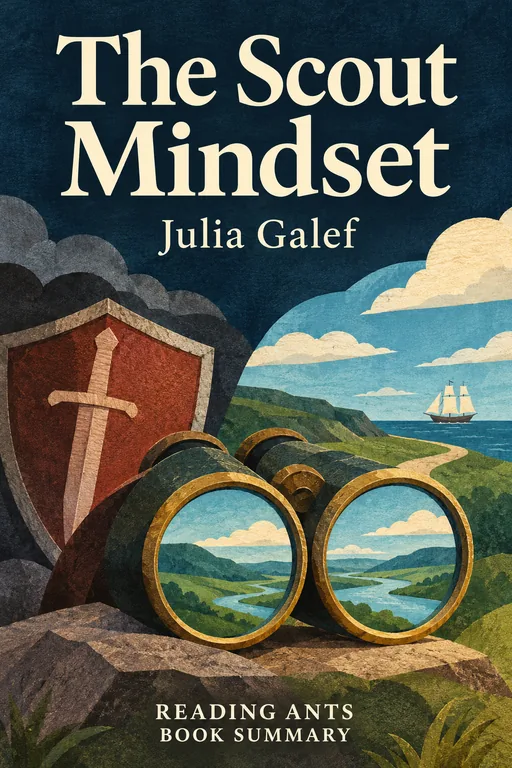
Julia Galef contrasts the "soldier mindset," which defends our beliefs, with the "scout mindset," which tries to see things as they are, and shows how to build the habit of honest, curious thinking.
Overview
The Scout Mindset: Why Some People See Things Clearly and Others Don’t was published in 2021 by Julia Galef, who co-founded the Center for Applied Rationality and hosted a podcast about reasoning. The book argues that the biggest obstacle to good judgment is not a lack of intelligence or information, but the motive with which we think. She draws on psychology and on stories from history, business and survival at sea. The tone is friendly and practical, and the book is meant for readers who want to improve their thinking, not just to learn about biases.
Full Summary
1. Two mindsets: soldier and scout
The idea: Galef borrows the idea of motivated reasoning. In the soldier mindset, thinking is like fighting: we defend our beliefs against attack, and hunt for evidence to support them. In the scout mindset, thinking is like mapmaking: the aim is to see the terrain as accurately as possible, whether or not the news is good. Scouts feel curiosity when they find that they are wrong, since it improves the map. Most of us shift between the two, but the soldier takes over more than we realize.
In real life: Someone who wants to be right in an argument acts like a soldier, while someone who wants to find out the answer acts like a scout.
2. Why we choose the soldier
The idea: The author explains that the soldier mindset serves emotional needs: comfort, self-esteem, morale, persuasion and image. Believing something pleasant can feel good, and showing confidence can win others over. She says that these benefits are real, but often smaller than we think, and that we can find other ways to meet these needs without distorting the truth. She notes that the cost of self-deception is that we make worse decisions. She also argues that supposed benefits such as staying happy, coping with hard situations, motivating ourselves and influencing others can be gained without giving up good judgment, and she points to Jeff Bezos and Elon Musk, who she says were not overconfident about their chances when they started out, and to the sailor Steven Callahan, who survived weeks on a life raft through careful decisions and by avoiding self-deception.
In real life: Telling yourself that a risky plan is certain to work feels good, but may lead you into trouble.
3. Signs of a scout
The idea: Galef describes habits of scouts. They tell other people when they are wrong, and react to criticism with curiosity. They test their own beliefs, and ask whether they would apply the same standards to those they disagree with. She suggests tests such as the double standard test, imagining that the same behavior was by someone on the other side; the outsider test, asking what someone new would do; and the conformity test, asking whether you would still hold a view if others did not.
In real life: If you excuse a mistake by a friend, ask whether you would excuse it by someone you dislike.
4. Calibration: how sure are you?
The idea: Scouts think in degrees of confidence and try to be calibrated, so that when they say they are ninety percent sure, they are right about nine times out of ten. Galef offers exercises, such as making predictions and checking them, and the “bet test,” asking whether you would put money on a claim. She argues that expressing uncertainty is not weakness, and can be a source of credibility, if it is accurate.
In real life: Writing down predictions about your own plans, and checking them later, shows how well you know yourself.
5. How to be wrong, and how to change your mind
The idea: The book encourages readers to treat mistakes as information. She suggests paying attention to things that are confusing or do not make sense, since they may signal that your picture is off, and reacting to evidence that you are wrong by updating your beliefs rather than seeing the mistake as a failure. She tells of Georges Picquart, a military official who, despite his own prejudice and outside pressure, worked to find the evidence that cleared Alfred Dreyfus, who had been wrongly convicted. Learning to engage productively with views that differ from yours helps.
In real life: If a friend gives you an argument that you cannot answer, thanking them is a sign of maturity.
6. Holding your identity lightly
The idea: Galef argues that when a belief becomes part of a person’s identity, it is harder for that belief to change, and so strong attachment to labels, such as political or religious identities, makes us defensive. She suggests limiting how much an ideology or movement becomes part of your identity, and argues that, perhaps surprisingly, holding your identity lightly can even help in activism. She also gives reasons to make the scout mindset itself part of your identity, and to treat the pursuit of truth as something you are proud of.
In real life: A person who defines themselves as someone who follows evidence may find it easier to change their mind.
Why It Matters
The Scout Mindset was widely praised, and became a popular guide to rational thinking. The Wall Street Journal included it on its 2022 list of twelve books to start a smart new year. Its simple metaphor, soldier versus scout, is easy to remember and use, and the book offers practical tools rather than only an account of biases. Its framework has a basis in psychological research, and the scout mindset resembles the “actively open-minded thinking” described by the psychologist Jonathan Baron. In a time of polarization and misinformation, its call to see things as they are, even when it is uncomfortable, has been widely valued. It is popular with readers interested in rational thinking.
Key Takeaways
- Motivation shapes thinking. We often defend beliefs instead of testing them.
- Aim to see clearly. The scout wants an accurate map.
- Use simple tests. Ask whether you apply a double standard.
- Be calibrated. Match confidence to evidence.
- Hold identity lightly. It makes changing your mind easier.
What We Can Learn
You can practice by noticing when you feel defensive, and asking what you are trying to protect. Try the double standard test the next time you judge someone’s behavior. Make small predictions, such as about test results, and note how often you are right. Look for people who disagree with you in a respectful way, and ask them to explain their reasons. Celebrate when you find a mistake in your own thinking. And remember that the goal is not to be harsh with yourself, but to be curious.
Criticism and Counterpoints
Galef herself lists several benefits of the soldier mindset, such as comfort, morale and persuasion, but argues that people systematically underestimate the value of the scout mindset, and not every reader agrees with how she weighs them. The psychologist Benjamin Lovett, writing in a journal, found the scout and soldier mindsets a useful framework for thinking about advocacy and objectivity, but was not convinced by her claim that the scout mindset makes advocates more effective, which he said is true sometimes but not always. A book of advice also cannot guarantee that readers will actually practice it, since calibration and open-minded habits take effort.
Who Should Read It
This book is for anyone who wants to think more clearly and to disagree more productively. It is short, readable and full of examples. Those who want a rigorous study of cognitive biases should read Kahneman’s Thinking, Fast and Slow.
Want the whole book?
A summary is a taste, not the meal. Here is where to find the full book.
You reached the end 🎉
Nicely done. Mark this one as read, and we will suggest what to read next.
Read this next

Thinking in Bets
Annie Duke
Former professional poker player Annie Duke argues that life's decisions are bets made with incomplete information, and shows how to judge decisions by their quality and not their results, by thinking in probabilities and by learning with the help of honest groups.
🧩 Mind & Psychology
Think Again
Adam Grant
Organizational psychologist Adam Grant argues that in a fast-changing world the ability to rethink and unlearn is as valuable as intelligence, and he shows how to question our own views and help others to open theirs.
🧩 Mind & Psychology
Thinking, Fast and Slow
Daniel Kahneman
Our minds run on two systems, a fast, intuitive one and a slow, careful one, and understanding how the fast system fools us can help us make better decisions about money, risk, work and happiness.
🧩 Mind & Psychology
Superforecasting
Philip E. Tetlock and Dan Gardner
Political scientist Philip Tetlock and journalist Dan Gardner report on a research project that found some ordinary people can predict world events better than experts, and describe the habits that make them so good.
🧩 Mind & Psychology
The Righteous Mind
Jonathan Haidt
Jonathan Haidt argues that moral judgments come mainly from intuition and emotion, not reason, that people's moral instincts rest on several foundations that differ across political groups, and that understanding this can help us to disagree without hating each other.
🧩 Mind & Psychology
Predictably Irrational
Dan Ariely
Behavioral economist Dan Ariely uses entertaining experiments to show that people's decisions are shaped by predictable mental quirks, such as relativity, the lure of "free" and social norms, rather than by cool, rational calculation.
🧩 Mind & PsychologyWant something different?
Pick another topic and we will show you three books to start with.