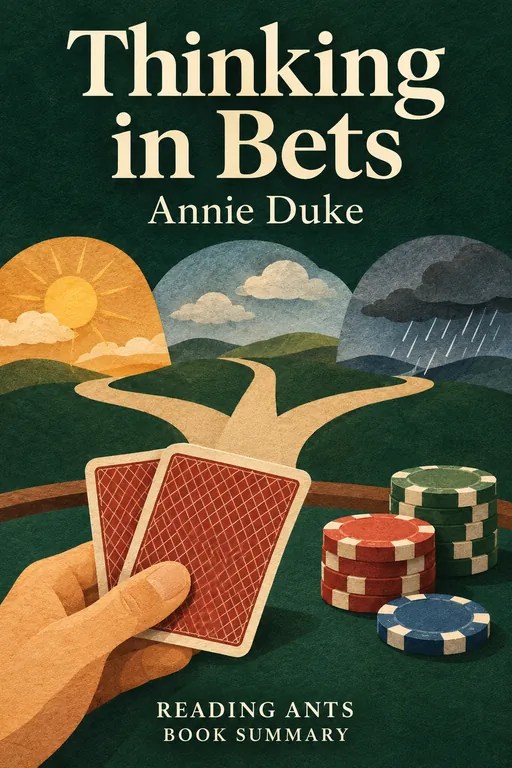
Former professional poker player Annie Duke argues that life's decisions are bets made with incomplete information, and shows how to judge decisions by their quality and not their results, by thinking in probabilities and by learning with the help of honest groups.
Overview
Thinking in Bets: Making Smarter Decisions When You Don’t Have All the Facts was published in 2018 by Annie Duke, who won a World Series of Poker bracelet and later became a speaker and consultant on decision making. She had earlier studied psychology and worked toward a doctorate in it. The book uses lessons from poker, a game of skill and luck in which one never has all the information, to describe how to make better choices in business, sports and daily life. She combines stories from her career with research from psychology and behavioral economics.
Full Summary
1. Life is poker, not chess
The idea: Duke opens with a famous decision in a football game, the Super Bowl call by Seahawks coach Pete Carroll to pass near the goal line, which was intercepted and widely criticized. She says that people judge decisions by how things turn out, which she calls “resulting.” In chess, nothing is hidden, and skill nearly always wins. But in poker, as in life, there is hidden information and luck, so that a good decision can have a bad outcome, and the reverse. We should separate the quality of the decision from the quality of the result.
In real life: Studying hard and still getting a low mark on a test does not mean that studying was a bad plan.
2. Wanna bet?
The idea: The author says that every decision is a bet on a future that is uncertain, and that we should state our beliefs in terms of probability, not certainty. Asking “wanna bet?” makes us examine how sure we really are, and what evidence we have. Instead of being 100 percent sure, we can say we are seventy percent sure. This helps us to be more open to new information, and to avoid being crushed when we are wrong.
In real life: Saying “I’m about 80 percent sure it will rain” is more useful than saying it definitely will.
3. Bet to learn: fielding the outcomes
The idea: Learning from experience is hard, because outcomes are a mix of skill and luck. Duke warns about the tendency to take credit for good results and to blame bad luck for bad ones, a bias called self-serving. To learn, we must sort outcomes into those caused by our decisions and those caused by luck, and be honest about it. She suggests rewarding ourselves for giving credit to others and to luck, for admitting mistakes, and for following a good process, and treating the way we explain an outcome as a bet, which pushes us to consider other causes.
In real life: A student who tells themselves “that exam was just unfair” may miss a chance to improve.
4. The buddy system and dissent: truth-seeking groups
The idea: Duke argues that we can improve our thinking by working with others who are committed to truth, and who challenge our views. She recommends forming a small truth-seeking group, with a charter that stresses accuracy, accountability and diverse perspectives. In these groups, people should feel safe to point out mistakes, and the shared goal of getting closer to the truth matters more than keeping the peace. Duke also discusses dissent: looking for reasons we might be wrong, sharing data even when it is unpleasant, not punishing people who bring bad news, and asking someone to argue the other side. The “red team” idea, in which a group is assigned to challenge a plan, is an example.
In real life: A friend who is willing to tell you that your plan has a flaw is worth listening to.
5. Adventures in mental time travel
The idea: The author describes tools that use the imagination to think more clearly about the future and the past. In a premortem, you imagine that a plan has failed and list the reasons why, which helps to spot risks in advance. In backcasting, you imagine a successful outcome and work backward to see how it came about. She also uses the “10-10-10” approach of Suzy Welch, asking how a decision will look in ten minutes, ten months and ten years, to reduce the grip of the moment.
In real life: Before a big trip, imagining what could go wrong helps you to pack the right things.
6. Decision hygiene: habits and precommitments
The idea: The last part of the book offers methods to make better decisions in the heat of the moment. Duke recommends precommitment, deciding in advance how you will act, for example walking away when you feel “tilted” by emotion. She describes “Ulysses contracts,” precommitments that bind your future behavior, either by raising barriers to bad choices or by lowering barriers to good ones. A simple contract such as a swear jar adds accountability. She also encourages a habit of expressing uncertainty.
In real life: Deciding in advance how much you will spend on a shopping trip helps you to stick to it.
Why It Matters
Thinking in Bets became a national bestseller, found a following among investors, and made the idea of probabilistic thinking accessible to general readers. It popularized the term “resulting” for judging a decision only by its outcome. It also gives readers concrete tools, such as premortems, backcasting, truth-seeking groups and precommitment, which they can try in their own work. The book shows that skills of professional gamblers can be applied outside of cards. It also contributed to a culture of humility and truth-seeking in discussions. Along with the work of Kahneman, Tetlock and others, it is part of a movement to improve how people reason under uncertainty.
Key Takeaways
- Do not judge decisions by results. Luck affects outcomes.
- Think in probabilities. Express beliefs with degrees of confidence.
- Learn honestly from outcomes. Separate skill from luck.
- Use truth-seeking groups. Invite dissent and reward honesty.
- Plan ahead. Use premortems and precommitments so that emotion does not decide for you.
What We Can Learn
You can start by noticing when you judge a choice only by what happened. After a success or a failure, ask what was in your control and what was not. Try expressing your beliefs as percentages, and ask what would change your mind. Find a friend or study group who will give honest feedback, and agree on how to do it kindly. Before a major decision, imagine that it failed and think about why. And be kind to yourself when a good decision leads to a bad result.
Criticism and Counterpoints
The book leans on poker as its model, and poker may not fit every decision, especially those where probabilities are hard to estimate. Poker is also a zero-sum game, which differs from cooperative life situations. Much of the advice, such as thinking in probabilities and seeking disconfirming evidence, draws on earlier work in psychology and decision science, so readers who know that work may find little that is new. Still, many find the practical framework helpful.
Who Should Read It
This book is for anyone who wants to make better decisions, including students, managers and investors. It is lively and easy to read, though you do not need to know poker. Those who want a deeper treatment of the research on judgment can also read Kahneman and Tetlock.
Want the whole book?
A summary is a taste, not the meal. Here is where to find the full book.
You reached the end 🎉
Nicely done. Mark this one as read, and we will suggest what to read next.
Read this next
Thinking, Fast and Slow
Daniel Kahneman
Our minds run on two systems, a fast, intuitive one and a slow, careful one, and understanding how the fast system fools us can help us make better decisions about money, risk, work and happiness.
🧩 Mind & Psychology
The Scout Mindset
Julia Galef
Julia Galef contrasts the "soldier mindset," which defends our beliefs, with the "scout mindset," which tries to see things as they are, and shows how to build the habit of honest, curious thinking.
🧩 Mind & Psychology
Superforecasting
Philip E. Tetlock and Dan Gardner
Political scientist Philip Tetlock and journalist Dan Gardner report on a research project that found some ordinary people can predict world events better than experts, and describe the habits that make them so good.
🧩 Mind & PsychologyThe Most Important Thing
Howard Marks
Howard Marks, a veteran investor, argues that successful investing depends on thinking more deeply than the crowd, understanding risk and cycles, and avoiding big mistakes, more than on finding secret formulas.
💰 Money & EconomicsThe Signal and the Noise
Nate Silver
Statistician and election forecaster Nate Silver explains why most predictions fail, and shows that better forecasting comes from thinking in probabilities, updating with new evidence and being humble about uncertainty.
🔬 Science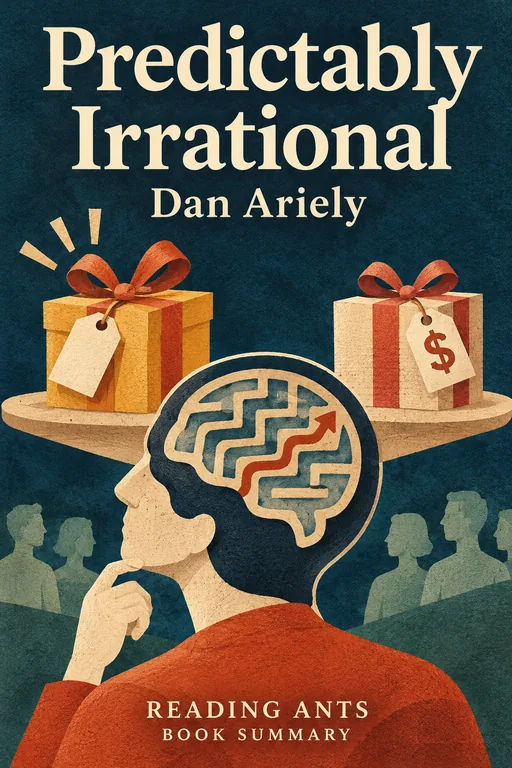
Predictably Irrational
Dan Ariely
Behavioral economist Dan Ariely uses entertaining experiments to show that people's decisions are shaped by predictable mental quirks, such as relativity, the lure of "free" and social norms, rather than by cool, rational calculation.
🧩 Mind & PsychologyWant something different?
Pick another topic and we will show you three books to start with.