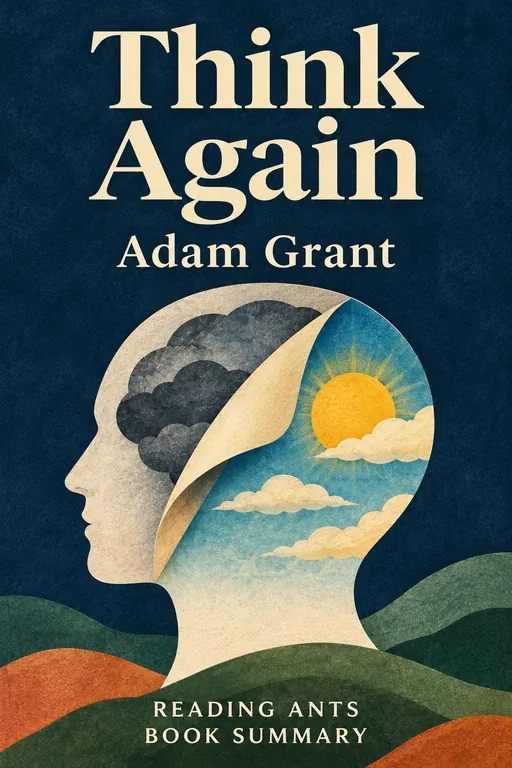
Organizational psychologist Adam Grant argues that in a fast-changing world the ability to rethink and unlearn is as valuable as intelligence, and he shows how to question our own views and help others to open theirs.
Overview
Think Again: The Power of Knowing What You Don’t Know was published in 2021 by Adam Grant, a professor at the Wharton School of the University of Pennsylvania and author of several books on work and motivation. Grant says that we spend most of our effort on thinking and learning, and little on rethinking and unlearning. He draws on research and stories from business, science, education and politics to show why we cling to old opinions, and how we can become more flexible. He also discusses how to have more productive conversations with people who disagree.
Full Summary
1. A preacher, prosecutor, politician and scientist
The idea: Grant describes three mental modes that block rethinking. In preacher mode, we defend our beliefs as sacred. In prosecutor mode, we attack the views of others. In politician mode, we try to win approval. He suggests that we should switch to scientist mode, in which we treat our views as hypotheses, run experiments and change our minds when the data say so. Being a scientist means searching for reasons why we might be wrong.
In real life: Instead of defending your first idea for a project, you test it and see whether it works.
2. The armchair quarterback and the impostor
The idea: The author says that people often fall into two traps related to confidence. The “Dunning-Kruger” effect, in which those with little knowledge are overconfident, is the armchair quarterback. At the other extreme is impostor syndrome, doubts about one’s ability. He proposes “confident humility”: having faith in our ability to reach a goal, while doubting the tools we have right now, and being willing to look for better ones. He suggests that impostor doubt can even have advantages, because it can push us to keep learning.
In real life: A beginner who thinks they know it all may stop learning, while one who doubts a little keeps improving.
3. The joy of being wrong
The idea: Grant argues that we can learn to enjoy discovering that we were wrong, which he illustrates with the psychologist Daniel Kahneman, who was delighted to learn that he was wrong because it meant he was now less wrong than before. He suggests separating our identity from our opinions, so that changing a belief does not feel like losing ourselves. He also encourages people to treat their opinions as hypotheses and to hold them loosely. He praises people who change their minds when evidence changes, as a mark of strength.
In real life: Finding out that you were mistaken about a fact is a chance to learn something new.
4. Challenge networks and good arguments
The idea: Instead of surrounding ourselves with people who agree, Grant suggests building a challenge network, a group of people who will question our thinking and point out our blind spots, but who respect us. He also discusses the difference between task conflict, disagreements about ideas, which can be productive, and relationship conflict, which is not. Good arguments are like a dance, not a war, in which both sides try to learn.
In real life: A friend who points out a flaw in your essay before the teacher does is a help.
5. Motivational interviewing and persuading others
The idea: A large part of the book looks at how to help others to rethink. Grant finds that attacking someone’s beliefs makes them dig in. He describes a method used by counselors, motivational interviewing, in which you ask open-ended questions, listen, and let people discover their own reasons for change. He also notes that people are more open when you acknowledge common ground and complexity, and when you show curiosity about their views, as in the story of the “vaccine whisperer” Arnaud Gagneur, who used these methods to help hesitant parents think about vaccinating their children.
In real life: Asking a friend why they feel a certain way can lead them to reflect, more than a lecture.
6. Learning cultures and rethinking in schools and groups
The idea: In the final chapters, Grant considers how organizations and schools can encourage rethinking. He recommends cultures in which people feel safe to speak up and admit mistakes, with a focus on the process, not only on results. He suggests that teachers ask students to revise their drafts, welcome feedback and test myths, so that rethinking becomes a habit. He also shows how a fixed identity, for example a single career goal chosen early, can block change, and urges readers to question their own plans regularly.
In real life: A classroom where it is acceptable to say “I changed my mind” encourages learning.
Why It Matters
Think Again became a bestseller and was widely read in business and education. It brought the research on belief change, humility and open-mindedness to a large audience, and gave practical tools for conversation across disagreement. Its stories, such as the Black musician Daryl Davis, who listened to members of hate groups and helped many to leave them, show how listening can open minds more than arguing does. Its central message, that rethinking is a skill, resonates in a world of rapid change and polarization. The book is also praised for being accessible and optimistic. It appeared at the same time as other works on rationality, such as The Scout Mindset.
Key Takeaways
- Rethinking is a skill. Unlearning matters as much as learning.
- Be a scientist. Treat beliefs as hypotheses.
- Embrace confident humility. Trust the goal, doubt the method.
- Build a challenge network. Seek out respectful critics.
- Persuade through curiosity. Ask open questions and listen before you try to convince.
What We Can Learn
You can start by asking yourself, “What would change my mind about this?” Notice when you slip into preacher, prosecutor or politician mode. Find a few people who will honestly challenge you, and thank them. When someone disagrees with you, ask them questions about how they came to their view, before presenting yours. Try to enjoy the surprise of being wrong. And revisit your plans and opinions regularly, since the world changes. A simple habit is to ask each month which belief of yours has changed, and why.
Criticism and Counterpoints
Some reviewers say that the book relies on engaging stories and tips, that its research is presented selectively, and that some of the studies it cites have not been replicated cleanly. Others find it short on surprising insights, or suggest that it favors advice that is easy for readers to accept. Readers may also wonder how far conversation alone can shift deeply held beliefs, and where open-mindedness should stop when the evidence is strong.
Who Should Read It
This book is for readers who want to be more open-minded and to talk more productively with those who disagree. It is lively and easy to follow. Those who want a deeper treatment of the psychology of belief might also read the original research.
Want the whole book?
A summary is a taste, not the meal. Here is where to find the full book.
You reached the end 🎉
Nicely done. Mark this one as read, and we will suggest what to read next.
Read this next
The Scout Mindset
Julia Galef
Julia Galef contrasts the "soldier mindset," which defends our beliefs, with the "scout mindset," which tries to see things as they are, and shows how to build the habit of honest, curious thinking.
🧩 Mind & Psychology
Thinking in Bets
Annie Duke
Former professional poker player Annie Duke argues that life's decisions are bets made with incomplete information, and shows how to judge decisions by their quality and not their results, by thinking in probabilities and by learning with the help of honest groups.
🧩 Mind & Psychology
Mindset: The New Psychology of Success
Carol S. Dweck
Psychologist Carol Dweck shows that people who believe abilities can grow, a growth mindset, learn, cope with failure and achieve more than people who believe their talents are fixed.
🌱 Self-ImprovementMake It Stick
Peter C. Brown, Henry L. Roediger III and Mark A. McDaniel
A writer and two cognitive scientists explain, with research and stories, that effective learning is often effortful, and that retrieval practice, spacing, interleaving and other "desirable difficulties" help knowledge to stick, while popular habits such as rereading do not.
🌱 Self-Improvement
Thinking, Fast and Slow
Daniel Kahneman
Our minds run on two systems, a fast, intuitive one and a slow, careful one, and understanding how the fast system fools us can help us make better decisions about money, risk, work and happiness.
🧩 Mind & Psychology
Predictably Irrational
Dan Ariely
Behavioral economist Dan Ariely uses entertaining experiments to show that people's decisions are shaped by predictable mental quirks, such as relativity, the lure of "free" and social norms, rather than by cool, rational calculation.
🧩 Mind & PsychologyWant something different?
Pick another topic and we will show you three books to start with.