 Reading Ants
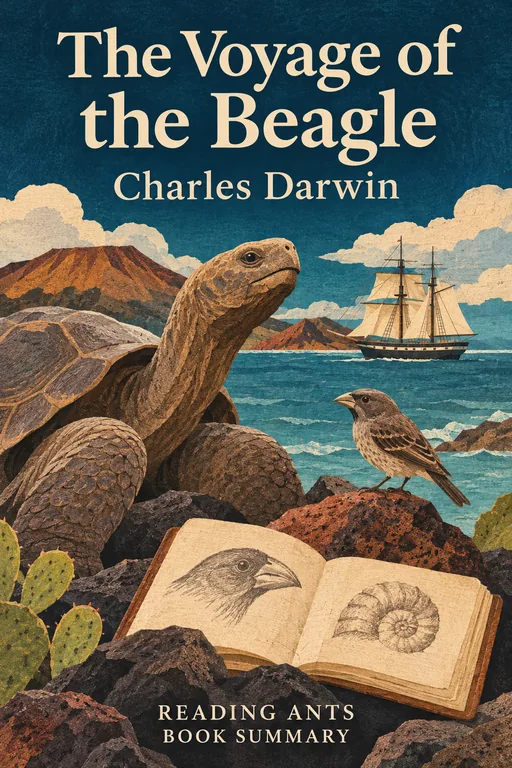
The Voyage of the Beagle
Charles Darwin's lively journal of his five-year voyage around the world on HMS Beagle records the animals, plants, rocks and peoples that he saw, and the observations that led him toward the theory of evolution.
Overview
The Voyage of the Beagle, first published in 1839 as Journal and Remarks (soon reissued as Journal of Researches), is Charles Darwin’s account of the survey voyage of the ship HMS Beagle, which left England in December 1831 and returned in October 1836. Darwin, then in his early twenties, went as a naturalist and a companion to the captain, Robert FitzRoy. The ship sailed to South America, the Galapagos Islands, Tahiti, New Zealand, Australia and back, and Darwin spent much of the time on land, collecting specimens. The book is not about evolution directly, but gives the observations that shaped his thinking, written in an engaging and descriptive style.
Full Summary
1. Setting out and the tropics
The idea: The book begins with the ship sailing from Devonport in December 1831, and Darwin mentions that he suffered from seasickness at sea. In the Cape Verde islands and then in Brazil, he is overwhelmed by the richness of the tropical forest, writing of the insects, flowers and sounds with delight. He observes the geology, noticing, in the islands, the evidence that the land has been raised or sunk. He draws throughout on the ideas of Charles Lyell, whose Principles of Geology argues that the earth has been shaped slowly over vast time.
In real life: Seeing a new environment for the first time can make everything seem fresh and strange.
2. Fossils, gauchos and the pampas
The idea: In Argentina and Uruguay, Darwin travels on horseback with the gauchos, and finds giant fossil bones of extinct animals, such as giant sloths and armadillo-like creatures, in cliffs. He is struck that these extinct animals are similar to living species in the same region, a clue that species may be related by descent. He also describes the wildlife of the plains, such as rheas, the large flightless birds, and notes that a smaller kind of rhea, later named after him, replaces the common one in southern Patagonia.
In real life: Finding a fossil in your own area that resembles a living animal suggests a connection.
3. The Andes, an earthquake and the shape of the land
The idea: In Chile, Darwin experiences a major earthquake, and sees that the land has been raised, with shells found above the sea. He crosses the Andes, and finds marine shells high in the mountains, which suggests that the mountains were once under the sea. This supports the idea that the earth changes slowly through the action of forces that can still be seen. His geological observations were an important part of his scientific reputation.
In real life: A seashell at the top of a mountain tells a long story.
4. The Galapagos Islands
The idea: The best-known part of the voyage is the stay of about five weeks at the Galapagos Islands. Darwin finds giant tortoises, marine iguanas, and many birds, such as mockingbirds and finches. He notes that the tortoises and mockingbirds differ from island to island, and the vice-governor tells him that he can tell which island a tortoise came from. At the time, he did not fully realize the significance, but later, back in England, the differences helped him to see that species could change as they adapted to different islands.
In real life: Small differences among creatures on separate islands can show how they diverge.
5. Peoples, slavery and the human side
The idea: Darwin also writes about the people he meets. In Tierra del Fuego, he meets the Fuegians, whom he describes with a mixture of astonishment and the prejudices of his time, and he describes the three Fuegians on board who had been taken to England by FitzRoy years earlier and were now being returned home. In Brazil, he is appalled by slavery, and writes with anger of its cruelty, and of those who excuse it. He notes the effects of European colonization on native peoples in South America and Australia.
In real life: A traveler may be shaped as much by what he sees of human suffering as by the plants and animals.
6. Coral reefs, the Pacific and the voyage home
The idea: He visits Tahiti, New Zealand and Australia, and compares the plants and animals of each. In Australia he sees a kangaroo rat chased by dogs and watches platypuses in a pond, calling the platypus a most extraordinary animal. Crossing the Indian Ocean, he studies coral reefs and atolls, notably at the Keeling Islands, and sets out his theory that atolls grow upward as volcanic islands slowly sink, an idea later largely confirmed. After a long journey, the ship returns to England. Darwin closes with a retrospect on the voyage, and later wrote in his autobiography that it was the most important event of his life.
In real life: A long journey can change the direction of a whole life.
Why It Matters
The Voyage of the Beagle is one of the great travel books and a classic of natural history, and is the best way to see the young Darwin at work. It was popular when it was published, and made his name before On the Origin of Species appeared in 1859. The observations he made on the voyage, of fossils, island species and geology, became the foundation of his later theories, and the book shows how a scientist’s thought develops from careful observation. It is still widely read, and is valued for its vivid descriptions and for its curiosity, honesty and humor.
Key Takeaways
- Careful observation leads to big ideas. Darwin noticed patterns that others missed.
- The earth changes slowly. Geology shows long processes.
- Island species vary. Differences among islands suggest adaptation.
- Fossils link past and present. Extinct animals resemble living ones nearby.
- Curiosity is the engine. A young naturalist’s voyage changed science.
What We Can Learn
You can follow Darwin’s example by keeping a notebook, and recording what you see in nature, with details and questions. Notice patterns, such as how animals differ from place to place. Be patient, since the meaning of observations may only become clear later. Treat people and creatures with respect, and speak up against cruelty, as Darwin did on slavery. Read the book for pleasure, as a story of adventure. And visit a natural history museum or a local park with the eyes of a naturalist.
Criticism and Counterpoints
Some modern readers note that Darwin’s descriptions of native peoples reflect the attitudes of his time, including condescending remarks, though he opposed slavery. Historians point out that the book was revised in later editions to include his ideas on evolution, and that the story of the Galapagos finches inspiring his theory is exaggerated, since he did not at first label them by island, and the idea came later. The pace of the journal may feel slow to some readers, with long geological passages. Still, it is a rich and rewarding account.
Who Should Read It
This book is for readers who like travel, nature and science, including older children. The language of the nineteenth century is clear, and the chapters can be read separately. Those who want a shorter introduction can start with the chapter on the Galapagos.
Want the whole book?
A summary is a taste, not the meal. Here is where to find the full book.
You reached the end 🎉
Nicely done. Mark this one as read, and we will suggest what to read next.
Read this next
The Blind Watchmaker
Richard Dawkins
Richard Dawkins argues that the complex, designed-looking features of living things are the result of natural selection acting cumulatively over vast time, a process with no foresight, which he calls a blind watchmaker.
🔬 Science
Your Inner Fish
Neil Shubin
Paleontologist Neil Shubin shows, through the discovery of a fossil fish with the beginnings of limbs, that the human body carries traces of its ancient ancestors, so that our hands, heads and even hiccups can be explained by evolution.
🔬 Science
A Sand County Almanac
Aldo Leopold
Forester and ecologist Aldo Leopold describes a year on a worn-out Wisconsin farm and his travels, and argues for a "land ethic," a view in which humans are members of the community of the land, with a duty to care for it.
🔬 Science
In the Shadow of Man
Jane Goodall
Jane Goodall tells how, as a young woman with no scientific degree, she went to Tanzania and learned to know wild chimpanzees as individuals, discovering that they make tools, have emotions and lead complex social lives.
🔬 Science
Kon-Tiki
Thor Heyerdahl
Thor Heyerdahl tells how he and five companions sailed a raft of balsa logs across the Pacific Ocean in 1947, to test his theory that ancient South Americans could have settled the islands of Polynesia.
👤 Real Lives
A Brief History of Time
Stephen Hawking
One of the world's greatest physicists explains, with almost no math, what we know about the origin, structure and fate of the universe, from the Big Bang to black holes and the nature of time itself.
🔬 ScienceWant something different?
Pick another topic and we will show you three books to start with.