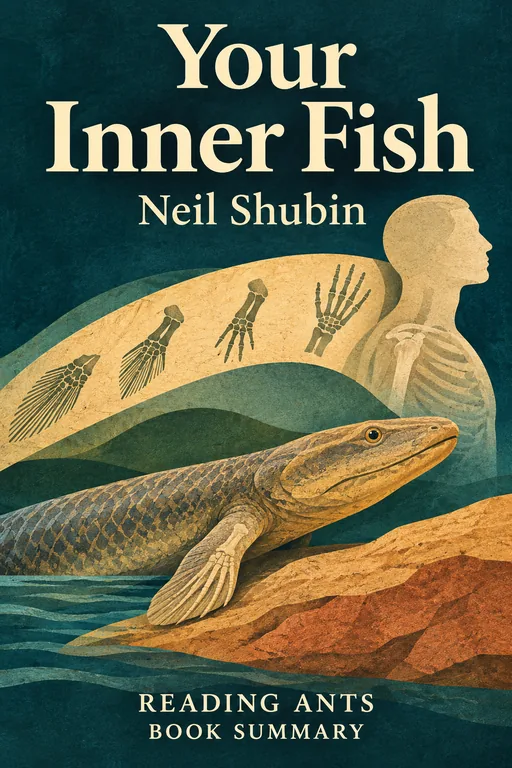
Paleontologist Neil Shubin shows, through the discovery of a fossil fish with the beginnings of limbs, that the human body carries traces of its ancient ancestors, so that our hands, heads and even hiccups can be explained by evolution.
Overview
Your Inner Fish: A Journey into the 3.5-Billion-Year History of the Human Body was published in 2008 by Neil Shubin, a paleontologist at the University of Chicago who also taught human anatomy to medical students. He is one of the discoverers of Tiktaalik, a fossil that shows the transition between fish and four-legged animals. The book weaves together stories of fieldwork in the Arctic, of studies in anatomy classes and of discoveries in genetics. Its main idea is that our bodies are a kind of museum of the history of life, and that to understand our anatomy, we should look at our ancestors. A television series based on it was shown on PBS in 2014.
Full Summary
1. Finding a fossil in the Arctic
The idea: Shubin opens with the problem: how did fish, which live in water, give rise to animals that walk on land? Evolution predicts a transitional creature, in rocks of a certain age. He and his colleagues chose a place in northern Canada where rocks of the right age are exposed, and after several seasons of searching in the cold, they found fossils of a creature with a flat head, neck and fins with wrist-like bones, which they named Tiktaalik. It is a fish with some features of a four-legged animal.
In real life: A scientist who predicts where to dig and finds what was expected has made a strong test of a theory.
2. Hands from fins
The idea: The author explains that the arm bones of humans, one upper bone, two lower and then the wrist and fingers, are found in the fins of Tiktaalik, in an early form. He traces the pattern through amphibians, reptiles and mammals, which show the same basic plan. The fossil shows that the sturdy fins of the fish could support the body, and had the beginnings of wrists. Studies of the genes that control the development of limbs show that the same genes build fins and hands.
In real life: Your hand has the same basic bones as a bat’s wing and a whale’s flipper.
3. Teeth, heads and the first jaws
The idea: Shubin looks at the human head, and at how the structure can be traced to ancestors such as sharks and early fish. The series of bones, nerves and arches in the head of a shark corresponds to the arrangement in humans, and the tiny bones of the middle ear derive from bones that once formed part of the jaw in reptile ancestors. Teeth, similarly, have a long history, which he follows through fossil fish. Our faces are the end of a long chain of changes.
In real life: The tiny bones that help you to hear began as part of the jaws of ancient animals.
4. Gene clues: how bodies are built
The idea: The discovery of the genes that control the development of an embryo, such as the Hox genes, revealed that the same genetic toolkit is used across the animal kingdom. A gene that builds the eye of a fly can help to build the eye of a mouse. Shubin says that evolution often works by modifying what already exists, not by designing from scratch. Changes in the timing and place where genes switch on can produce big differences in form.
In real life: A small change in a recipe’s timing can produce a very different cake.
5. Why we have flaws: hernias and hiccups
The idea: The author shows that many of our common medical problems can be explained by our evolutionary history. Our bodies are a fish body plan that was reworked into a mammal one, and then adapted to walk upright, and such makeovers leave weak spots. In men, the testes move down from a position high in the body of our fish-like ancestors, which leaves a weak place in the wall of the groin and helps to explain why hernias happen there. Hiccups, he says, probably come from a nerve circuit in the brain stem that we share with amphibians, and that tadpoles use when they breathe with their gills. He suggests that understanding our heritage can help medicine.
In real life: A bridge that was adapted from an older design may show weak points because of its history.
6. Senses and the road to us
The idea: The final chapters explore our senses, such as the eyes, ears and sense of smell, and how the genes involved are shared with many animals. Human color vision, for example, has features inherited from ancient ancestors, and our smell genes include many that are no longer working, which reflect the decline of that sense in primates. Shubin concludes that evolution is not only about the past, but about the way we are, and that we are connected to all living things.
In real life: Our sense of smell is weaker than that of a dog, partly because many of our smell genes have been switched off.
Why It Matters
Your Inner Fish was a widely read, clear and lively demonstration of how fossils, anatomy and genetics all point to evolution. The discovery of Tiktaalik, announced in 2006, became a famous example of how scientific predictions can be confirmed. The book helped to make paleontology more familiar and popular, and showed readers that they carry the history of life in their bodies. It grew out of the author’s experience of teaching human anatomy to medical students, and it shows how evolutionary ideas can make anatomy easier to understand. The television series based on it brought the story to an even larger audience.
Key Takeaways
- Our bodies carry ancient traces. Human anatomy is a product of evolution.
- Predictions can be tested. Tiktaalik was found where evolution said to look.
- Genes build bodies. A shared toolkit shapes fins, wings and hands.
- Evolution modifies what exists. It tinkers, not designs from scratch.
- History explains some health problems. Our ancestry helps to explain flaws.
What We Can Learn
You can look at your own body with new eyes, noticing the bones in your hand or the tiny muscles in your face, and thinking of their long history. Learn about fossils in your region, and visit a natural history museum. Appreciate how scientists make a prediction and check it. When you hear someone say that science cannot explain something, ask what evidence there is. And enjoy the connection to other living things, which is a reason to care for them.
Criticism and Counterpoints
Some critics say that the book’s title and message could mislead, since we are not descended from modern fish, and some claims that link the details of anatomy to evolutionary history, such as those about hiccups, are speculative. Others note that Tiktaalik is a transitional form but is very unlikely to be a direct ancestor, as Shubin himself says, calling it more like a cousin of our ancestor, and that later fossil finds, including tetrapod-like footprints from Poland that are older than Tiktaalik, complicate the timeline. Opponents of evolution reject the claims on other grounds. Scientists generally accept the main points, but some details are still debated.
Who Should Read It
This book is for readers of all ages who like science, fossils and the human body. It is easy to read, and full of stories of fieldwork. Those who want a deeper treatment of evolution can read the works of Dawkins and others.
Want the whole book?
A summary is a taste, not the meal. Here is where to find the full book.
You reached the end 🎉
Nicely done. Mark this one as read, and we will suggest what to read next.
Read this next
The Blind Watchmaker
Richard Dawkins
Richard Dawkins argues that the complex, designed-looking features of living things are the result of natural selection acting cumulatively over vast time, a process with no foresight, which he calls a blind watchmaker.
🔬 Science
The Gene: An Intimate History
Siddhartha Mukherjee
Physician and writer Siddhartha Mukherjee tells the story of the gene, from Mendel's pea plants to gene editing, weaving in the history of his own family's experience with mental illness and asking what mastery over heredity means.
🔬 Science
The Voyage of the Beagle
Charles Darwin
Charles Darwin's lively journal of his five-year voyage around the world on HMS Beagle records the animals, plants, rocks and peoples that he saw, and the observations that led him toward the theory of evolution.
🔬 ScienceThe Body: A Guide for Occupants
Bill Bryson
Bill Bryson takes a funny and amazed tour of the human body, from the skin to the brain, and the history of those who have studied it, to show how remarkable, complicated and fragile our bodies are.
🔬 Science
The Double Helix
James D. Watson
James Watson gives a personal, frank and controversial account of how he and Francis Crick worked out the double-helix structure of DNA in 1953, and of the rivalry, luck and ambition that went with it.
🔬 Science
A Brief History of Time
Stephen Hawking
One of the world's greatest physicists explains, with almost no math, what we know about the origin, structure and fate of the universe, from the Big Bang to black holes and the nature of time itself.
🔬 ScienceWant something different?
Pick another topic and we will show you three books to start with.