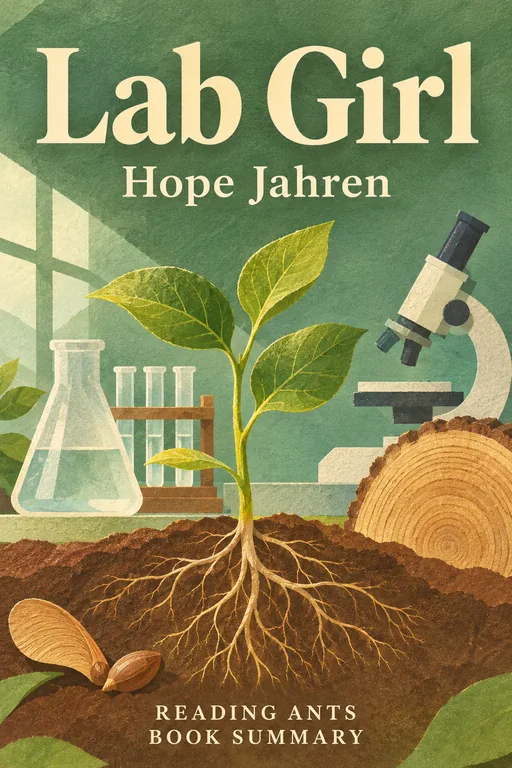
Lab Girl
Geobiologist Hope Jahren interweaves the story of her life as a scientist, with its struggles and her deep friendship with her lab partner Bill, with lyrical chapters on how plants live, grow and survive.
Overview
Lab Girl was published in 2016 by Hope Jahren, a professor who studies the chemistry of fossil plants and ancient forests. She grew up in rural Minnesota, the daughter of a science teacher, and spent her childhood in her father’s college laboratory. The book alternates between chapters about her own career, from graduate school to professor, with moves among universities, and chapters about plants, such as roots, seeds, leaves and trees. It also tells of her mental illness, a bipolar disorder, and her long and unusual friendship with Bill, her lab manager. It won the National Book Critics Circle Award for autobiography, along with other prizes.
Full Summary
The book has three parts, “Roots and Leaves,” “Wood and Knots” and “Flowers and Fruit.” Each part pairs chapters about Jahren’s life with chapters about plants, and the plant topics serve as metaphors for what is happening to her.
1. A childhood in a laboratory
The idea: Jahren grew up in a small town in rural Minnesota, in a reserved family that showed little outward affection. Her father taught physics and earth science at a community college, and she spent evenings in his laboratory, among the benches and equipment, where he taught her to take things apart and put them back together. She also read literature with her mother, though the relationship was complicated. These evenings gave her a sense of the laboratory as a place of safe curiosity, and made science feel like home. She went on to study geology at the University of Minnesota and then to graduate school at the University of California, Berkeley.
In real life: A child who is given room to explore may find a lifelong passion.
2. Roots, seeds and the life of plants
The idea: Between the autobiographical chapters, Jahren writes short pieces on the lives of plants. They include a lotus seed that sprouted after about two thousand years, resurrection plants that revive after drying out, hackberry seeds that contain opal, and how plants survive drought and winter. Another chapter covers trees and their partnership with fungi. She treats plants as active, determined creatures, not as passive decoration, and uses their lives to comment on her own.
In real life: A weed pushing through a crack in a sidewalk shows the strength of a seedling.
3. Graduate school and the partnership with Bill
The idea: As a graduate student, Jahren met Bill Hagopian, who later became her lab manager and closest friend. Their bond was intimate but never romantic, and Bill worked for her for very little pay, sometimes living in his car or in the laboratory. Together they built laboratories at three universities, starting with Georgia Tech, where Jahren was an assistant professor, then Johns Hopkins and the University of Hawaii. She describes the funny and hard moments, such as a week-long field trip with students to Monkey Jungle in Florida and a drive toward a conference in California that ended with a crashed university van.
In real life: A good partner in work can make a difficult path possible.
4. The scientist’s struggle: money, sexism and moves
The idea: Jahren is open about the difficulties of an academic career: the endless search for grants, the cost of paying staff, and the shortage of research posts. After she ran out of money at Georgia Tech, she took a job at Johns Hopkins and got a job there for Bill too. As a woman, she faced bias and at times was shunned at conferences, and when she became pregnant her supervisor banned her from her own laboratory. She describes sneaking in after hours as a one-woman protest. The book shows that science is exciting but also precarious, and that passion is often paid for with sacrifice.
In real life: A researcher may spend as much time writing proposals for money as doing experiments.
5. Mental illness and motherhood
The idea: The author writes candidly about her manic-depressive illness, also known as bipolar disorder, and about times of crisis. Bill helped her through manic episodes. Her pregnancy was a hard and lonely time, made worse by the lack of support from her university. She also describes becoming a mother, and the way she came to accept herself in that role. She has found a regimen of treatment and support that keeps her balanced and lets her work.
In real life: Treatment and support can help a person with a serious illness to continue doing work they love.
6. A home in Hawaii
The idea: Jahren married and had a son. She left Johns Hopkins soon after his birth, partly because of the ban on her working in the lab, and moved with her family, and with Bill, to Hawaii, where she and Bill set up a new laboratory at the University of Hawaii at Manoa, and where she became a tenured professor. The last chapters bring together her work, her family and her love of plants, and the book ends with a sense that science is a way of seeing, and that wonder is a good reason to keep going.
In real life: A change of place can open new possibilities.
Why It Matters
Lab Girl was widely praised by reviewers and is a favorite of readers who love science and memoir. It won the National Book Critics Circle Award for autobiography and a prize for excellence in science books from the American Association for the Advancement of Science, and many publications named it a book of the year. It gave an intimate picture of a scientist’s life, including the mundane and difficult parts, and brought attention to the barriers faced by women in science, such as the struggle for funding and the way pregnancy was treated. The chapters on plants invite readers to see trees and weeds with new eyes, and reviewers welcomed Jahren’s candor about her mental illness.
Key Takeaways
- Plants are active and remarkable. They sense, grow and survive in surprising ways.
- Science takes passion and sacrifice. Research can be precarious.
- Friendship sustains work. Jahren and Bill formed a lifelong team.
- Mental illness is manageable. Honesty and treatment help.
- Wonder is a reason to continue. Curiosity drives discovery.
What We Can Learn
You can start by looking closely at a plant, such as a tree or a weed, and thinking about how it grew. Try sprouting a seed. If you are interested in science, find a mentor or a partner who shares your curiosity, and do not be put off by obstacles. Be honest about struggles with mental health, and seek help from doctors and friends. Support fair treatment of women and others in science and other fields. And be grateful for the people who support you, as Jahren was for Bill.
Criticism and Counterpoints
Reviews were mostly very positive, and the criticism is mild. One reviewer felt that her difficult relationship with her mother is touched on but never explored, like a hole in the narrative. The plant chapters are short, and the book is mainly a memoir, so those who want thorough botany will find only glimpses. Her experience of academia in the United States, and at a few particular universities, is also her own and may not match that of every scientist. Most readers find the book honest and moving.
Who Should Read It
This book is for readers who like memoirs, nature and science, including older teenagers. It is lyrical and funny. Those who want a straightforward botany text should look elsewhere, and those who are sensitive to descriptions of mental illness should read with care.
Want the whole book?
A summary is a taste, not the meal. Here is where to find the full book.
You reached the end 🎉
Nicely done. Mark this one as read, and we will suggest what to read next.
Read this next
Entangled Life
Merlin Sheldrake
Biologist Merlin Sheldrake takes readers into the hidden world of fungi, showing how these strange organisms, which are neither plants nor animals, shape ecosystems, forge partnerships with plants, and may help to solve human problems.
🔬 Science
The Periodic Table
Primo Levi
Chemist and writer Primo Levi tells twenty-one short stories, each named after a chemical element, that mix memoir, fiction and reflection to explore his life as a chemist, a Jew in fascist Italy and a survivor of Auschwitz.
🔬 Science
Madame Curie
Eve Curie
Eve Curie writes the story of her mother, Marie Curie, a poor Polish student who became the first woman to win a Nobel Prize and the only person to win it in two different sciences.
👤 Real Lives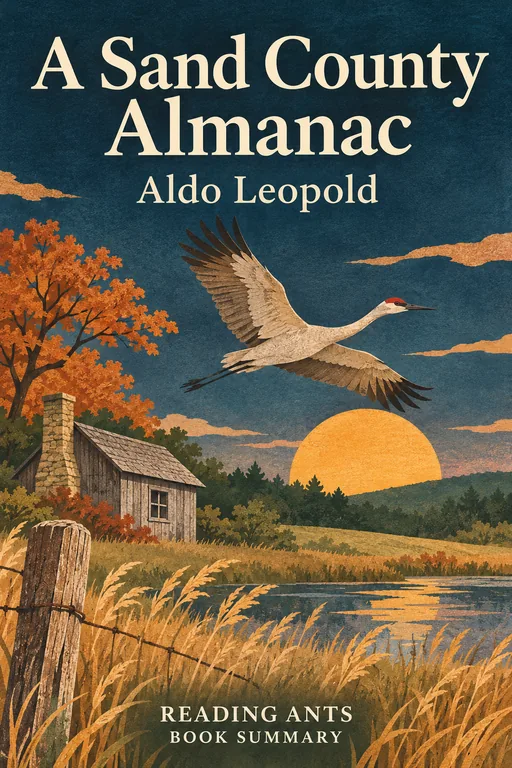
A Sand County Almanac
Aldo Leopold
Forester and ecologist Aldo Leopold describes a year on a worn-out Wisconsin farm and his travels, and argues for a "land ethic," a view in which humans are members of the community of the land, with a duty to care for it.
🔬 Science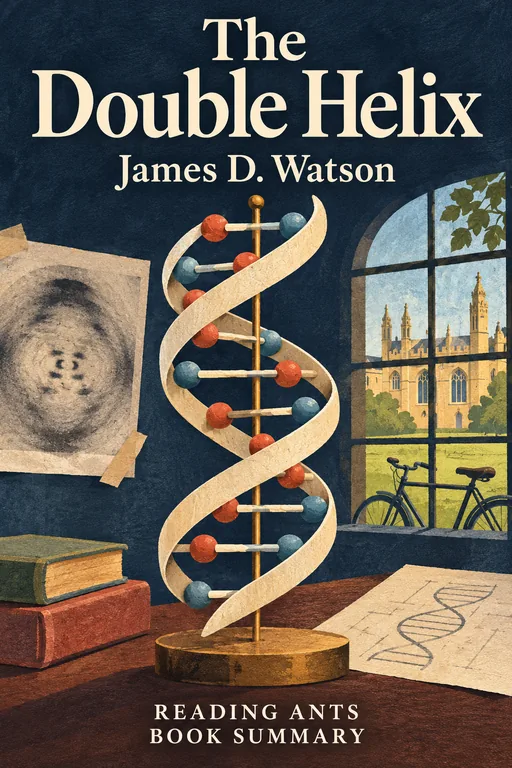
The Double Helix
James D. Watson
James Watson gives a personal, frank and controversial account of how he and Francis Crick worked out the double-helix structure of DNA in 1953, and of the rivalry, luck and ambition that went with it.
🔬 Science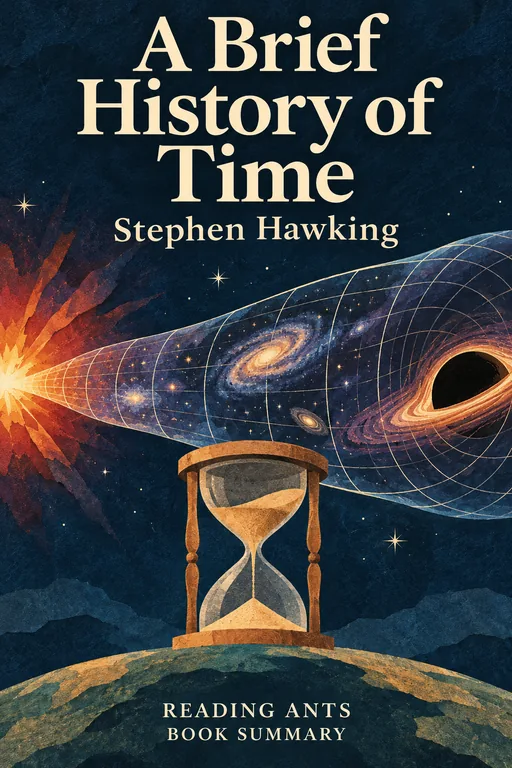
A Brief History of Time
Stephen Hawking
One of the world's greatest physicists explains, with almost no math, what we know about the origin, structure and fate of the universe, from the Big Bang to black holes and the nature of time itself.
🔬 ScienceWant something different?
Pick another topic and we will show you three books to start with.