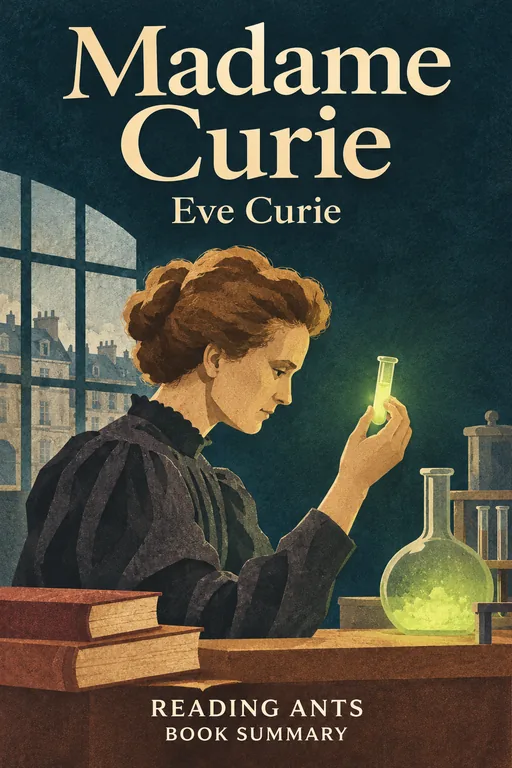
Madame Curie
Eve Curie writes the story of her mother, Marie Curie, a poor Polish student who became the first woman to win a Nobel Prize and the only person to win it in two different sciences.
Overview
Madame Curie is a biography written by Eve Curie, the younger daughter of Marie and Pierre Curie, and published in French in 1937. Eve was a writer and musician, and she drew on her family’s letters, her mother’s papers and her own memories. The book is warm and admiring, and tells the story from Marie’s childhood in Poland to her death in 1934. It was a bestseller in many countries and made Marie Curie a symbol of dedication to science. It is also a story about family, courage and persistence in a world that did not welcome women in laboratories.
Full Summary
A Girl in Warsaw
Marie Sklodowska was born in 1867 in Warsaw, which at the time was ruled by the Russian empire, and in which the Polish language and culture were suppressed. Her parents were teachers who loved learning, and Marie was a brilliant student, who finished at the top of her class. Her mother died when Marie was young, and the family was not wealthy. Women were not allowed to attend university in Warsaw, so Marie dreamed of studying abroad.
Sacrifice and Paris
Marie made a deal with her older sister Bronia: she would work as a governess to pay for Bronia’s medical studies in Paris, and then Bronia would help her in turn. For years she taught and tutored in the countryside, saving her money and studying alone at night. In 1891, she finally traveled to Paris and enrolled at the Sorbonne. She lived in a tiny attic room with no heating, no lighting and no running water, and for weeks at a time ate little but buttered bread and tea. She worked so hard and ate so little that she sometimes fainted.
Marriage to Pierre
In Paris, Marie became friends with Pierre Curie, a physicist who was devoted to his research and who shared her love of science. They married in 1895 and set up a home. They had a daughter, Irene, in 1897, and later Eve. The Curies worked together in a simple, leaking shed, which they used as a laboratory. Their partnership was one of the great scientific collaborations, based on shared passion and mutual respect.
The Discovery of Radium
Inspired by the discovery that uranium gives off mysterious rays, Marie began to investigate this property, which she called radioactivity. She found that some ores were more radioactive than could be explained by uranium alone, and she and Pierre concluded that they contained new elements. They discovered polonium, named for her homeland, and radium, in 1898. To prove their case, they had to extract a tiny amount of radium salts from tons of ore, in years of exhausting work. In 1903, they shared a Nobel Prize in physics with Henri Becquerel, whose work on uranium rays had started the inquiry.
Loss and a Second Prize
In 1906, Pierre was killed when he was hit by a horse-drawn wagon in the street. Marie was heartbroken, but she continued her work, and took over his teaching position at the Sorbonne, becoming the first woman to teach there. In 1911, she was awarded a second Nobel Prize, in chemistry, for her work on the radioactive elements she had discovered. During this period, she faced attacks from some of the press, and also from those who resented a foreign woman’s success. She stayed devoted to science.
War, the Institute and the End
During the First World War, Marie created mobile X-ray units, nicknamed “little Curies,” to help doctors to find bullets and broken bones in wounded soldiers, and she even drove one of the vehicles herself. After the war, she led the Radium Institute in Paris, and trained students from many countries. She died in 1934, of an illness related to long exposure to radiation, whose dangers were not well understood at the time. Eve ends the book with a portrait of a woman of modesty and focus.
Why It Matters
Madame Curie helped to make Marie Curie one of the best-known scientists in history, and inspired generations of readers, especially girls, to study science. It was translated into many languages, and became the basis of a film in 1943. Eve Curie’s account is loving, and gives a human face to the discovery of radioactivity, which changed physics, chemistry and medicine. It also shows the obstacles faced by women in science in the early twentieth century. The Curies’ work led to cancer treatments, and to the later understanding of the atom. The book remains a classic example of a scientific biography for young readers.
Key Takeaways
- Determination can overcome barriers. Marie pursued learning despite poverty and prejudice.
- Science depends on patience. Isolating radium took years of difficult work.
- Partnership multiplies effort. Marie and Pierre made discoveries together.
- Modesty and focus. She preferred research to fame.
- Discovery has risks. The dangers of radiation were not known.
What We Can Learn
Marie Curie’s story encourages us to work toward our goals even when resources are scarce, and to treat education as a precious opportunity. It also shows the value of shared work with someone who believes in you, and of patience in research. If you are interested in science, think about the questions that excite you, and look for ways to explore them. And remember that safety matters: the Curies’ exposure to radiation shows that new knowledge needs care. The book is also a reminder to support opportunities for girls and women in science.
Criticism and Counterpoints
Because the author was Marie’s daughter, the book is deeply admiring, and some historians say it presents an idealized picture and plays down difficulties, such as her low spirits after Pierre’s death and the press scandal of 1911, which the book mentions only in veiled terms. Later biographers have given a fuller and more critical view, including her personal life. The book also simplifies the science, and some of the details of the discovery are told in a romantic style. Nevertheless, it is valued as a first-hand family portrait and an inspiring story, to be read together with more recent scholarship.
Who Should Read It
This book is for readers of all ages who are interested in science, biography and women’s history. It is clear and moving, and suitable for older children and teenagers. Those who want a rigorous or critical biography should also read a modern scholarly life of Marie Curie.
Want the whole book?
A summary is a taste, not the meal. Here is where to find the full book.
You reached the end 🎉
Nicely done. Mark this one as read, and we will suggest what to read next.
Read this next
The Making of the Atomic Bomb
Richard Rhodes
Richard Rhodes tells the full story of nuclear weapons, from the physics discoveries of the late nineteenth century to the secret wartime project that built the first bombs and the explosions over Hiroshima and Nagasaki in 1945.
🏛️ History
A Short History of Nearly Everything
Bill Bryson
Bill Bryson sets out to understand how we know what we know about the universe, the Earth and life, and tells the story through the odd, brilliant and sometimes unlucky people who figured it out.
🏛️ History
Hidden Figures
Margot Lee Shetterly
Margot Lee Shetterly tells the true story of the Black women mathematicians who worked at NASA's Langley research center and helped America win the space race, despite segregation and sexism.
🔬 Science
The Autobiography of Benjamin Franklin
Benjamin Franklin
Benjamin Franklin tells the story of his rise from a poor Boston boy to a successful printer, inventor and public leader in Philadelphia, and shares his methods of self-improvement.
👤 Real Lives
The Diary of a Young Girl
Anne Frank
A Jewish teenage girl hiding from the Nazis in a secret apartment in Amsterdam records two years of fear, family quarrels, first love and big dreams in a diary that became one of the most famous books in the world.
👤 Real Lives
Man's Search for Meaning
Viktor E. Frankl
A psychiatrist who survived the Nazi concentration camps explains that even in the worst suffering, people can choose their attitude, and that finding a reason to live is what gives us the strength to endure.
👤 Real LivesWant something different?
Pick another topic and we will show you three books to start with.