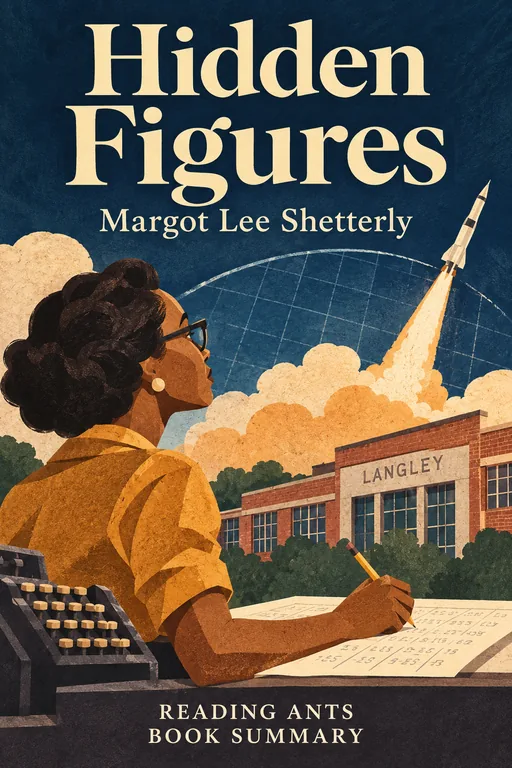
Hidden Figures
Margot Lee Shetterly tells the true story of the Black women mathematicians who worked at NASA's Langley research center and helped America win the space race, despite segregation and sexism.
Overview
Hidden Figures: The American Dream and the Untold Story of the Black Women Mathematicians Who Helped Win the Space Race was written by Margot Lee Shetterly and published in 2016. Shetterly grew up in Hampton, Virginia, near the Langley Research Center, and knew many of the people involved, since her father worked at NASA. The book follows several women who worked as “human computers,” doing complex calculations by hand and with machines, at a time when the laws of Virginia required racial segregation. The best known are Dorothy Vaughan, Mary Jackson and Katherine Johnson. A film adaptation released in 2016 brought the story to a global audience.
Full Summary
1. War, workers and the West Computers
The idea: During World War II, the United States needed more workers at its research facilities, and the shortage of men opened doors to women, including Black women. At Langley, the National Advisory Committee for Aeronautics (NACA), the forerunner of NASA, hired women with math skills to compute data from wind tunnels and flight tests. Black women were assigned to a separate group, the West Area Computing Unit, which Dorothy Vaughan came to lead in 1949, and worked in a segregated section, with separate bathrooms and dining tables.
In real life: Before electronic computers were common, the word “computer” meant a person who did calculations.
2. Dorothy Vaughan: leadership and new skills
The idea: Vaughan, a mathematics teacher, became the first Black supervisor at NACA. She worked to make sure her team had fair pay and recognition, and she and her colleagues proved their value. When electronic computers began to appear in the 1950s, Vaughan saw that they would change the work, so she taught herself and her team to program in the language FORTRAN. This foresight let them move from manual calculation to the new technology, instead of being replaced.
In real life: Learning new skills ahead of change is one of the best ways to stay valuable in a changing workplace.
3. Mary Jackson: engineering and persistence
The idea: Mary Jackson worked in a team studying supersonic wind tunnels and was encouraged by a supervisor to train as an engineer. To take the necessary classes, she had to ask for special permission to attend an all-white high school at night, since the courses were not available to Black students. She succeeded and became NASA’s first Black female engineer. She later worked to help other women advance in their careers.
In real life: Some people succeed by finding a way around an unfair barrier, and then helping to take it down for others.
4. Katherine Johnson and the trajectory
The idea: Katherine Johnson, a gifted mathematician, worked on flight data and then on the calculations needed to send humans into space. After the Soviet Union launched Sputnik in 1957, the race into space became urgent. Johnson’s skill with geometry led to her work on the trajectory of Alan Shepard’s flight in 1961, the first American in space. When astronaut John Glenn prepared to orbit the Earth in 1962, he asked that Johnson personally verify the electronic computer’s numbers, trusting her more than the machine.
In real life: Even with advanced machines, human checks catch errors and build confidence in a plan.
5. Life under segregation
The idea: The book also depicts the women’s lives outside work. They lived in a segregated Virginia, where schools, restaurants and public places were separated by race. Many of them were active in churches and community groups and raised families while working demanding jobs. The women faced indignities, from rules about which bathrooms to use to doubts about their abilities, but they supported one another, sharing advice and encouragement. The civil rights movement and legal changes opened new opportunities in the 1960s.
In real life: Support networks of friends and colleagues can help people persevere through unfair treatment.
6. Legacy and recognition
The idea: In the final chapters, Shetterly describes how the women’s work contributed to the Apollo program and beyond, and how they came to be recognized only many decades later. Christine Darden, another mathematician, joined later and became a leading engineer. Shetterly stresses that these women were not isolated exceptions but part of a larger community of Black professionals who built careers in difficult conditions, and whose stories had been overlooked by history.
In real life: Many stories in history are hidden because the people who lived them were not given the same attention as others.
Why It Matters
Hidden Figures spent many weeks on bestseller lists and became a hit film with an Oscar-nominated cast. It brought long-overdue recognition to Katherine Johnson, Dorothy Vaughan, Mary Jackson and their colleagues. In 2015, President Obama awarded Johnson the Presidential Medal of Freedom, and NASA has named buildings and a facility in honor of the women.
The book encourages girls and students of color to imagine themselves in science, technology and engineering, and highlights the importance of recording and telling forgotten history.
It also demonstrates that a local story can become a national one: Shetterly’s research began with conversations in her own hometown, and the result changed how many people think about the American space program and about who gets credit for scientific achievement.
Key Takeaways
- Talent exists everywhere. Barriers kept many gifted people from opportunity.
- Skills open doors. Math and programming made these women essential.
- Persistence matters. They faced unfair rules and kept going.
- Support helps. Friends and colleagues sustained one another.
- History needs retelling. Many contributions are hidden until someone tells them.
What We Can Learn
The book teaches that progress depends on many people, not just those whose names are famous. When we see a major achievement, we can ask who else helped and whether their work was recognized.
It also shows that fairness benefits everyone. By excluding capable people, the country lost talent; by including them, it gained, a lesson that applies to schools and workplaces today.
Finally, it encourages us to learn new things and to prepare for change, as Vaughan did, so that new technology becomes an opportunity.
Criticism and Counterpoints
Some critics say that the film adaptation changed or invented events, such as scenes about the segregation of bathrooms and coffee pots, and combined people and incidents for drama, so it should not be taken as an exact history. The book itself has been praised for research, but some reviewers felt that it is dense with names and background and has a loose narrative thread.
Others note that the book focuses on a few women, and that more could be said about the wider group of Black and white women who worked as computers. Katherine Johnson’s exact role in some missions has also been discussed by historians. Overall, though, its basic story is well documented and widely praised.
Who Should Read It
This book suits readers from about age ten up to adults. It is inspiring and fairly easy to follow, though some sections about the history of aeronautics are detailed. A young readers’ edition is also available.
Want the whole book?
A summary is a taste, not the meal. Here is where to find the full book.
You reached the end 🎉
Nicely done. Mark this one as read, and we will suggest what to read next.
Read this next

The Warmth of Other Suns
Isabel Wilkerson
Isabel Wilkerson tells the story of the Great Migration, in which about six million Black Americans left the South for cities in the North and West, through the lives of three people who made the journey.
🏛️ History
I Am Malala
Malala Yousafzai with Christina Lamb
Malala Yousafzai tells how a girl who loved school stood up for girls' education in Pakistan's Swat Valley, was shot by the Taliban at age fifteen, survived, and became a global voice for children's right to learn.
👤 Real Lives
The Immortal Life of Henrietta Lacks
Rebecca Skloot
Doctors took cells from Henrietta Lacks, a poor Black woman, without telling her, creating the HeLa cell line that transformed medicine; Rebecca Skloot tells the story of the woman and her family.
🔬 Science
Unbroken
Laura Hillenbrand
This is the true story of Louis Zamperini, an Olympic runner who survived a plane crash, weeks adrift on the Pacific and years in brutal Japanese prison camps during World War II, then fought to rebuild his life.
🏛️ History
A Brief History of Time
Stephen Hawking
One of the world's greatest physicists explains, with almost no math, what we know about the origin, structure and fate of the universe, from the Big Bang to black holes and the nature of time itself.
🔬 Science
On the Origin of Species
Charles Darwin
All living things are related and have slowly changed over immense periods of time, shaped by natural selection, the process by which individuals better suited to their environment survive and pass on their traits.
🔬 ScienceWant something different?
Pick another topic and we will show you three books to start with.