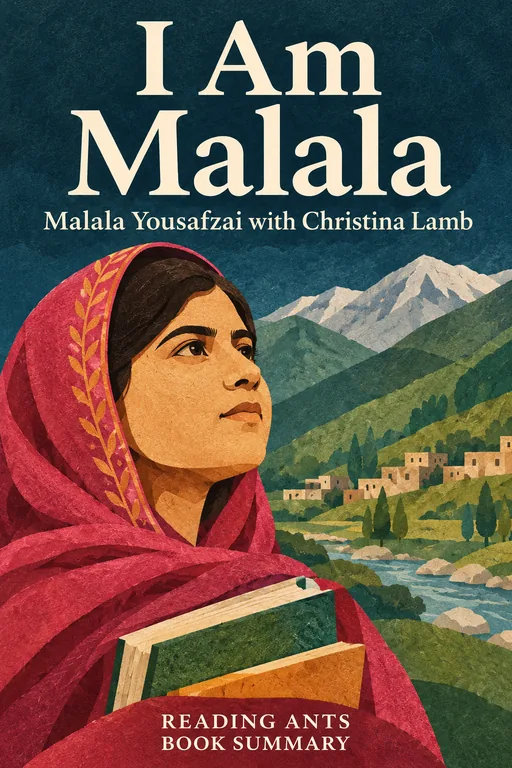
I Am Malala
Malala Yousafzai tells how a girl who loved school stood up for girls' education in Pakistan's Swat Valley, was shot by the Taliban at age fifteen, survived, and became a global voice for children's right to learn.
Overview
I Am Malala: The Girl Who Stood Up for Education and Was Shot by the Taliban was written by Malala Yousafzai with the British journalist Christina Lamb and published in 2013, when Malala was sixteen. Malala was born in 1997 in the Swat Valley in northwest Pakistan, a beautiful region that became a battleground when the Taliban gained control. Her father ran a school and taught her to speak out. The book tells about her childhood, her family, her love of learning and the events that led to the attack on her in October 2012. It was a worldwide bestseller, and in 2014 she became the youngest person ever to win the Nobel Peace Prize.
Full Summary
1. A girl born in Swat
Malala begins with her childhood in Mingora, a town in the Swat Valley. She is the daughter of Ziauddin Yousafzai, a teacher who runs a school, and Toor Pekai. In their culture, the birth of a girl was not often celebrated, but her father was delighted and gave her a name after a famous Afghan heroine, Malalai of Maiwand. She grew up with two younger brothers and loved school, books and cartoons. Her father encouraged her to ask questions and to speak her mind, which was unusual, and he talked about the dream of educating every child.
2. The coming of the Taliban
In the 2000s, extremist groups, including the Taliban, gained influence in the Swat Valley. They banned music, television and the education of girls, and used fear and violence to enforce their rules. Malala describes the changes in daily life: women were told to stay at home, shops closed and schools were bombed. Her father’s school became a target for threats. Despite the danger, Malala kept going to class, sometimes hiding her books under her shawl.
3. Speaking out
In 2009, when she was eleven, Malala began writing an anonymous blog for the BBC Urdu service about life under Taliban rule, using a different name. This gave the outside world a child’s view of the conflict. As the Pakistani army pushed back the Taliban, the family and many others left the valley for a time and later returned. Malala started speaking in public and giving interviews, and was given a national peace award. She became known for her bravery, and her father was proud, though anxious about the risks.
4. The attack
On October 9, 2012, as Malala was riding home from school in a bus, a gunman boarded and asked for her by name and shot her in the head. Two other girls were also wounded. She was flown to a military hospital in Pakistan, and later to Birmingham, England, for specialized treatment, because her injuries were so serious. The attack was condemned around the world, and the Taliban said they had targeted her because of her activism. Malala explains that she remembers little of the shooting itself, and that she woke in a hospital in Britain not knowing where she was.
5. Recovery in a new country
Malala underwent surgery and long months of recovery. Her family joined her in England and found it difficult at first to adjust to a new country, since they had had to leave their home. She describes the kindness of strangers who sent cards and gifts, and her determination to return to school. She resumed her studies in Birmingham, though she missed her friends and the valley. She expresses her sense that she had been given a second life, and that she must use it to speak for those who cannot.
6. A voice for every child
The final chapters show Malala’s growing role as an advocate. She gave a speech at the United Nations on her sixteenth birthday, calling on world leaders to provide education for all children. She also describes starting the Malala Fund to support girls’ schooling. She emphasizes that she is only one of millions of children denied school and that her story is meant to inspire action. She says she still hopes to return to Pakistan one day, and she ends with a message of faith that books and pens are powerful tools.
Why It Matters
I Am Malala brought the story of a girl in Pakistan to the entire world and drew attention to the fact that millions of children, especially girls, are still denied an education. Malala’s courage inspired students, teachers and politicians, and the book has been translated into dozens of languages and widely read in schools. A version for younger readers was later released.
Her work helped spark campaigns, funding and policy changes on girls’ education, and made her a symbol of peaceful resistance. The Nobel Peace Prize, which she shared in 2014 with the Indian children’s rights activist Kailash Satyarthi, recognized the importance of this cause.
Key Takeaways
- Education is a right. Every child deserves to learn.
- Young voices matter. A child can start a worldwide conversation.
- Courage can be quiet. Small acts, like going to school, can be brave.
- Family support helps. Her father’s encouragement was key.
- Words are strong tools. Writing and speaking can challenge violence.
What We Can Learn
The book reminds us not to take school for granted. For many of us, going to class is routine, but for Malala and millions of others, it can be dangerous or impossible, and that makes learning precious.
It also shows that courage can start with a single voice. Malala began by writing a blog and speaking out, and her actions encouraged others to join her.
Finally, the book teaches that we can respond to hatred with determination instead of revenge. Malala said she did not hate the man who shot her, and she chose to use her recovery to help others.
Criticism and Counterpoints
Some critics in Pakistan have accused Malala of being too close to Western interests or have questioned her story, and conspiracy theories have circulated about the attack, which are not supported by evidence. Others have said that the focus on one celebrated girl can overshadow the work of many local activists, or that the book reflects its co-writer’s perspective as much as the young author’s.
Some readers also find the political background of the region complex and wish for more explanation. A few Pakistani commentators have objected to how the book describes certain subjects. Even so, most reviewers and readers have found it an inspiring and honest account of a young person’s courage.
Who Should Read It
This book suits readers from about age ten and up, including adults. It describes a shooting but not in graphic detail. It is a good choice for families and classrooms to read together and discuss the value of education.
Want the whole book?
A summary is a taste, not the meal. Here is where to find the full book.
You reached the end 🎉
Nicely done. Mark this one as read, and we will suggest what to read next.
Read this next
The Diary of a Young Girl
Anne Frank
A Jewish teenage girl hiding from the Nazis in a secret apartment in Amsterdam records two years of fear, family quarrels, first love and big dreams in a diary that became one of the most famous books in the world.
👤 Real Lives
Educated
Tara Westover
A girl raised by survivalist parents in the mountains of Idaho, with no school, no birth certificate and no doctors, teaches herself enough to reach university and eventually earns a PhD from Cambridge, at the painful cost of her family.
👤 Real Lives
The Story of My Life
Helen Keller
Helen Keller, left deaf and blind by illness as a baby, tells how her teacher Anne Sullivan opened the world to her through language, and how she went on to study at Radcliffe College.
👤 Real Lives
Long Walk to Freedom
Nelson Mandela
Nelson Mandela tells his own story, from a village childhood to twenty-seven years in prison to becoming South Africa's first democratically elected president, and shows how patience, courage and forgiveness helped end apartheid.
👤 Real Lives
Man's Search for Meaning
Viktor E. Frankl
A psychiatrist who survived the Nazi concentration camps explains that even in the worst suffering, people can choose their attitude, and that finding a reason to live is what gives us the strength to endure.
👤 Real Lives
Night
Elie Wiesel
Elie Wiesel tells, in short and searing pages, how as a teenager he was taken from his hometown of Sighet to Auschwitz and Buchenwald, lost his family and watched his faith and childhood break apart.
👤 Real LivesWant something different?
Pick another topic and we will show you three books to start with.