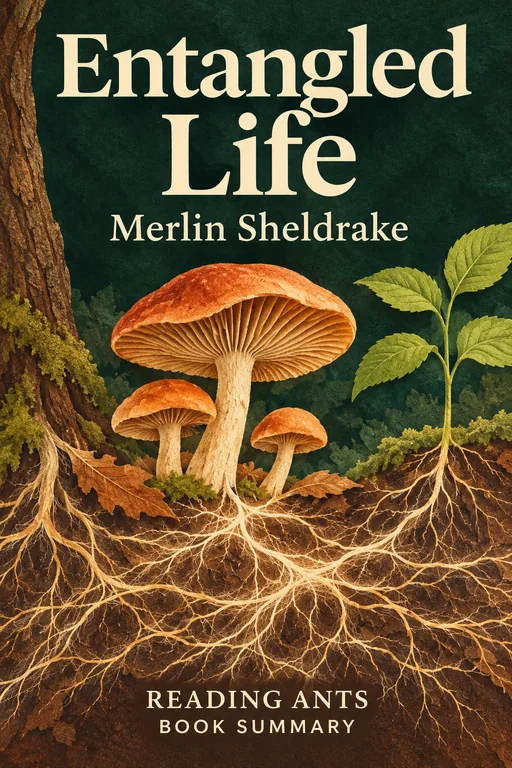
Entangled Life
Biologist Merlin Sheldrake takes readers into the hidden world of fungi, showing how these strange organisms, which are neither plants nor animals, shape ecosystems, forge partnerships with plants, and may help to solve human problems.
Overview
Entangled Life: How Fungi Make Our Worlds, Change Our Minds and Shape Our Futures was published in 2020 by Merlin Sheldrake, a British biologist with a doctorate in tropical ecology from Cambridge University, whose research focused on underground fungal networks in tropical forests. He writes about mushrooms as the visible fruit of a vast hidden body, called the mycelium, a web of fine threads that spreads through soil, wood and other materials. The book combines scientific research, stories from his own experiences and portraits of mycologists. It was a bestseller and received a number of prizes. The tone is enthusiastic, and the book is a celebration of curiosity.
Full Summary
1. What is a fungus?
The idea: Sheldrake begins by explaining that fungi are a kingdom of life as distinct as plants and animals, and, in fact, are more closely related to animals than to plants. The mushroom, he says, is only the reproductive structure, like an apple on a tree, while the main part of the fungus is the mycelium, a network of microscopic threads that grows through its food and absorbs nutrients. Some fungi form enormous networks, and one honey fungus individual in Oregon is thought to cover a few square miles.
In real life: A mushroom in a lawn is a clue to a hidden network underneath.
2. Decomposers and recyclers
The idea: The author describes the role of fungi as decomposers, which break down dead plant and animal matter, and return nutrients to the soil. Without them, the world would be piled up with dead wood and leaves. Fungi produce powerful enzymes that can digest tough materials such as lignin in wood. Some can break down oil and other pollutants, so that they are studied for cleaning up contaminated sites, a field called mycoremediation.
In real life: A fallen log slowly turns into soil because fungi feed on it.
3. Partnerships with plants: mycorrhizas
The idea: Most land plants, about ninety percent, form partnerships with fungi in their roots, called mycorrhizas. The fungus extends the plant’s reach, supplying water and minerals such as phosphorus, and the plant gives sugars made by photosynthesis in exchange. Sheldrake suggests that such a relationship may have helped plants to move onto land hundreds of millions of years ago. Many forests, he says, depend on these networks for their health.
In real life: A tree and its fungus are like business partners who trade what each has in excess.
4. The “wood wide web”
The idea: Sheldrake discusses the idea that fungal networks link the roots of different plants, and may allow them to share resources and signals, as in the famous “wood wide web.” Experiments suggested that carbon moved between trees through fungi, and that older “mother trees” might support seedlings. He presents these findings with enthusiasm, but also notes that the science is still developing, and that the meaning of such exchanges is debated.
In real life: Imagine an underground telephone line linking the trees of a forest, though scientists are still working out how it operates.
5. Minds, chemicals and strange abilities
The idea: The book explores some of the unusual abilities of fungi. Slime molds, which are not true fungi but are often studied alongside them, can solve mazes without a brain, and mycelium shows behaviors that look like decision making. Some fungi produce substances that affect the human mind, such as psilocybin, the active compound in “magic mushrooms,” which is being studied for the treatment of depression and other conditions. Sheldrake asks what it means to think without a brain.
In real life: A slime mold finding the shortest path through a maze shows that intelligence can take many forms.
6. Fungi and human futures
The idea: In the final chapters, he looks at the many uses of fungi: for food, such as yeast for bread and beer, and mushrooms; for medicines, such as penicillin and other antibiotics; and for new materials, such as packaging and building blocks grown from mycelium. They can also be used to clean up pollution and to help honeybees. He suggests that fungi may offer solutions to problems of waste and climate, and that we should learn from them how to live in partnership.
In real life: Packaging made from mushroom material can replace plastic foam and decompose.
Why It Matters
Entangled Life was among the most praised popular science books of its year, and it helped to raise awareness of fungi, which have long been overlooked compared with plants and animals. It encouraged both scientific interest and wider public curiosity, and prompted many readers to look at forests, soil and mushrooms in a new way. The book also reflects a broader shift in biology toward the study of symbiosis, partnerships between species, as a major force in life. It has been taken as an inspiration by those studying sustainability and by people seeking a different way to see nature.
Key Takeaways
- Fungi are a kingdom of their own. They are not plants.
- The mycelium is the main body. The mushroom is only the fruit.
- Fungi recycle life. They decompose dead matter and enrich soil.
- Partnerships are widespread. Most plants rely on fungal partners.
- Fungi may help us. They offer food, medicine and cleanup tools.
What We Can Learn
Next time you walk in a forest or park, look for mushrooms and think about the network under your feet. Learn about the fungi in your region, with a guide, and avoid eating wild mushrooms without expert advice, since some are deadly. Appreciate the idea that cooperation is as important in nature as competition. Consider how decomposition and recycling work, and what you can compost at home. And let the book inspire curiosity about the unseen parts of the world.
Criticism and Counterpoints
Some scientists say that the book repeats, with excessive enthusiasm, claims about the “wood wide web” and the sharing of resources and information among trees, which later studies have questioned, since the evidence that fungal networks benefit seedlings or enable communication is limited. Others point out that the language that compares fungi to minds or to intelligence is metaphorical and may mislead. A few critics find the writing too lyrical, or the personal anecdotes distracting. The author is careful to say where uncertainty lies, and many scientists praise the book.
Who Should Read It
This book is for readers who love nature, biology and clear writing. It is thoughtful and fun, with some technical passages. Those who want a field guide to identifying mushrooms need a different book.
Want the whole book?
A summary is a taste, not the meal. Here is where to find the full book.
You reached the end 🎉
Nicely done. Mark this one as read, and we will suggest what to read next.
Read this next
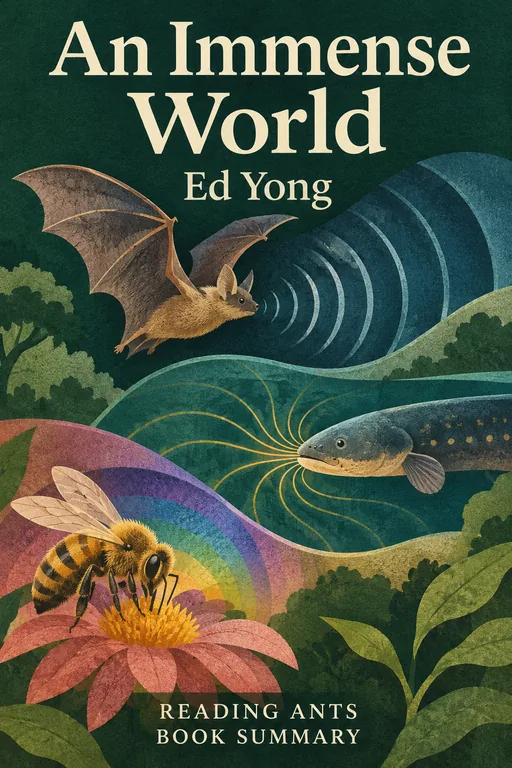
An Immense World
Ed Yong
Science journalist Ed Yong explores the astonishing range of ways that animals sense the world, from bats that see with sound to fish that feel electric fields, and shows that every species lives in its own private sensory bubble.
🔬 Science
A Sand County Almanac
Aldo Leopold
Forester and ecologist Aldo Leopold describes a year on a worn-out Wisconsin farm and his travels, and argues for a "land ethic," a view in which humans are members of the community of the land, with a duty to care for it.
🔬 Science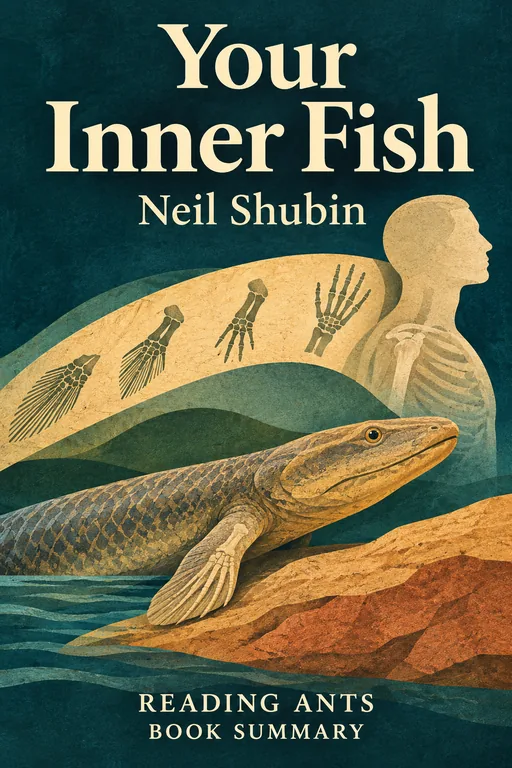
Your Inner Fish
Neil Shubin
Paleontologist Neil Shubin shows, through the discovery of a fossil fish with the beginnings of limbs, that the human body carries traces of its ancient ancestors, so that our hands, heads and even hiccups can be explained by evolution.
🔬 ScienceThe Body: A Guide for Occupants
Bill Bryson
Bill Bryson takes a funny and amazed tour of the human body, from the skin to the brain, and the history of those who have studied it, to show how remarkable, complicated and fragile our bodies are.
🔬 Science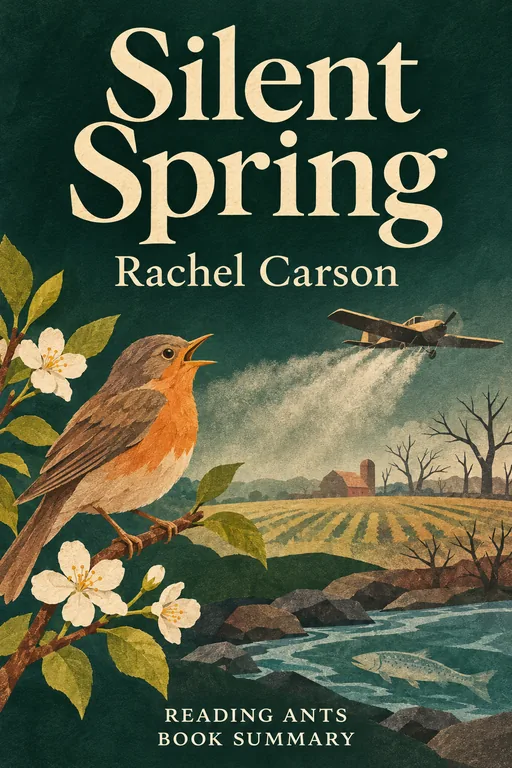
Silent Spring
Rachel Carson
The careless spraying of powerful chemical pesticides like DDT was poisoning birds, fish, soil, water and people, and humans must learn to live with nature instead of waging war on it.
🔬 Science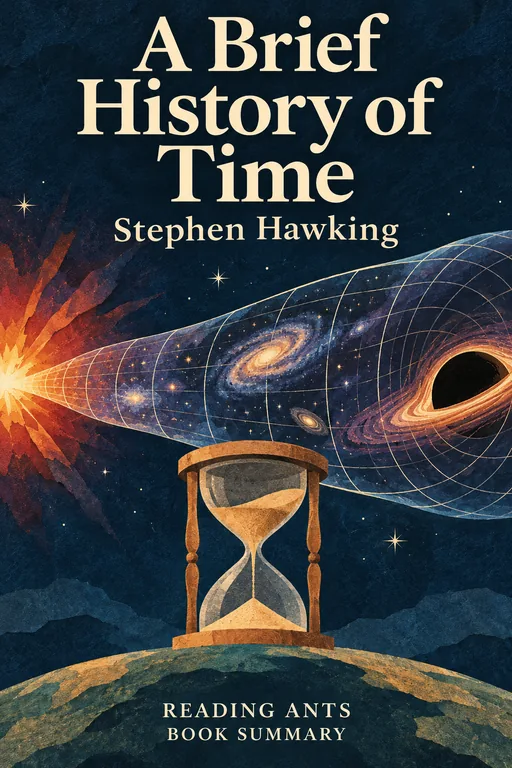
A Brief History of Time
Stephen Hawking
One of the world's greatest physicists explains, with almost no math, what we know about the origin, structure and fate of the universe, from the Big Bang to black holes and the nature of time itself.
🔬 ScienceWant something different?
Pick another topic and we will show you three books to start with.