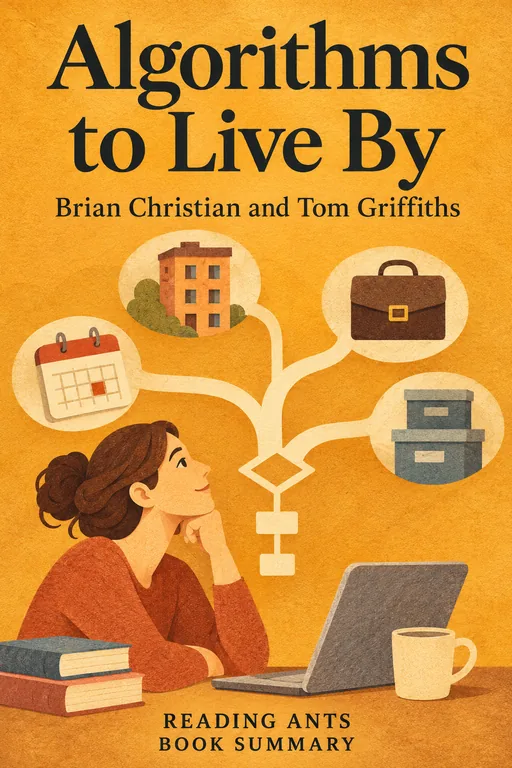
Writer Brian Christian and cognitive scientist Tom Griffiths show how ideas from computer science, such as optimal stopping, sorting, caching and scheduling, offer practical guidance for everyday decisions about time, space, choices and other people.
Overview
Algorithms to Live By: The Computer Science of Human Decisions was published in 2016 by Brian Christian, an author who writes about technology, and Tom Griffiths, a cognitive scientist (now a professor of psychology and computer science at Princeton). Computers face problems very like ours: how to use limited time, how to store things, how to choose when information is incomplete. The authors take well-known algorithms and show what they suggest about hiring, apartment hunting, organizing a desk, planning a day and more. They are careful to say that a good strategy cannot always guarantee a good outcome.
Full Summary
1. Optimal stopping: when to stop looking
The idea: The first chapter covers the problem of deciding when to stop searching, as when choosing an apartment, a candidate or a partner. A classic result, often called the secretary problem, says that for a simple version you should look at roughly the first 37 percent of the options without committing, to set a standard, and then take the first option that beats everything you saw. The exact fraction depends on the setup. The lesson is that you cannot choose well without first exploring, and that you must eventually commit.
In real life: When viewing apartments, you can use early visits to learn what is normal before you decide.
2. Explore and exploit
The idea: The next problem is how to balance trying new things against enjoying known favorites, like choosing between a restaurant you love and an unknown one. Computer scientists study this as the multi-armed bandit problem. When you have a long time ahead, exploring is worth more, since a discovery pays off for many years; when time is short, exploiting what you know is wiser. The authors say that this helps to explain why children explore and older people stay with favorites, and it is rational.
In real life: A traveler on the last night of a trip should return to the best meal, not gamble on a new place.
3. Sorting and its cost
The idea: Sorting items, from books to emails, takes effort, and computer science shows that the cost grows faster than the number of items. The authors argue that this means that sorting is not always worth it. If you will rarely search, a pile may be cheaper than a neat filing system. They also note that sports tournaments are a form of sorting, and that different formats trade off the number of games against the certainty of the ranking.
In real life: A messy but rarely searched box of old papers may not deserve careful filing.
4. Caching and memory
The idea: Computers keep frequently used data close at hand in a cache, and the best rule is to throw out whatever you are least likely to need again, often approximated by what has been used least recently. The authors say that this suggests a way to organize a home or an office: keep the things you used most recently near the front, and put the oldest at the back. They also suggest that the human mind works like a cache, so that forgetting is a sign of a well-organized system.
In real life: The jacket you wore yesterday belongs by the door, not at the back of the closet.
5. Scheduling and thrashing
The idea: Another section deals with how to order tasks. If your goal is to finish as many as possible, do the shortest first; if tasks have deadlines, work on the one due soonest. The authors note that switching between tasks has a cost, and that a computer overwhelmed with too many jobs can spend almost all its time switching, which is called thrashing. People can experience the same thing when they take on too much. They suggest grouping small tasks and turning off interruptions.
In real life: Answering email once or twice a day can be more efficient than checking every few minutes.
6. Randomness, networks and being kind to yourself
The idea: The final chapters discuss further ideas. Randomness can help solve hard problems, as when a random sample gives a good estimate. When a perfect solution is too difficult, a simpler, relaxed version can be good enough. In networks, a polite way to resend a message after a failure is to wait longer each time, which is called exponential backoff, and which the authors suggest could be applied to forgiving others. They end with the idea of “computational kindness,” which means making problems easier, not harder, for other people, and they stress that a good decision is one made by a good process, whatever the outcome.
In real life: If a friend does not answer, waiting a little longer before each new attempt is gentle and effective.
Why It Matters
Algorithms to Live By became a bestseller and a favorite of readers who wanted to understand decision making in a new way. It brought concepts from computer science, which are often hidden in technical courses, to a general audience, and linked them to psychology and daily life. It encouraged readers to treat many problems as tradeoffs of limited resources, rather than as failures of willpower. It also offered reassurance: because many problems are intrinsically hard, even the best strategies sometimes fail, and this is not a personal flaw. The book remains a popular gift for curious people.
Key Takeaways
- Explore first, then commit. Early search sets a standard for later choices.
- Exploring matters most with a long horizon. Short horizons favor known favorites.
- Sorting has a cost. Neatness is not always worth the effort.
- Keep recent things close. A good cache holds what you used lately.
- Switching tasks is expensive. Overload can leave you doing nothing useful.
What We Can Learn
You can use the book to make decisions with less anxiety, by recognizing when a problem is genuinely hard and when a simple rule is good enough. Set a search period before you start looking for a house or a job, then commit. Try new things when you have time to benefit from them, and enjoy favorites when time is short. Batch your small tasks, and cut interruptions. Tidy only what you will actually need to find. And accept that a good decision can still have a bad result.
Criticism and Counterpoints
Some readers feel that the analogies between computer algorithms and human life are stretched, since the neat assumptions of the math, such as known probabilities or a fixed number of options, rarely hold in real life, and that the advice is sometimes obvious or hard to apply. Others find that certain chapters become technical and demanding. Some experts point out that the optimal rules depend heavily on details, which the book mentions but which casual readers may overlook. Supporters answer that the point is a way of thinking and not a set of rigid rules, and that this is useful.
Who Should Read It
This book is for curious readers who enjoy ideas from science and mathematics applied to everyday life, including older teenagers. It requires no technical background, though some chapters ask for attention. Those who want strict mathematical details will need specialized textbooks.
Want the whole book?
A summary is a taste, not the meal. Here is where to find the full book.
You reached the end 🎉
Nicely done. Mark this one as read, and we will suggest what to read next.
Read this next
Thinking in Bets
Annie Duke
Former professional poker player Annie Duke argues that life's decisions are bets made with incomplete information, and shows how to judge decisions by their quality and not their results, by thinking in probabilities and by learning with the help of honest groups.
🧩 Mind & Psychology
The Art of Thinking Clearly
Rolf Dobelli
Swiss author Rolf Dobelli collects about a hundred short chapters on common thinking errors, such as confirmation bias, survivorship bias and the sunk-cost fallacy, to help readers make fewer foolish decisions.
🧩 Mind & Psychology
Superforecasting
Philip E. Tetlock and Dan Gardner
Political scientist Philip Tetlock and journalist Dan Gardner report on a research project that found some ordinary people can predict world events better than experts, and describe the habits that make them so good.
🧩 Mind & Psychology
The Paradox of Choice
Barry Schwartz
Psychologist Barry Schwartz argues that having too many options can make us anxious, indecisive and less satisfied, and that we often do better by choosing "good enough" and by limiting our choices.
🧩 Mind & Psychology
The Signal and the Noise
Nate Silver
Statistician and election forecaster Nate Silver explains why most predictions fail, and shows that better forecasting comes from thinking in probabilities, updating with new evidence and being humble about uncertainty.
🔬 Science
The Innovators
Walter Isaacson
Walter Isaacson tells the history of the digital revolution through the people who invented the computer, the internet and the web, and argues that innovation is mostly the product of collaboration, not the work of lone geniuses.
💡 TechnologyWant something different?
Pick another topic and we will show you three books to start with.