 Reading Ants
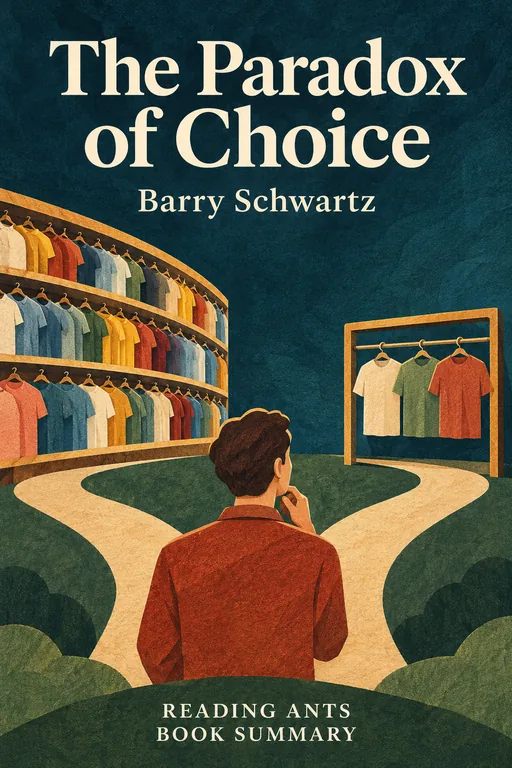
Psychologist Barry Schwartz argues that having too many options can make us anxious, indecisive and less satisfied, and that we often do better by choosing "good enough" and by limiting our choices.
Overview
The Paradox of Choice: Why More Is Less was published in 2004 by Barry Schwartz, a psychologist who teaches at Swarthmore College. Modern societies, and the United States above all, celebrate freedom of choice, and in many areas, such as shopping, health care, education and careers, we now face an enormous number of options. Schwartz says that this abundance, while it has benefits, also has costs that we rarely notice. The book draws on research in psychology and economics, and uses everyday examples, such as buying jeans, choosing a college or picking a retirement plan.
Full Summary
1. When choice becomes too much
The idea: Schwartz starts from the ordinary choices of modern life, comparing the range of goods in a supermarket with the range of classes at a college. He does not say that choice is bad in itself: autonomy and freedom of choice, he writes, are critical to our well-being. His point is that Americans now have more choice than any people before them and yet do not seem to benefit from it psychologically, and more options bring more effort, as we must collect information and weigh the pros and cons. His own example is a day spent buying a pair of jeans when the store offered many different cuts. He also cites studies by Sheena Iyengar and Mark Lepper. In a gourmet food store, shoppers who saw twenty-four jams on the sample table were far less likely to buy one than those who saw six (about 3 percent against about 30 percent), even though the larger table drew more people. In a chocolate experiment, students offered a smaller array were more satisfied with their tasting than those offered a larger one. Later work has shown that results of this kind vary.
In real life: Faced with a menu of fifty items, you may spend a long time and still feel unsure.
2. Maximizers and satisficers
The idea: The author distinguishes two types of decision makers. Maximizers want the very best, and so try to look at all the options, since only then can they be sure nothing better exists. Satisficers look for something that meets their standards, and stop when they find it. Their standards can be just as high; they are simply content with the excellent rather than the absolute best. The idea of satisficing comes from the economist and psychologist Herbert Simon, who introduced it in the 1950s and argued that, once the costs in time, money and anguish of gathering information are counted, satisficing is in fact the sensible strategy. Schwartz and his colleagues built a questionnaire of thirteen statements to measure the tendency to maximize. He reports that maximizers may end up with objectively better results, yet they tend to feel worse about them: in his team’s surveys they were less happy, less optimistic, less satisfied with life, more prone to regret and more depressed, though he stresses that this shows a correlation and not proof of cause. His advice is to learn to satisfice.
In real life: Someone who accepts a good jacket is likely to be happier than one who keeps searching for the perfect one.
3. Opportunity costs and regret
The idea: When there are many options, every choice means giving up others, and these lost opportunities weigh on us. We imagine the benefits of the roads not taken, which lowers our enjoyment of what we picked. Schwartz also describes regret, the feeling that we could have made a better decision. It comes in two forms, regret after a decision, sometimes called buyer’s remorse, and anticipated regret before it, which can make decisions harder to make. Regret is stronger when we feel responsible for the choice, and when the option we missed was a near miss, and maximizers feel it more. The more options there are, the more our results seem to be our own doing, and the more we hold ourselves responsible for any disappointment.
In real life: After choosing a vacation destination, you may wonder whether another place would have been better.
4. Adaptation, expectations and comparison
The idea: We adapt: the pleasure of a new purchase fades as we get used to it, so we gain less from our choices than we expected, and the effort we put into choosing seems less worthwhile. Schwartz calls this a treadmill, and says it hits maximizers hardest because they invest the most effort. More choice also raises our expectations, since in a world of many options we expect the result to be close to perfect. He notes that, with so many cuts of jeans on offer, he now expects a pair to fit as if made for him. And we compare our experiences with what we hoped for, with our past experiences and with what other people have, which often reduces satisfaction. Maximizers, he reports, are especially affected by what others are doing. These effects work together to reduce the benefit of added options.
In real life: A new phone is exciting at first, but then you see a friend with a better one.
5. Choice and unhappiness
The idea: Schwartz connects the rise in choice with the decline in reported happiness and the rise in clinical depression in wealthy societies, where by some estimates depression is far more common than a century ago. He suggests that increased choice may contribute to this, while noting that depression has many causes. When the results of a decision disappoint us, we ask why, and in a culture that stresses individual control the answer is often that it was our own fault. With more options, there is more to blame ourselves for. Unrealistic expectations combined with self-blame are a harmful mix, especially for maximizers, whose scores on his team’s depression measures were higher. He adds that having some control over our lives matters a great deal to well-being, but that when options become overwhelming we can feel unable to cope instead of in control.
In real life: If you pick a poor class from a long list, you may blame yourself.
6. How to choose less and be happier
The idea: In the final part, the author offers a list of eleven suggestions. Decide which decisions are really important, and which are not, and save your effort for the former. Be a satisficer more often, by setting clear standards for what is good enough. Limit the options you consider, and try not to dwell on the opportunities you give up. Make important decisions final where you can, since the option of changing our minds makes us less satisfied. Practice gratitude for what you have, expect less, and avoid comparing yourself with others. Accept constraints, such as rules and habits, as helpful, since they remove the need to decide again and again.
In real life: Having a few favorite meals that you often cook saves time and worry.
Why It Matters
The Paradox of Choice helped to popularize the idea that more is not always better, and made choice overload a familiar topic in discussions of consumer behavior. The book draws on research from psychology and behavioral economics, including the work of Daniel Kahneman, Amos Tversky, Richard Thaler and Cass Sunstein, and it questions the assumption that people always benefit from maximum freedom. Its practical advice, to focus on what matters and to accept good enough, has been taken up by many readers. Later research has qualified some of the findings, but the main insight remains useful.
Key Takeaways
- More choice can mean more stress. Too many options overwhelm us.
- Good enough is often best. Satisficers tend to be happier than maximizers.
- Opportunity costs hurt. Thinking of what we gave up reduces satisfaction.
- Expectations matter. High expectations lead to disappointment.
- Limit your options. Choose rules and constraints to simplify decisions.
What We Can Learn
When you face a decision, decide first how much it matters, and how much time it deserves. For small decisions, set a few criteria, choose the first option that meets them, and move on. Avoid comparing your choices with those of others, and notice what is good about what you have. Create routines that remove everyday decisions. When you feel regret, remember that one decision rarely has the power to change a whole life, and try to think about how things could have turned out worse. Where a decision is important and final, such as a life partner, commit to it and put your energy into making it work, instead of wondering whether you could have done better. And be glad of the choices you have, while recognizing that you do not have to use them all.
Criticism and Counterpoints
Researchers say that the evidence for choice overload is mixed. Attempts to reproduce the jam study and similar experiments have had mixed success: a meta-analysis of 50 studies found no meaningful connection between choice and anxiety, while a later meta-analysis of 99 studies found that the effect of large assortments depends on factors such as how complex the choice set is, how hard the task is, how unsure the person is of their preferences, and what the decision goal is. A later study of maximizers also questioned whether they are really less happy, though they still seemed more prone to regret. The advice is best taken as a set of useful habits and not as proven laws.
Who Should Read It
This book is for readers interested in psychology, shopping, careers and everyday decisions. It is easy to read, has many relatable examples, and ends with practical suggestions that anyone can try. Those who want a rigorous review of the research on choice overload should consult the academic studies.
Want the whole book?
A summary is a taste, not the meal. Here is where to find the full book.
You reached the end 🎉
Nicely done. Mark this one as read, and we will suggest what to read next.
Read this next
Predictably Irrational
Dan Ariely
Behavioral economist Dan Ariely uses entertaining experiments to show that people's decisions are shaped by predictable mental quirks, such as relativity, the lure of "free" and social norms, rather than by cool, rational calculation.
🧩 Mind & Psychology
Stumbling on Happiness
Daniel Gilbert
Harvard psychologist Daniel Gilbert explains, with wit and research, that we are surprisingly poor at predicting what will make us happy, because the imagination fills in details wrongly, and he suggests that other people's experience is often a better guide than our own forecasts.
🧩 Mind & Psychology
Thinking, Fast and Slow
Daniel Kahneman
Our minds run on two systems, a fast, intuitive one and a slow, careful one, and understanding how the fast system fools us can help us make better decisions about money, risk, work and happiness.
🧩 Mind & Psychology
Essentialism
Greg McKeown
Greg McKeown argues that we should do fewer things, but do them better, by deciding what is truly essential, saying no to the rest, and building simple routines that protect our time and energy.
🌱 Self-Improvement
The Art of Thinking Clearly
Rolf Dobelli
Swiss author Rolf Dobelli collects about a hundred short chapters on common thinking errors, such as confirmation bias, survivorship bias and the sunk-cost fallacy, to help readers make fewer foolish decisions.
🧩 Mind & Psychology
Nudge
Richard H. Thaler and Cass R. Sunstein
Because people are not perfectly rational, the way choices are presented strongly affects what they choose, and designers of choices can gently steer people toward better decisions without taking away their freedom.
🧩 Mind & PsychologyWant something different?
Pick another topic and we will show you three books to start with.