 Reading Ants
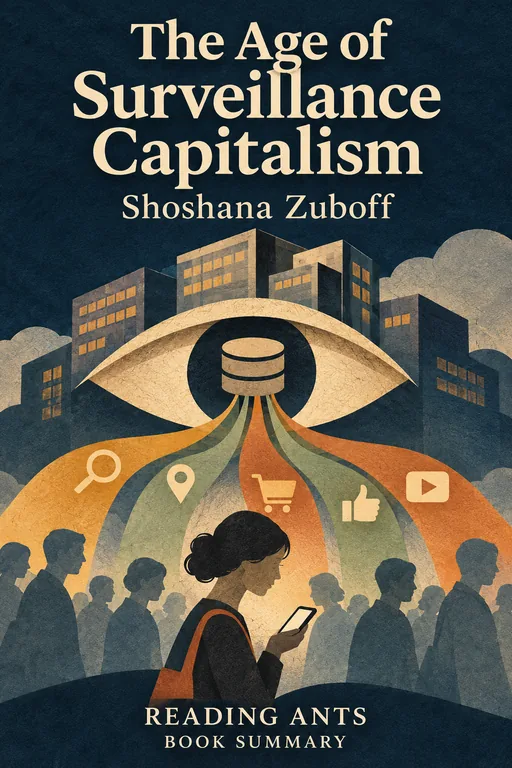
The Age of Surveillance Capitalism
Harvard professor Shoshana Zuboff argues that large technology companies have created a new kind of capitalism that gathers vast amounts of personal data, turns it into predictions of our behavior and sells them, threatening privacy, autonomy and democracy.
Overview
The Age of Surveillance Capitalism: The Fight for a Human Future at the New Frontier of Power was published in 2019 by Shoshana Zuboff, a scholar who had earlier written about the effects of computers on work. The book is long, and develops a theory that she has named surveillance capitalism. It traces how this economic logic arose at Google in the early 2000s, and spread to Facebook and other firms, and then to many industries. The book has an introductory chapter, three parts and a conclusion, eighteen chapters in all: Part I covers the foundations, with Google as the pioneer, Part II the advance of the new logic into the wider world, and Part III the kind of power that it produces. She uses new terms to describe it, and uses historical comparisons, for example with Ford and General Motors and with twentieth-century totalitarianism, to explain why it is a new form of power, which she says deserves to be resisted.
Full Summary
1. Behavioral surplus
The idea: Zuboff explains that, in its first years, Google used the data that people left behind when they searched only to improve its service. After the dot-com bubble burst in 2000, investors pressed the young company to make money, and the founders turned to advertising. Google began to use the leftover data, which she calls behavioral surplus, to target ads and to predict which ones people would click on. She sees 2002 as the year in which this took root. This turned the data from a by-product into the main raw material. The users, she says, are neither customers nor the product, but the source of raw material, while advertisers became the customers who buy the results.
In real life: A free app that makes money from your data is not selling a product to you, but selling information about you to others.
2. Prediction products and behavioral futures
The idea: The data are processed by machine intelligence into prediction products, which anticipate what a person will do now, soon or later. These are sold in what she calls behavioral futures markets, at first mainly to advertisers, and later to any business that wants to know or influence what people will do. The more data a company gathers, the better its predictions, so there is a drive for more and more information about more and more aspects of life.
In real life: A company that knows your habits may guess when you are likely to buy something.
3. From prediction to influence
The idea: Zuboff says that to make predictions more certain, companies seek not only to know, but to shape behavior, by nudging, tuning and herding people toward outcomes that serve their commercial aims. She describes two Facebook experiments, one that encouraged voting in the 2010 US elections and one that changed the emotional tone of what users saw in their news feeds, and the mobile game Pokemon Go, in which businesses paid to be “sponsored locations” that draw players to them. This power, she says, is largely invisible to the people it affects.
In real life: A feed designed to keep you scrolling shapes what you do, without announcing it.
4. The rise of the instrumentarian power
The idea: The author coins the term instrumentarianism for a form of power that knows and shapes human behavior toward the ends of others, as distinct from totalitarian power, which uses violence and seeks to control the soul. She calls the networked digital apparatus through which it works Big Other. It is built into everyday devices, things and online services. She traces the way of seeing behind it to the ideas of the psychologist B. F. Skinner, who treated people as organisms whose behavior can be observed and shaped, and she describes this power as the precise opposite of Big Brother in Orwell’s novel 1984, because it does not care what people think or feel, but only what they do.
In real life: A device that learns your habits may also be used to influence what you buy.
5. The loss of rights and autonomy
The idea: Zuboff argues that surveillance capitalism claims human experience as free raw material, without asking. In Part II she says that its hidden methods of influence challenge what she calls the right to the future tense, the ability to imagine, intend, promise and build a future of one’s own without being steered by forces that we cannot see. In Part III she says that a world in which Big Other reaches into the home and into social life, with no exit, threatens the right to sanctuary, a space of refuge. She says that existing laws, centered on privacy and competition, have not been enough to stop this logic, that users have little real way to leave or object, and that new kinds of response are needed.
In real life: Clicking “I agree” on a long document does not mean that you understand what you are giving away.
6. Resistance and the fight for a human future
The idea: In the later chapters and the conclusion, she calls for democratic action. She says that laws are needed that reject the legitimacy of surveillance capitalism and interrupt its basic operations, such as taking human experience as raw material and trading in behavioral futures, and that new forms of collective action and new democratic institutions will be needed to make such laws real. She warns that the stakes include control over our own lives, democracy and a human future. She says that people must refuse to accept that this is inevitable, and must be “the friction” against it, and she insists that the digital future should serve humanity.
In real life: Rules such as data protection laws are one way to set limits on companies.
Why It Matters
The Age of Surveillance Capitalism became a widely discussed book, and gave readers a vocabulary to describe a pattern in the digital economy. It influenced debates about privacy, regulation and the power of large technology firms, and was widely praised, and was named among the top nonfiction books of 2019 by the New Yorker and among the favorite books of the year by Barack Obama. The phrase “surveillance capitalism” has become common in public discussion. The book is part of a wave of works that question the culture of data collection. Its claim that data collection is not simply a technical matter, but one of power and rights, has made people think about the trade they make when they use free digital services.
Key Takeaways
- Your data has become raw material. Companies profit from information about behavior.
- Prediction is the product. Others pay to anticipate and influence what you do.
- Influence can be hidden. Design may steer choices without your knowledge.
- Consent is often weak. Users have few real alternatives.
- Democratic limits are possible. Laws and public pressure can shape the digital world.
What We Can Learn
You can start by looking at the privacy settings of the apps that you use, and asking what they collect and why. Limit the permissions that you give, and consider alternatives that collect less. Notice how feeds and notifications are designed to keep your attention. Talk with family and friends about what data they share. Support rules that protect privacy and give people control. And remember that technology is not neutral, and that choices about design and law belong to the public.
Criticism and Counterpoints
Some critics say that Zuboff overstates the power of behavioral prediction and manipulation, and that people retain a great deal of autonomy. Others argue that her new vocabulary and her contrast with totalitarianism are exaggerated, and one reviewer says she downplays how surveillance can serve authoritarian governments, as in China. Some point out that data-driven tools, such as health trackers, can also give users more control over their lives. A commentator at the London School of Economics blog worried that the book could inspire paralysis rather than action. The book is also very long, with more than 500 pages of main text before the notes. Still, many regard it as an important contribution.
Who Should Read It
This book is for readers interested in technology, privacy, economics and politics, and who are willing to read a long, demanding work. Those who prefer a shorter introduction can start with articles or shorter books on data and privacy, and then read portions of this book.
Want the whole book?
A summary is a taste, not the meal. Here is where to find the full book.
You reached the end 🎉
Nicely done. Mark this one as read, and we will suggest what to read next.
Read this next
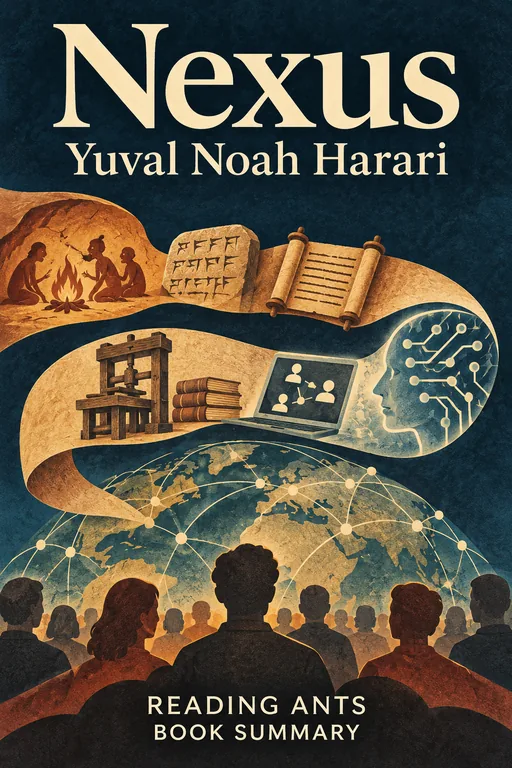
Nexus
Yuval Noah Harari
Yuval Noah Harari traces the history of how humans have shared information, from stories and writing to printing and algorithms, and warns that artificial intelligence is a new kind of network that could reshape power and even threaten democracy.
🏛️ History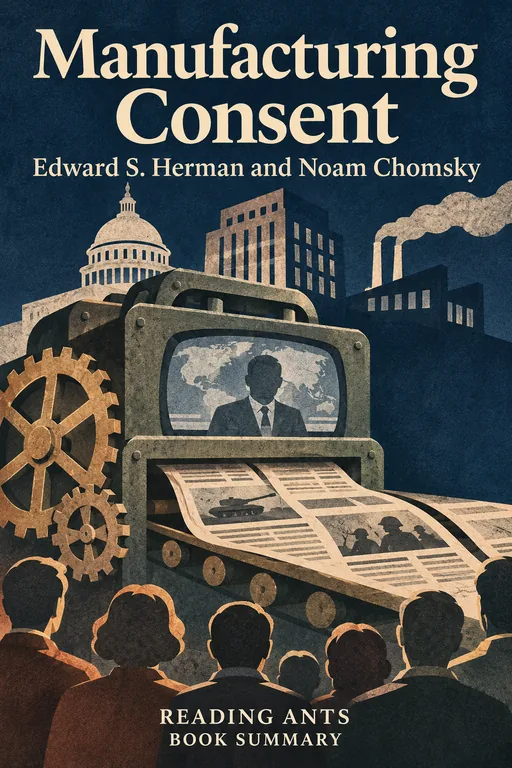
Manufacturing Consent
Edward S. Herman and Noam Chomsky
Edward Herman and Noam Chomsky argue that the mass media in the United States, though free from government control, systematically serve the interests of powerful elites, through a "propaganda model" with five filters that shape which news is reported and how.
⚖️ Politics & Society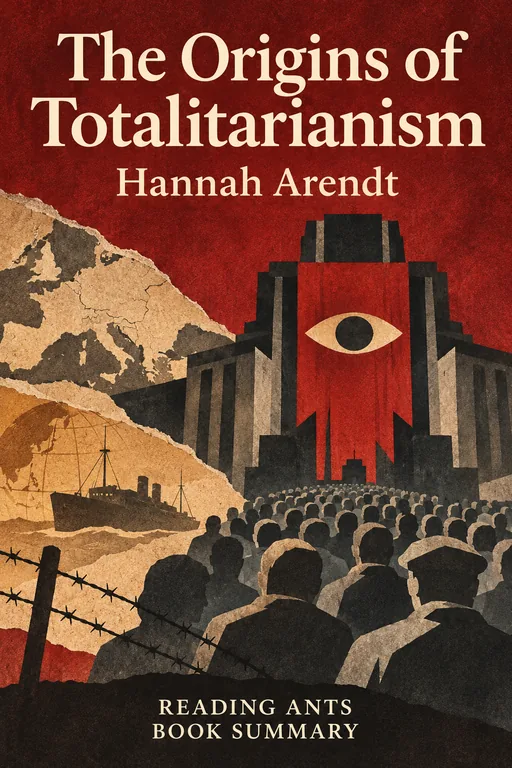
The Origins of Totalitarianism
Hannah Arendt
Hannah Arendt examines how antisemitism, imperialism and the breakdown of society in Europe prepared the ground for the totalitarian regimes of Nazi Germany and Stalin's Soviet Union, and what made these regimes new and uniquely terrible.
🏛️ History
Stolen Focus
Johann Hari
Johann Hari argues that our collective ability to pay attention is being eroded not just by personal weakness but by twelve forces in modern life, including technology designed to hook us, and that we must change both our habits and the systems around us.
🧩 Mind & Psychology
21 Lessons for the 21st Century
Yuval Noah Harari
Historian Yuval Noah Harari examines the biggest challenges facing humanity today, from artificial intelligence and fake news to nationalism, religion and meaning, and asks how we can think clearly and stay sane in a fast-changing world.
🏛️ History
The Prince
Niccolo Machiavelli
A Renaissance diplomat advises rulers to judge their actions by results rather than morality, arguing that a successful leader must sometimes be cunning and ruthless to win and keep power.
⚖️ Politics & SocietyWant something different?
Pick another topic and we will show you three books to start with.