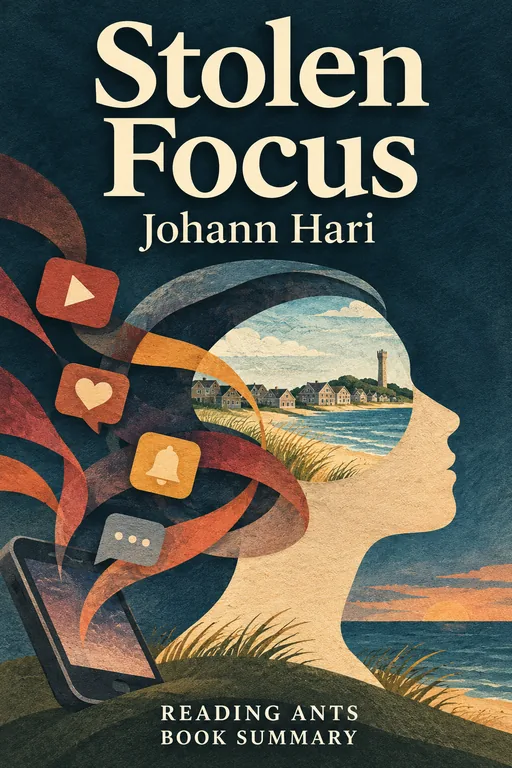
Stolen Focus
Johann Hari argues that our collective ability to pay attention is being eroded not just by personal weakness but by twelve forces in modern life, including technology designed to hook us, and that we must change both our habits and the systems around us.
Overview
Stolen Focus: Why You Can’t Pay Attention, and How to Think Deeply Again was published in 2022 by Johann Hari, a British writer who had earlier written about addiction and depression. He began the book after noticing how distracted he and the people around him had become, and traveled to interview scientists and experts, including during a three-month stay offline in the seaside town of Provincetown, Massachusetts. He states that the problem is not simply a lack of willpower, and that many people share it. The book organizes its findings into twelve causes of the decline in attention, and offers some solutions.
Full Summary
1. The attention problem and the myth of willpower
The idea: Hari opens by describing how his own mind had become scattered, and how many people report similar problems, with studies suggesting that attention spans for tasks such as reading and working have dropped. He challenges the view that this is mainly a matter of individual weakness, saying that it is a result of environments that have changed rapidly, and that systems are designed to capture our attention. We have, he says, been told that it is our fault, and that is the wrong story.
In real life: If everything around you is built to distract you, it is not surprising that it is hard to focus.
2. The speeding up of life and the cost of switching
The idea: The author discusses research showing that the mind does not truly multitask, but switches between tasks, and each switch has a cost: it takes time to return to the original focus, and switching wears the brain down. Our culture, which encourages constant checking of messages, forces a pattern of switching. He cites research suggesting that office workers focus on one task for only about three minutes at a time, and that college students manage barely a minute. He notes that sustained attention needs periods without interruption.
In real life: Stopping to check a message while doing homework means that it takes longer to get back into it.
3. Technology designed to hook us
The idea: A large part of the book concerns the role of social media and apps, which are built to maximize the time people spend on them. Hari talks to Silicon Valley insiders, including Tristan Harris, who describe techniques such as endless scrolling and streaks that keep people coming back, and he explains how companies such as Facebook and YouTube try to maximize screen time so that they can collect personal data and keep people engaged. He also reports that negative emotions spread faster online than positive ones. He argues that this is a business model that profits from fragmenting our attention, and that individuals cannot fight it alone.
In real life: A feed that never ends, because there is no natural stopping point, is hard to put down.
4. Sleep, mind-wandering and flow
The idea: Hari looks at other factors that affect attention. The lack of sleep reduces the capacity for concentration, and many people sleep too little. Mind-wandering, the state of letting the mind drift, which is often seen as a waste of time, is important for creativity and processing, and is being squeezed out. Flow, the deep absorption in a challenging task, is harder to reach when constantly interrupted. He emphasizes that rest and slow time are not luxuries.
In real life: A walk without a phone can give the mind space to wander and solve a problem.
5. Diet, pollution, stress and the way we are raised
The idea: The author describes other contributors to poor attention, including diets high in processed foods, pollution, the decline of sustained reading, stress and economic insecurity, which leave people in a constant state of alert, and changes in childhood, such as less free play outdoors and more structured and monitored time. He also discusses the way that attention problems are often diagnosed and treated as individual medical disorders, and argues that the social and environmental context should be considered.
In real life: A child who is overscheduled and not allowed to play freely may find it hard to focus.
6. Solutions: individual and collective
The idea: In the final part, Hari offers suggestions. Individually, he describes practices such as locking away his phone or blocking the internet in advance, sleeping more, taking walks without a phone to let the mind wander, and trying to avoid switching between tasks. But he stresses that these are not enough, and that collective changes are needed, such as banning business models that depend on surveillance and engagement, a four-day working week, and letting children play freely. He calls for an attention rebellion, a broader social movement to defend attention.
In real life: Rules that limit how apps may track and hook their users are examples of collective action.
Why It Matters
Stolen Focus was a bestseller, and joined a growing public discussion about the effects of technology on attention and well-being. It popularized the idea that distraction is a social and political problem, as well as a personal one, and encouraged conversations about the design of apps and the need for regulation. Its practical advice, along with the call for systemic change, has made it a common reference in talk about screens and focus. Hari’s earlier controversies about journalism have made some readers cautious, but the topic has been of wide interest.
Key Takeaways
- Attention is under pressure. Many forces compete for it.
- It is not only a personal failing. Systems and designs matter.
- Switching has a cost. Multitasking is largely a myth.
- Rest and mind-wandering are valuable. Sleep and play support focus.
- Individual and collective action are both needed. Habits and policies work together.
What We Can Learn
You can use the book to look at your daily habits: turn off non-essential notifications, keep your phone out of the bedroom, and try to do one thing at a time for a set period. Make time for sleep, exercise and unstructured time outside. Notice which apps leave you feeling drained, and reduce them. Talk with friends and family about shared phone-free times. And support efforts at school and in your community to protect attention, since it is easier to change habits together. If you have serious attention difficulties, speak to a doctor.
Criticism and Counterpoints
Some critics say that the book overstates the case. The psychologist Stuart Ritchie, cited in The Irish Times, has pointed to a lack of scientific evidence for the book’s central claim that people’s ability to focus has changed over time. One Irish Times reviewer felt that Hari sometimes reduces complex topics to bullet points, and another reviewer described the book as mostly a retelling of research already covered elsewhere. Blaming technology can also be too simple, as people have always worried about new media. Hari’s earlier journalistic controversies have made some readers wary of his sourcing. Still, many readers have found the book useful and readable.
Who Should Read It
This book is for readers who feel distracted and want to understand why, and for parents, teachers and employers. It is easy to read and personal. Those who prefer a strictly scientific treatment should consult research papers, and take the claims with some caution.
Want the whole book?
A summary is a taste, not the meal. Here is where to find the full book.
You reached the end 🎉
Nicely done. Mark this one as read, and we will suggest what to read next.
Read this next
The Age of Surveillance Capitalism
Shoshana Zuboff
Harvard professor Shoshana Zuboff argues that large technology companies have created a new kind of capitalism that gathers vast amounts of personal data, turns it into predictions of our behavior and sells them, threatening privacy, autonomy and democracy.
⚖️ Politics & Society
Atomic Habits
James Clear
Big changes in life come not from huge leaps but from tiny habits repeated every day, and you can build good habits (and break bad ones) by designing your life so the right choices are obvious, attractive, easy and satisfying.
🌱 Self-Improvement
Drive: The Surprising Truth About What Motivates Us
Daniel H. Pink
Daniel Pink argues that, for creative and complex work, carrots and sticks such as bonuses are less effective than the inner drive provided by autonomy, mastery and purpose, and that businesses and schools should be redesigned around them.
🧩 Mind & Psychology
Nexus
Yuval Noah Harari
Yuval Noah Harari traces the history of how humans have shared information, from stories and writing to printing and algorithms, and warns that artificial intelligence is a new kind of network that could reshape power and even threaten democracy.
🏛️ History
Why We Sleep
Matthew Walker
Neuroscientist Matthew Walker argues that sleep is essential for memory, mood, health and long life, and that modern habits are causing a widespread and dangerous lack of it.
🧩 Mind & Psychology
Thinking, Fast and Slow
Daniel Kahneman
Our minds run on two systems, a fast, intuitive one and a slow, careful one, and understanding how the fast system fools us can help us make better decisions about money, risk, work and happiness.
🧩 Mind & PsychologyWant something different?
Pick another topic and we will show you three books to start with.