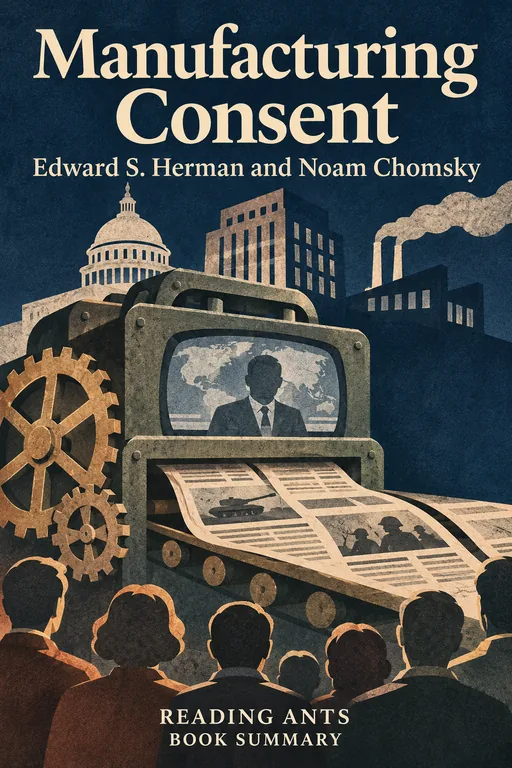
Manufacturing Consent
Edward Herman and Noam Chomsky argue that the mass media in the United States, though free from government control, systematically serve the interests of powerful elites, through a "propaganda model" with five filters that shape which news is reported and how.
Overview
Manufacturing Consent: The Political Economy of the Mass Media was published in 1988 by Edward S. Herman, an economist, and Noam Chomsky, a linguist and political critic. The title borrows a phrase from the journalist Walter Lippmann, who wrote of the “manufacture of consent.” The authors argue that, in a society where the state does not censor, the media still end up supporting the views of the powerful, not through conspiracy, but through structural features. They present a model, and test it with case studies, from the Vietnam War to elections and killings in Central America in the 1980s, comparing the treatment of events involving official enemies with similar events involving friendly governments. The edition most readers meet today also carries a new introduction from 2002 in which the authors update the model.
Full Summary
1. The propaganda model
The idea: The authors begin by arguing that the media are businesses, and that the news is a product shaped by the market and by the interests of owners and advertisers. In their view, a propaganda model, in which the media filter the news, explains why they often serve the dominant political and economic interests. They emphasize that this is not a conspiracy, but a result of choices made by individuals within a system that rewards some outcomes and not others.
In real life: A school paper funded by one donor may avoid stories that upset that donor, without anyone saying so.
2. The first three filters: ownership, advertising and sources
The idea: The first filter is the size and ownership of the media, which are large profit-seeking corporations, often part of conglomerates. The second is advertising, since the media rely on revenue from advertisers who prefer a favorable environment for selling. The third is sourcing: journalists rely on government and corporate officials and experts for a steady flow of information, which makes them dependent, and so reluctant to offend them. These forces, the authors say, tilt coverage toward the powerful.
In real life: A reporter who depends on a spokesperson for access may hesitate to write critical stories.
3. The last two filters: flak and an enemy
The idea: The fourth filter is flak, negative responses to media statements, such as complaints, lawsuits and campaigns by powerful groups and organizations, which can be costly. The fifth, in the Cold War era, was anticommunism as a national ideology and control mechanism, used to mobilize opinion against a common enemy and to discredit critics. In the 2002 introduction the authors add that this filter may have weakened after the collapse of the Soviet Union, but that a strong faith in the free market largely offsets that loss. Together, the five filters shape what is seen as acceptable.
In real life: If criticism of a certain view brings a storm of angry responses, people may become more careful.
4. Worthy and unworthy victims
The idea: The authors compare the coverage of victims of violence by official enemies with that of victims of friendly or allied governments. They argue that the media gave extensive and sympathetic coverage to the first group, such as Jerzy Popieluszko, a Polish priest murdered by members of the Polish secret police in 1984, and little to the second, such as the roughly one hundred religious figures killed in Latin America by agents of US-backed governments, among them Archbishop Oscar Romero and four American churchwomen in El Salvador. They report that the coverage of the one Polish priest outweighed that of all the hundred put together. Thus, they say, some victims were considered “worthy” and others “unworthy,” in a way that served the interests of foreign policy.
In real life: A story about harm done by a rival school may get more attention than a similar story about your own.
5. Legitimizing elections
The idea: The book analyzes the coverage of elections in El Salvador (1982 and 1984) and Guatemala (1984-85), which the US government supported, and in Nicaragua (1984), which it opposed. They claim that the media portrayed the first as meaningful, despite violence and limited choice, and the second as shams. They argue that this treatment mirrored official positions rather than the facts, and that the media took the role of validating government policy.
In real life: A vote that you favor may be described as free, while a similar vote that you oppose may be described as rigged.
6. The Bulgarian Connection
The idea: A chapter on the 1981 shooting of Pope John Paul II in St. Peter’s Square by Mehmet Ali Agca, a Turkish gunman with ties to the far-right Gray Wolves, shows the model at work on a story that the media themselves helped to build. The authors argue that a claim of a Bulgarian and Soviet plot, pushed by a 1982 Reader’s Digest article by Claire Sterling and by an NBC television program, became the dominant frame in the major media, even though they judge the evidence for it to have been weak from the start. They say alternative explanations were shut out, and that when an Italian court failed to convict the Bulgarians after the trial that ended in 1986, the media offered no serious reassessment.
In real life: A rumor that suits everyone with influence may be repeated until it feels like fact, and then dropped without a correction.
7. The Vietnam War and Indochina
The idea: A large part of the book examines the media coverage of the Vietnam War and of events in Indochina. The authors argue that although the press reported some failures of the war, it accepted the basic premise that the American intervention was well-intentioned, and that it questioned American tactics and judgment but rarely the motives or morality of the intervention. They reject the popular charge that hostile reporting, for example on the Tet offensive, made the media responsible for losing the war. They contend that the debate stayed within limits set by elites, and that more fundamental criticism was excluded. In the chapter on Laos and Cambodia they argue that attention to the Khmer Rouge’s victims was intense because it was useful to Western governments, while the earlier victims of the US bombing of Cambodia were largely ignored.
In real life: A discussion that only asks how to do something better may never ask whether it should be done.
Why It Matters
Manufacturing Consent has been among the most influential critiques of the news media. It encouraged readers to look critically at how news is produced and who benefits, and is widely read and discussed, including in media studies. A 1992 documentary film, named after the book and featuring Chomsky, brought its ideas to a wider audience. The propaganda model has been applied to many topics, and updated by its authors and others. Whether or not one accepts its conclusions, the book prompts important questions about ownership, advertising and the dependence of the press, which remain relevant in the age of the internet.
Key Takeaways
- Structure shapes news. Ownership, advertising and sources influence coverage.
- No conspiracy is needed. Incentives lead to similar outcomes.
- Victims are treated unequally. Coverage depends on political usefulness.
- Debate has boundaries. Acceptable views are limited by elite consensus.
- Be a critical reader. Ask who benefits from a story.
What We Can Learn
You can use the book to build habits of media literacy. When you read a story, ask who owns the outlet, who pays for it, where the information comes from and what is missing. Compare coverage of similar events from different outlets and countries. Seek out sources that differ from your usual ones. At the same time, be cautious about assuming that all news is propaganda, since this can lead to cynicism, and consider the strengths of independent reporting as well as its limits.
Criticism and Counterpoints
Many critics say that the propaganda model is too deterministic and conspiratorial, even if the authors deny it, and that it does not account for investigative reporting that has exposed government and corporate wrongdoing. Others argue that the examples were selected to fit the thesis, that the authors overstate their claims about Cambodia and other cases, and that the media are more diverse than depicted. Some say that the rise of the internet and social media has changed the situation. Supporters say that the model still provides a useful framework.
Who Should Read It
This book is for readers interested in journalism, politics and critical thinking, including students and activists. It is dense and detailed, with many footnotes. Those who want a balanced view should also read defenses of the press and other analyses of the media.
Want the whole book?
A summary is a taste, not the meal. Here is where to find the full book.
You reached the end 🎉
Nicely done. Mark this one as read, and we will suggest what to read next.
Read this next
The Age of Surveillance Capitalism
Shoshana Zuboff
Harvard professor Shoshana Zuboff argues that large technology companies have created a new kind of capitalism that gathers vast amounts of personal data, turns it into predictions of our behavior and sells them, threatening privacy, autonomy and democracy.
⚖️ Politics & Society
On Tyranny
Timothy Snyder
Historian Timothy Snyder draws twenty practical lessons from the history of fascism, communism and other dictatorships of the twentieth century, to help ordinary citizens defend freedom in democratic societies today.
🏛️ History
The Origins of Totalitarianism
Hannah Arendt
Hannah Arendt examines how antisemitism, imperialism and the breakdown of society in Europe prepared the ground for the totalitarian regimes of Nazi Germany and Stalin's Soviet Union, and what made these regimes new and uniquely terrible.
🏛️ History
The True Believer
Eric Hoffer
Longshoreman-philosopher Eric Hoffer argues that people who join fanatical mass movements are usually frustrated and dissatisfied with themselves, and that such movements, whether religious, nationalist or revolutionary, appeal to the same needs and use similar methods.
⚖️ Politics & Society
How Democracies Die
Steven Levitsky and Daniel Ziblatt
Two Harvard political scientists argue that democracies today usually die not from coups but from elected leaders who slowly weaken the rules, and that they survive when political parties and politicians respect unwritten norms of tolerance and restraint.
⚖️ Politics & Society
The Prince
Niccolo Machiavelli
A Renaissance diplomat advises rulers to judge their actions by results rather than morality, arguing that a successful leader must sometimes be cunning and ruthless to win and keep power.
⚖️ Politics & SocietyWant something different?
Pick another topic and we will show you three books to start with.