 Reading Ants
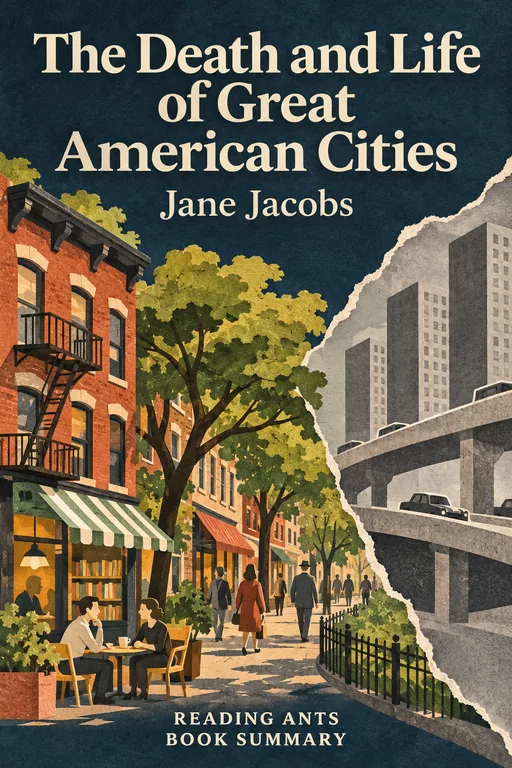
The Death and Life of Great American Cities
Jane Jacobs argues that the best cities are lively, mixed and walkable neighborhoods, and that the planning fashions of her day, with highways, towers and rigid zoning, were destroying the very things that make cities work.
Overview
The Death and Life of Great American Cities was published in 1961 by Jane Jacobs, a writer and activist who lived in Greenwich Village in New York. She was not a trained planner, and she wrote from careful observation of how streets, parks and neighborhoods work in everyday life. At the time, many city officials and planners favored urban renewal, which meant clearing old neighborhoods, building large housing projects and building roads for cars. Jacobs challenged this approach. Her book was one of the most important and controversial works on cities in the twentieth century.
Full Summary
1. Eyes on the street
The idea: Jacobs begins with the question of what makes a street safe. She says that it is not mainly police, but the presence of many people using the sidewalk at different times, with shopkeepers, residents and passers-by keeping a casual watch. She calls these “eyes on the street.” A street needs a clear distinction between public and private space, buildings that face it and a steady flow of users. Empty, quiet streets are more dangerous.
In real life: A street with shops and homes where people look out of windows feels safer than a blank wall.
2. The uses of sidewalks
The idea: She argues that sidewalks are more than a place to walk. They are where contact happens, where neighbors greet one another, where children play under adult supervision and where trust is built through small, public exchanges, such as asking a shopkeeper for directions or advice, or nodding hello to a passerby. She says that these casual connections are the basis of a healthy community, and that planners who remove them in favor of sheltered green space turned away from the street damage that life.
In real life: A chat with the baker or the newsstand owner makes a neighborhood feel like home.
3. The need for mixed uses
The idea: Jacobs contends that a lively district needs a mix of uses, such as homes, shops, offices and restaurants, so that people are around at different hours. Separating residential areas from commercial areas, as many zoning laws did, produces places that are empty for part of the day. She also says that short blocks, which give people many choices of route, and a mixture of old and new buildings, which allow for different rents, are essential for diversity.
In real life: A district with only offices is deserted in the evening, but one with apartments and cafes stays alive.
4. Concentration, and the problem of parks and projects
The idea: Another condition is a sufficiently dense concentration of people, so that businesses can support themselves and a variety of services can thrive. Jacobs criticizes planners who regarded density as a problem and promoted sprawl. She also challenges the notion that parks and open space are automatically good. A park surrounded by empty buildings may be dangerous, and public housing projects, set apart from the rest of the city, become isolated and unsafe.
In real life: A playground in the middle of a busy street is used more than one hidden away.
5. Slums, gentrification and the decline of neighborhoods
The idea: Jacobs discusses how neighborhoods decline or are renewed. She argues that slums can be improved from within by the efforts of residents if they have access to capital and security, and that wiping them out disperses communities and creates new problems. She also describes the process of “unslumming” and the danger of success, when a district becomes so popular that it kills its own diversity by raising prices, which is what is now often called gentrification.
In real life: A neighborhood that becomes fashionable may become too expensive for those who made it so.
6. Cities as problems of organized complexity
The idea: In the final chapters, Jacobs says that cities are problems of organized complexity, like living organisms, where many elements interact. They cannot be understood or planned from above by simple formulas, as the planners tried to do. She calls for approaches that study the details of how places work, for support of local initiative and for flexibility. She ends with a call for citizens to take part in shaping their cities.
In real life: A city is more like a garden that grows than a machine that you can design in advance.
Why It Matters
The Death and Life of Great American Cities changed the way that people think about cities, and is regarded as one of the most influential books on urban planning. It encouraged the preservation of historic neighborhoods, the revival of walkable, mixed-use areas, and public participation in planning. Jacobs’s own activism helped to stop a highway through lower Manhattan. Her ideas have shaped the movement known as New Urbanism, and are cited by planners, architects and activists. The book also contributed to the broader appreciation of everyday urban life, and of the knowledge of ordinary people, a respect that makes it popular even outside the field.
Key Takeaways
- Lively streets are safer. Eyes on the street protect better than empty space.
- Mix uses and ages. Diversity keeps neighborhoods active.
- Density supports variety. Enough people allow many businesses and services.
- Observe before planning. Look at how places actually work.
- Residents should have a voice. Local knowledge is valuable.
What We Can Learn
You can use the book as a way to look at the streets around you. Notice what makes a place pleasant to walk in, and what makes it feel empty or unsafe. Support local shops, and use public spaces. If you can take part in neighborhood or city decisions, speak up for the needs of walking, mixed uses and local life. Remember that a lively place depends on many small decisions. At the same time, think about how to keep neighborhoods affordable for all, since popularity can lead to displacement.
Criticism and Counterpoints
Some critics say that Jacobs romanticized the old, dense neighborhoods, and overlooked their problems, such as overcrowding and discrimination, and that the book is based on a few examples from New York and other cities. Others note that her ideas, when applied, have contributed to gentrification and rising costs, which she herself warned about. Planners have argued that large-scale renewal could, at times, provide needed housing. Some say that her suspicion of planning goes too far. Still, her main insights about street life remain widely accepted.
Who Should Read It
This book is for anyone interested in cities, architecture, planning and community life. It is long and detailed, but written in a lively, accessible style. Those who want a modern view should combine it with recent research on housing and transport.
Want the whole book?
A summary is a taste, not the meal. Here is where to find the full book.
You reached the end 🎉
Nicely done. Mark this one as read, and we will suggest what to read next.
Read this next
Bowling Alone
Robert D. Putnam
Political scientist Robert Putnam shows with a wealth of data that Americans have become less connected to one another in clubs, churches, unions and neighborhoods since the 1960s, and argues that this loss of social capital weakens democracy and well-being.
⚖️ Politics & Society
Evicted
Matthew Desmond
Sociologist Matthew Desmond lived among poor tenants and landlords in Milwaukee and shows that eviction is not just a result of poverty but a major cause of it, trapping families in a cycle of lost homes, jobs and hope.
⚖️ Politics & Society
The World Is Flat
Thomas L. Friedman
New York Times columnist Thomas Friedman argues that technology and new business practices have leveled the global playing field, so that people anywhere can compete and collaborate with anyone else, and he asks how individuals and countries should respond.
⚖️ Politics & Society
Democracy in America
Alexis de Tocqueville
After touring the United States in the 1830s, the young Frenchman Alexis de Tocqueville wrote a penetrating study of American democracy, praising its energy and liberty, and warning about its dangers, such as the tyranny of the majority and a retreat into private life.
⚖️ Politics & Society
Silent Spring
Rachel Carson
The careless spraying of powerful chemical pesticides like DDT was poisoning birds, fish, soil, water and people, and humans must learn to live with nature instead of waging war on it.
🔬 Science
The Prince
Niccolo Machiavelli
A Renaissance diplomat advises rulers to judge their actions by results rather than morality, arguing that a successful leader must sometimes be cunning and ruthless to win and keep power.
⚖️ Politics & SocietyWant something different?
Pick another topic and we will show you three books to start with.