 Reading Ants
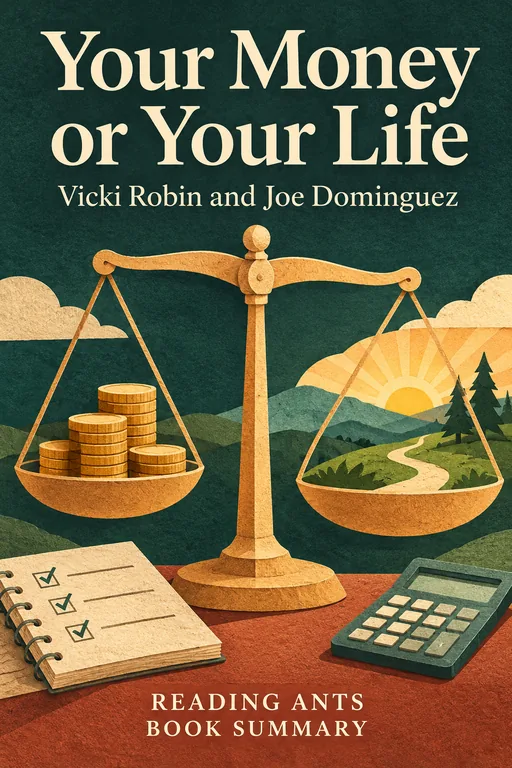
Your Money or Your Life
Vicki Robin and Joe Dominguez teach that money is something you trade your life energy for, and they offer a step-by-step program to track every cent, spend on what truly matters and reach financial independence.
Overview
Your Money or Your Life was first published in 1992 by Vicki Robin and Joe Dominguez, and it was later revised several times. Dominguez had retired early after a career on Wall Street, and the two created a course which became the book. They ask readers to look at money in a new way. Each dollar you earn costs you some of your life, so spending should be a deliberate choice. The book describes a nine-step program, which includes tracking, calculating your real hourly pay, spending less and investing, until your income from savings can cover your needs. It has inspired the movement for financial independence.
Full Summary
1. Money is life energy
The idea: The authors define money as something that you exchange your life energy for. Time at work, and the effort that goes with it, is a limited part of your life. They ask a powerful question about each purchase: how much of my life did it cost? They say that most people have never really looked at this, and that many buy things that bring little lasting satisfaction.
In real life: If you must work for ten hours to pay for a pair of shoes, you may want to be sure that you will love them.
2. Know where you are, and track everything
The idea: The program begins with an honest look at your past and present. You look at what you have earned in the past and where you stand now, then keep a record of every cent that comes in or goes out. This can be uncomfortable, but the authors say that it gives you a clear and unemotional picture of your life. After a month or more, you group the spending into categories and see where your life energy really goes.
In real life: A student who writes down every purchase for a month may discover that small snacks and apps add up to more than expected.
3. Your real hourly wage
The idea: The authors say that a job’s pay is not the same as what you earn per hour. When you add the time you spend getting ready, commuting and recovering from work, and subtract costs such as work clothes, transport and takeout meals, your real wage per hour is lower than it looks. Knowing this number helps you to judge whether a purchase, or a job, is worth it.
In real life: A job that pays well, but takes two hours of travel each day and a lot of expensive lunches, may pay less per hour of life than a closer, lower-paid one.
4. The fulfillment curve and “enough”
The idea: The book introduces the idea that, for each category of spending, satisfaction rises quickly at first and then levels off, or even falls. After a certain point, more money brings less happiness. The authors encourage readers to find their own “enough,” the level at which they have what they need and are not driven by endless wanting. A main exercise is to ask three questions about each expense: did it give fulfillment in proportion to the life energy it cost, does it fit my values, and how would I spend if I did not have to work for money?
In real life: The first bicycle may change your world, but the fifth may only crowd the garage.
5. Lower spending, raise income
The idea: After tracking and thinking, the program suggests ways to spend less on things that do not matter, and to raise your income in ways that suit you. Lower spending is powerful, they say, because it both raises what you can save and lowers the amount you need to be free. They encourage finding satisfaction in simple pleasures and not trying to keep up with what other people spend.
In real life: Cooking at home instead of ordering takeout may save a lot over a year and can also be enjoyable.
6. Capital and the crossover point
The idea: The authors say that your savings can be invested so that they earn income. When that income covers your monthly expenses, you reach the “crossover point,” when you no longer need to work for money. They describe basic investments such as bonds, index funds and stocks, and explain their risks and rewards. They also say that a lower level of spending makes crossover happen sooner.
In real life: If your needs are small, a modest income from savings may be enough to live on, but if they are large, you will need much more.
7. Living a life of enough
The idea: Reaching financial independence does not mean that you must stop working. The authors say that people can then do work they value, volunteer, care for family or pursue their interests. They also argue that living with less has benefits for the planet, since consuming fewer goods reduces waste. The final steps focus on managing your money and your life with care.
In real life: A person who no longer needs a paycheck might spend a year teaching, painting or helping a community project.
Why It Matters
Your Money or Your Life is regarded as a classic of the simple living and financial independence movements. Its idea of linking money to life energy has affected many readers and writers on personal finance, including those in the modern FIRE movement, which stands for “financial independence, retire early.” The book changed how many people thought about work, spending and success, and made them ask what they really wanted from life. It also brought attention to the connection between consumer habits and the environment. Several revised editions have kept it up to date, and it remains a source of practical exercises that anyone can try.
Key Takeaways
- Money costs life. Every purchase is a trade of your time and effort.
- Track to see clearly. Recording every cent shows where your life energy goes.
- Find your enough. More spending does not always bring more happiness.
- Spend with purpose. Match your money to your values.
- Aim for freedom. Savings that cover your needs give you choices.
What We Can Learn
You can try a simple version of the main exercise. For one month, write down every purchase, and ask how many hours of work it cost and whether it was worth it. Look for areas where you spend a lot but gain little joy, and for those where a small amount brings great pleasure. If you earn an allowance or a salary, think of what “enough” looks like for you. Talk about money with family in an open way. And remember that financial independence is a long road, so progress in small steps is worth celebrating.
Criticism and Counterpoints
Critics point out that the program is easiest for people with a good income and few obligations, and that it may not be realistic for people struggling with low wages, debt or medical bills. The advice to retire early with a modest income can be risky if the savings run out or if costs such as healthcare rise. Some find the tone preachy or idealistic, and the early editions give specifics about interest rates and investments that are now out of date. Some reviewers find it repetitive and say it explains how to track spending better than how to cut it. Readers may take the parts that suit them.
Who Should Read It
This book is for anyone who wants to rethink their relationship with money, whether they are starting out, feeling stuck in a job they dislike, or thinking about a simpler life. It is practical and includes exercises. People who need advice about a specific tax or legal situation, or who prefer a more traditional approach to saving, may find it a thought-provoking addition.
Want the whole book?
A summary is a taste, not the meal. Here is where to find the full book.
You reached the end 🎉
Nicely done. Mark this one as read, and we will suggest what to read next.
Read this next
The Simple Path to Wealth
J. L. Collins
J. L. Collins explains, in the form of letters to his daughter, how to build wealth with a simple plan: avoid debt, spend less than you earn, and invest steadily in a low-cost fund that owns the whole stock market.
💰 Money & Economics
I Will Teach You to Be Rich
Ramit Sethi
Ramit Sethi gives young adults a practical six-week program to set up accounts, automate saving and investing, and spend freely on what they love, without having to track every coffee.
💰 Money & Economics
The Total Money Makeover
Dave Ramsey
Dave Ramsey presents a step-by-step plan, called the Baby Steps, to get out of debt, build savings and invest, based on cash, a budget and the firm belief that the real problem with money is behavior and not information.
💰 Money & Economics
Walden
Henry David Thoreau
Henry David Thoreau describes the two years he spent living simply in a small cabin by Walden Pond in Massachusetts, and argues that people should simplify their lives, spend time in nature and think for themselves.
🕊️ Philosophy & Religion
The Psychology of Money
Morgan Housel
How you behave with money matters more than how much you know about it, and good financial outcomes come from humility, patience and avoiding big mistakes, not from being the smartest person in the room.
💰 Money & Economics
The Wealth of Nations
Adam Smith
A nation's true wealth is not its stock of gold but the goods and services its people produce, and that wealth grows fastest when people specialize, trade freely and compete, with government providing justice, defense and public goods.
💰 Money & EconomicsWant something different?
Pick another topic and we will show you three books to start with.