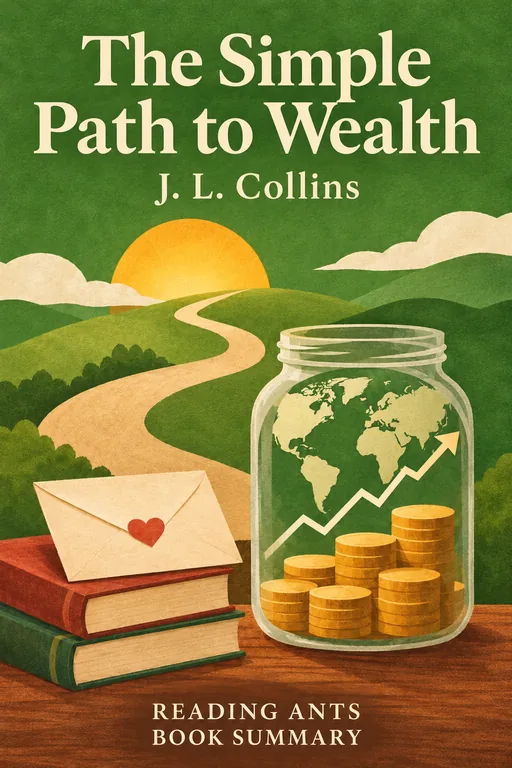
The Simple Path to Wealth
J. L. Collins explains, in the form of letters to his daughter, how to build wealth with a simple plan: avoid debt, spend less than you earn, and invest steadily in a low-cost fund that owns the whole stock market.
Overview
The Simple Path to Wealth was published in 2016 by J. L. Collins, who had written about money on his blog. It began as a series of letters to his daughter, because he wanted her to understand money before she grew up. The book moves from the basics of money and debt, to how to invest, to how to live on your investments. Collins writes in a friendly, conversational tone, and he says that you do not need to be an expert to do well. Many details are written with American readers in mind.
Full Summary
1. Money is a tool for freedom
The idea: Collins begins by saying that the purpose of money is freedom, the ability to make choices about your life, and not to buy as many things as you can. He describes savings large enough to let you say no to a boss or a situation you dislike as the real prize of investing. He says that wealth comes from a few clear habits, kept over a long time, and not from clever tricks.
In real life: A person who has savings can quit a job that makes them miserable without panic, while one who has none cannot.
2. Avoid debt, and spend less than you earn
The idea: The foundation, Collins says, is to avoid debt, especially credit card debt, and to spend less than you earn so that you have something to invest. He calls debt a trap that takes away your options. He accepts a credit card that is paid off in full each month, but not one that carries a balance.
In real life: Paying cash for a purchase, instead of financing it, leaves more money to invest and no interest to pay.
3. The stock market tends to go up
The idea: Collins argues that over the long term, the stock market has risen, even though it has crashes and long downturns. He says that the key is not to try to time the market, but to stay invested. Panic and selling at the wrong moment are the biggest dangers. Seeing drops as a normal part of investing helps people to stay calm.
In real life: A sea has waves, but the tide in the long run still comes in.
4. Buy a total market index fund
The idea: The core of his advice is to put your money into a low-cost index fund that holds a share of every major company in the market. He explains that it is diversified, cheap and requires no research. He argues that trying to pick winning stocks or hiring expensive managers usually costs more than it gains. He says that for most people, one fund and a bit of patience are enough.
In real life: Rather than choosing one team to bet on, you own a small slice of the whole league.
5. Bonds and your stage of life
The idea: Collins explains that in the building years, when you are earning and adding money, you can hold mostly stocks, since you have time to recover from falls. As you approach the time when you will start to live on your investments, you may add bonds to reduce the swings. He gives an example of holding roughly a quarter of the portfolio in bonds at that later stage, and says that the right mix depends on your stage, your tolerance for risk and your time horizon.
In real life: A young saver can accept big ups and downs, but someone about to pay for a house in two years should not.
6. Living on your wealth
The idea: In the final part, Collins discusses how to use your investments when you stop working. He discusses withdrawing a small percentage of the total each year, with about four percent as a common guideline based on past data, and says that this has often allowed money to last for decades. He also explains tax-advantaged retirement accounts, such as 401(k) plans and Roth IRAs, and encourages readers to build a plan.
In real life: If a fund is large enough, you may live on the yearly growth, as you would on the fruit of an orchard, without cutting down the trees.
Why It Matters
The Simple Path to Wealth has become a favorite among people interested in financial independence, and it is one of the most recommended books on the topic. Collins’s popular blog posts and his book gave many readers a simple, calm approach to investing, in contrast to complicated products. The book is also known for its warm, parental tone, and for the humility with which it shows that the main lessons are few and easy to say, even if they are hard to follow. It has been influential in online communities, and it helped spread the idea of using a total market index fund. For many readers, it was the first book that made investing feel simple and possible.
Key Takeaways
- Wealth buys freedom. The goal is choice, not a pile of possessions.
- Avoid debt. Debt narrows your options and drains your money.
- Invest in the whole market. A low-cost total market fund is an easy, sturdy choice.
- Stay calm in downturns. Selling in fear is the costliest mistake.
- Keep it simple. A few good habits do most of the work.
What We Can Learn
Think about what freedom would mean for you. Would it be the ability to change jobs, to study something new or to help family? Then make a plan to save regularly, even if the amount is small. Learn how fees affect your returns, and look for simple, low-cost options. When prices fall, remind yourself of the long view, and avoid making sudden choices. Share what you learn with friends and family. Because the book’s details mostly refer to the United States, adjust them for your country, and check your own situation before you act.
Criticism and Counterpoints
Critics say that the book’s emphasis on stocks may be too bold for some people, because markets can fall deeply for many years, and a retiree with a large share in stocks could be hurt by a poorly timed crash. The four percent rule is based on past data in the United States, and may not apply in other countries or in future decades. Others note that the advice favors those who have enough income to save, and gives less help to people with low wages or large debts. Some readers feel that the book is repetitive, because it covers ideas that are also on the author’s blog.
Who Should Read It
This book is for beginners and for anyone who is overwhelmed by investing advice. It is readable and reassuring, with a direct message. Readers who want detailed advice about taxes or products in a specific country, or who prefer an active approach to investing, will need to look elsewhere.
Want the whole book?
A summary is a taste, not the meal. Here is where to find the full book.
You reached the end 🎉
Nicely done. Mark this one as read, and we will suggest what to read next.
Read this next
The Little Book of Common Sense Investing
John C. Bogle
John Bogle, founder of the investment firm Vanguard, argues that most people should buy and hold a low-cost fund that owns the whole stock market, because costs quietly eat up the gains from active investing.
💰 Money & Economics
A Random Walk Down Wall Street
Burton G. Malkiel
Burton Malkiel argues that stock prices are so hard to predict that most investors, professional or not, are better off holding a broad, low-cost index fund than trying to beat the market.
💰 Money & Economics
Your Money or Your Life
Vicki Robin and Joe Dominguez
Vicki Robin and Joe Dominguez teach that money is something you trade your life energy for, and they offer a step-by-step program to track every cent, spend on what truly matters and reach financial independence.
💰 Money & Economics
I Will Teach You to Be Rich
Ramit Sethi
Ramit Sethi gives young adults a practical six-week program to set up accounts, automate saving and investing, and spend freely on what they love, without having to track every coffee.
💰 Money & Economics
The Psychology of Money
Morgan Housel
How you behave with money matters more than how much you know about it, and good financial outcomes come from humility, patience and avoiding big mistakes, not from being the smartest person in the room.
💰 Money & Economics
The Wealth of Nations
Adam Smith
A nation's true wealth is not its stock of gold but the goods and services its people produce, and that wealth grows fastest when people specialize, trade freely and compete, with government providing justice, defense and public goods.
💰 Money & EconomicsWant something different?
Pick another topic and we will show you three books to start with.